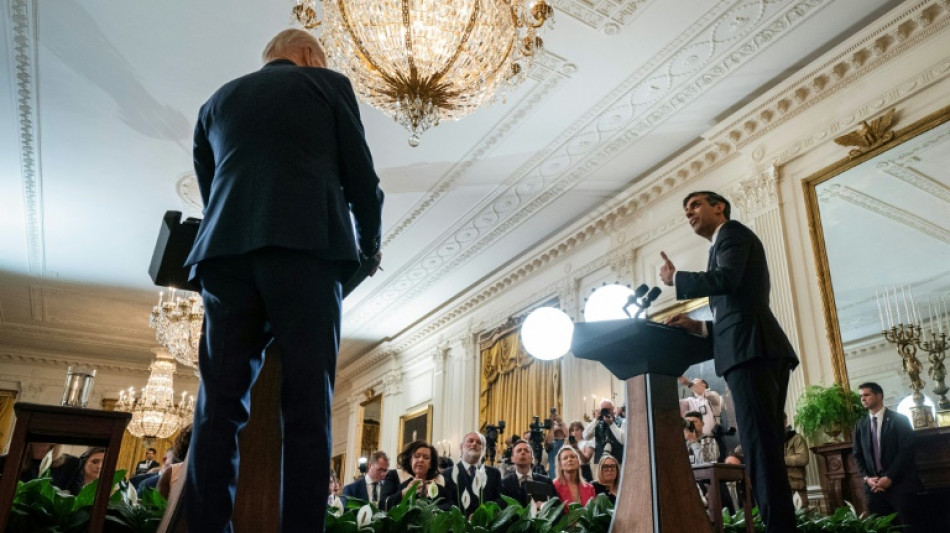
US, Britain forge pact to counter new threats / Photo: ANDREW CABALLERO-REYNOLDS - AFP
 Brussels Education Unions Schedule Major November Protest Over Funding and Reforms

 Making Your Home Safer for Aging Parents: Accessibility Renovations That Add Value

 iPS Cell Research Accelerates Drug Discovery for ALS and Spinal Cord Injury

 Rene Eyre Revisits Autobiographical Performance 'Say A Little Prayer' in London

 UAE's HCT Holds Record Graduation and Announces Major Training Expansion

 NASA Awards $10B Lunar Contract Framework to SpaceX, Blue Origin

 Katy Perry Tells Fans Ex-Husband Russell Brand 'Should Be in Jail' During UK Concert

The United States and Britain on Thursday announced a new strategic pact as their leaders rededicated the "special relationship" to counter Russia, China and economic instability.
In a White House summit, US President Joe Biden and British Prime Minister Rishi Sunak presented a united front on Russia's invasion of Ukraine and the lightning-fast evolution of artificial intelligence.
But Sunak came away empty-handed on Britain's ambitions for a post-Brexit free-trade agreement with Washington, settling instead to tack along with Biden's plan to craft a new green economy through vast industrial subsidies.
An "Atlantic Declaration" adopted by the leaders aims to boost industry ties on defense and renewable energy, in the face of growing competition from authoritarian states.
"Countries like China and Russia are willing to manipulate and exploit or steal our intellectual property, use technology for authoritarian ends, or withdraw crucial resources like energy," Sunak told a news conference alongside Biden.
"They will not succeed," the prime minister added.
Under the declaration, the two sides agreed to open talks on US treatment of critical minerals used in electric batteries in Britain.
Biden also agreed to ask Congress to designate Britain as a domestic source for defense procurement, to speed up development of next-generation weapons such as hypersonic missiles.
- 'Never been stronger' -
Despite the lack of a trade deal, Sunak said "the economic relationship has never been stronger," describing the "special relationship" as in fact the "indispensable alliance."
Sunak's first White House summit was equally about reforging personal relationships after Britain went through three prime ministers last year, and after Biden, proud of his Irish roots, made clear his displeasure about Boris Johnson's handling of Northern Ireland.
Biden agreed that for the United States, "there's no country that comes close" in importance as Britain -- words he was unlikely to say in the post-Brexit discord seen under Johnson.
Both leaders concurred that the world economy was undergoing the biggest changes since the Industrial Revolution, in part driven by AI, which is prompting doomsday warnings that sentient machines could wipe out humanity unless governments coordinate a response.
Biden backed Sunak's plan to convene "like-minded" countries for the world's first AI summit in Britain later this year -- while the prime minister also wants the UK to host a future AI regulatory body.
"The potential of AI is staggering," the president said, saying it had "the potential to do great damage if it's not controlled."
"We are looking to Great Britain to help lead a way through this. There is no country we have greater faith in to help negotiate our way through this," Biden added.
Yet there are headwinds for Sunak's ambitions, with the United States and European Union already engaged in their own dialogue on an AI code of conduct as industry figures plead for regulation.
- NATO leadership -
Biden and Sunak promised to keep spearheading global support for Ukraine, after committing billions of dollars in military aid to help Kyiv fight Russian invaders.
Biden said that they discussed their "unwavering support for the people of Ukraine who are defending themselves against most brutal aggression we have seen in a long time."
"I want to thank the prime minister for his strong, strong leadership," he said, also voicing confidence that the United States, despite hesitation from some of his Republican rivals, will provide "funding necessary to support Ukraine as long as it takes."
Sunak and Biden discussed the leadership of NATO, with British Defense Secretary Ben Wallace among the contenders as the alliance prepares a summit in Vilnius next month.
"They have a candidate who's a very qualified individual," Biden said of Wallace's candidacy, responding "maybe" when asked if it was time for another British secretary-general of NATO.
Current Secretary-General Jens Stoltenberg, who has won high marks from allies for his leadership in the war, is scheduled to leave in October.
He already extended his tenure once, postponing his appointment as central bank chief in his native Norway.
But Biden said that NATO needed a "consensus." The prime ministers of Denmark and Estonia are also seen as contenders.
J.Williams--AMWN
