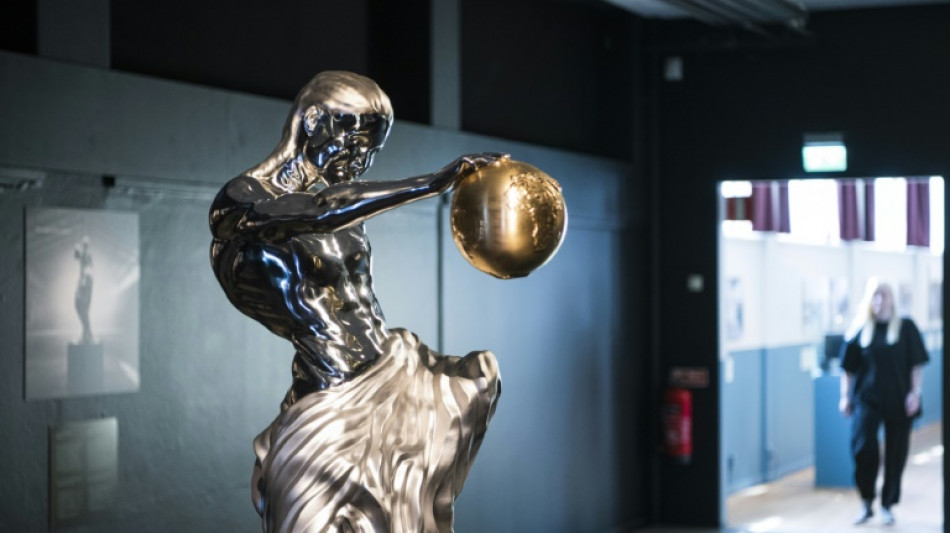
AI statue designed by Michelangelo on show in Sweden / Photo: Jonathan NACKSTRAND - AFP
 Brussels Education Unions Schedule Major November Protest Over Funding and Reforms

 Making Your Home Safer for Aging Parents: Accessibility Renovations That Add Value

 iPS Cell Research Accelerates Drug Discovery for ALS and Spinal Cord Injury

 Rene Eyre Revisits Autobiographical Performance 'Say A Little Prayer' in London

 UAE's HCT Holds Record Graduation and Announces Major Training Expansion

 NASA Awards $10B Lunar Contract Framework to SpaceX, Blue Origin

 Katy Perry Tells Fans Ex-Husband Russell Brand 'Should Be in Jail' During UK Concert

A historical dream team of five master sculptors, including Michelangelo, Rodin and Takamura, have trained artificial intelligence (AI) to design a sculpture dubbed "the Impossible Statue", now on show in a Swedish museum.
"This is a true statue created by five different masters that would never have been able to collaborate in real life," said Pauliina Lunde, a spokeswoman for Swedish machine engineering group Sandvik that used three AI software programmes to create the artwork.
Shaking up traditional conceptions about creativity and art, the stainless steel statue depicts an androgynous person with the lower half of the body covered by a swath of material, holding a bronze globe in one hand.
On show at Stockholm's National Museum of Science and Technology, the statue measures 150 centimetres (4 feet 11 inches) and weighs 500 kilograms (1,100 pounds).
The idea was to create a mix of styles from five famed sculptors who each made their mark on their era: Michelangelo (Italy 1475-1564), Auguste Rodin (France 1840-1917), Kathe Kollwitz (Germany 1867-1945), Kotaro Takamura (Japan 1883-1956) and Augusta Savage (US 1892-1962).
"Something about it makes me feel like this is not made by human being," Julia Olderius, in charge of concept development at the museum, told AFP.
Visitors will note the muscular body inspired by Michelangelo, and the hand holding the globe inspired by Takamura.
Sandvik's engineers trained the AI by feeding it a slew of images of sculptures created by the five artists.
The software then proposed several images in 2D which it believed reflected key aspects from each of the artists.
"In the end we had 2D images of the sculpture in which we could see the different masters reflected. Then we put these 2D images into 3D modeling," Olderius said.
But is it art, or technological prowess?
"I don't think you can define what art is. It's up to every human being to see, 'this is art, this is not art'. And it's up to the audience to decide," Olderius said.
Amid debate about the role of AI in the art world, Olderius said she was optimistic.
"I don't think you have to be afraid of what AI is doing with creativity or concepts or art and design," she said.
"I just think you have to adapt to a new future where technology is a part of how we create concepts and art."
Th.Berger--AMWN
