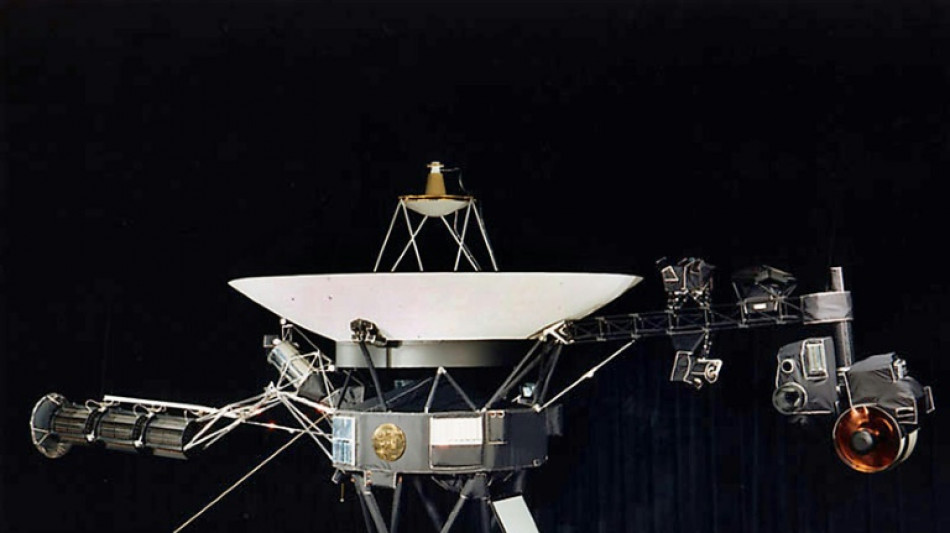
NASA back in touch with Voyager 2 after 'interstellar shout' / Photo: Handout - NASA/AFP/File
 Root says new balls behind batsmen's struggles in England

 Swollen rivers, washed-out roads hamper Nepal rescue effort

 In France's north, winegrowers bet on a warmer future

 Deadly virus stalks South Africa's sardines

 South Korea women's football body probes 'period' insult

 Transitional Fashion Essentials for Autumn: Key Pieces from M&S and Joe Browns

 China's Xi and Iran's Pezeshkian in Kyrgyzstan, Putin expected

 Rescuers hunt for missing after deadly N.Cyprus ferry accident

 Ethiopia's Abiy could consolidate power as 'executive president'
 Crude prices rise on US-Iran strikes, equities mixed after Warsh remarks

 South Korea court gives Unification Church leader 2 years prison

 US hosts G20 finance talks with growth, Iran pressure on agenda

 African players in Europe: Wissa flick seals Newcastle victory

 Venice film preview: Clooney, Oasis and Musk

 Poorly Djokovic crashes out of US Open first round

 Djokovic falls in US Open first round, earliest Grand Slam exit in 20 years

 Chinese guitar capital's stairway to export heaven

 Stocks drop as Warsh fans US rate hike bets, crude up on US-Iran strikes

 Injuries cloud tennis as US Open gets under way

 Iran retaliates after first US strikes in a month

 Itauma says 'I'll be back' after bruising heavyweight title loss

 Brilliant Palou clinches fourth straight IndyCar crown

 Nextech3D.ai Delivers 101% Revenue Growth in Fiscal Q1 2027 as AI-Powered Event Platform Accelerates

 ATHA Energy Provides Board of Directors Update
 Clough Global Opportunities Fund Section 19(a) Notice

NASA has succeeded in re-establishing full contact with Voyager 2 thanks to an "interstellar shout" that righted the distant probe's antenna orientation, the space agency said Friday.
Launched in 1977 to explore the outer planets and serve as a beacon of humanity to the wider universe, it is currently more than 12.3 billion miles (19.9 billion kilometers) from our planet -- well beyond the solar system.
A series of planned commands sent to the spaceship on July 21 mistakenly caused the antenna to point two degrees away from Earth, compromising its ability to send and receive signals and endangering its mission.
The situation was not expected to be resolved until at least October 15 when Voyager 2 was scheduled to carry out an automated realignment maneuver.
But on Tuesday, engineers enlisted the help of multiple Earth observatories that form the Deep Space Network (DSN) to detect a carrier or "heartbeat" wave from Voyager 2, though the signal was still too faint to read the data it carried.
In a new update on Friday, NASA's Jet Propulsion Laboratory (JPL), which built and operates the probe, said it had succeeded in a longshot effort to send instructions that righted the craft.
"The agency's Deep Space Network facility in Canberra, Australia, sent the equivalent of an interstellar 'shout,'" JPL said.
"With a one-way light time of 18.5 hours for the command to reach Voyager, it took 37 hours for mission controllers to learn whether the command worked."
The probe began returning science and telemetry data at 12:29 am Eastern Time on August 4, "indicating it is operating normally and that it remains on its expected trajectory," added JPL.
Voyager 2 left the protective magnetic bubble provided by the Sun, called the heliosphere, in December 2018, and is currently traveling through the space between the stars.
Before leaving our solar system, it explored Jupiter and Saturn, and became the first and so far only spacecraft to visit Uranus and Neptune.
Voyager 2's twin Voyager 1 was mankind's first spacecraft to enter the interstellar medium, in 2012, and is currently almost 15 billion miles from Earth.
Both Voyager spacecraft carry "Golden Records" -- 12-inch, gold-plated copper disks intended to convey the story of our world to extraterrestrials.
P.M.Smith--AMWN