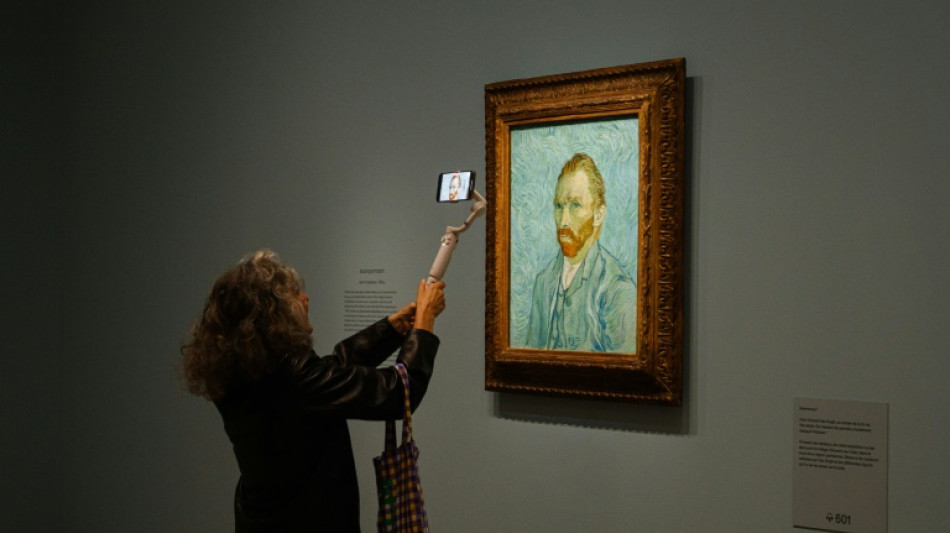
AI Vincent Van Gogh says you're wrong about his ear / Photo: Dimitar DILKOFF - AFP
 Brussels Education Unions Schedule Major November Protest Over Funding and Reforms

 Making Your Home Safer for Aging Parents: Accessibility Renovations That Add Value

 iPS Cell Research Accelerates Drug Discovery for ALS and Spinal Cord Injury

 Rene Eyre Revisits Autobiographical Performance 'Say A Little Prayer' in London

 UAE's HCT Holds Record Graduation and Announces Major Training Expansion

 NASA Awards $10B Lunar Contract Framework to SpaceX, Blue Origin

 Katy Perry Tells Fans Ex-Husband Russell Brand 'Should Be in Jail' During UK Concert

AI Vincent Van Gogh is patient but unimpressed by yet another question about his chopped-off ear.
"I apologise for any confusion but it seems you are mistaken," says the great painter's avatar, in the sort of testy tone familiar to anyone who has toyed with AI language models.
"I only cut off a small part of my ear lobe," he insists (in fact, there are multiple accounts of how the artist mutilated his ear).
The artificial intelligence Van Gogh appears on a video screen at the end of a blockbuster exhibition at the Musee d'Orsay in Paris. The exhibition, running until February, is dedicated to the final weeks of his life in the village of Auvers-sur-Oise, just north of the French capital.
Van Gogh shot himself with a rusty pistol in 1890 aged 37. It took him two days to die.
But the AI Vincent is surprisingly well-versed in 21st century therapy-speak.
"While I did face mental health struggles, my move to Auvers-sur-Oise was not motivated by a desire to end my life," he says.
As the 40 or so paintings at the Orsay exhibition make clear, his final weeks were extraordinarily prolific, full of masterpieces including "The Church at Auvers", "Wheatfield with Crows" and his very last, "Tree Roots".
All the more surprising is that this period has never been given a dedicated showcase, said Christophe Leribault, Musee d'Orsay president.
- Virtual Vincent -
Among the highlights is a room dedicated to his "double-square" panoramas, a technical revolution in which he used very long and thin canvases, prefiguring the wide-screen landscapes of cinema.
It is perhaps fitting, then, that the show ends with modern technologies, which have become increasingly common as exhibitions try to pull in young audiences.
As well as the Van Gogh chatbot, visitors can also don a virtual reality headset to enter the kitchen of Dr Gachet, where Van Gogh spent time in his final weeks, take a surreal trip around an enormous version of his paint palette and plunge into the tree roots of his final painting.
The state-of-the-art helmet from Taiwanese firm Vive Arts can track the hands of users -- without the need for handheld controllers -- allowing them to pick up items in the virtual world and play with globules of paint.
The AI, by contrast, displays some of the teething problems of the nascent tech.
Asked about his favourite colour, AI Vincent is very certain (yellow).
But he struggles to recognise people in his life, failing to pick up the name of Dr Gachet when asked by a French journalist.
"It recognises words in the French language but we still need to fine-tune the AI so that it understands proper nouns better," said Christophe Renaudineau, head of Jumbo Mana, the Strasbourg start-up which designed the machine.
"This experiment will allow us to improve the model," he added.
L.Miller--AMWN
