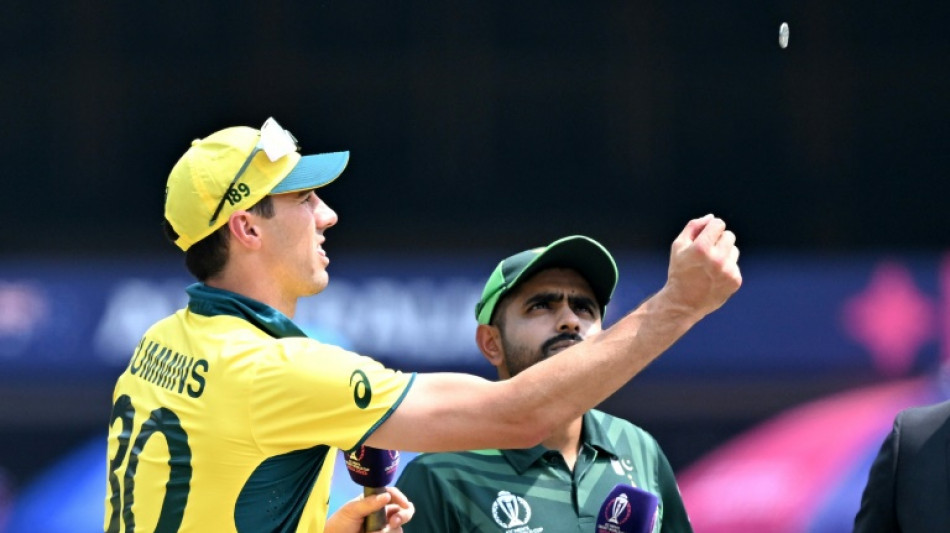
Coin tosses are not 50/50: researchers find a slight bias / Photo: Sajjad HUSSAIN - AFP/File
 Benzema ends brief stint with Al Hilal in Saudi league

 Djokovic's Grand Slam future uncertain after brutal US Open defeat
 Turkey says regional defence pact not against any country

 US vows to keep economic pressure on Iran as G20 finance talks begin

 Shein valued at $26.3 bn in Hong Kong market debut

 Crude prices rise above $90 per barrel on US-Iran strikes

 Liverpool sign Barcola from PSG for reported £124 million

 Putin, Xi, Iran's Pezeshkian in Kyrgyzstan for summit

 Fully Permitted Tanzanian Gold Project Clears Path to Construction as Financing, EPCM Fall in Place (LVGLF)

 EdWealth Announces MoneyBench Benchmark Comparing AI Money Answers From Ed, ChatGPT and Gemini

 Root says new balls behind batsmen's struggles in England

 Swollen rivers, washed-out roads hamper Nepal rescue effort

 In France's north, winegrowers bet on a warmer future
 Deadly virus stalks South Africa's sardines

 South Korea women's football body probes 'period' insult

 Transitional Fashion Essentials for Autumn: Key Pieces from M&S and Joe Browns

 China's Xi and Iran's Pezeshkian in Kyrgyzstan, Putin expected

 Rescuers hunt for missing after deadly N.Cyprus ferry accident

 Ethiopia's Abiy could consolidate power as 'executive president'
 Crude prices rise on US-Iran strikes, equities mixed after Warsh remarks

 South Korea court gives Unification Church leader 2 years prison

 US hosts G20 finance talks with growth, Iran pressure on agenda

 African players in Europe: Wissa flick seals Newcastle victory
 Venice film preview: Clooney, Oasis and Musk

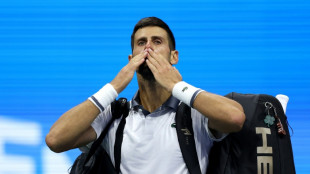 Poorly Djokovic crashes out of US Open first round

Want to get a slight edge during a coin toss? Check out which side is facing upwards before the coin is flipped –- then call that same side.
This tactic will win 50.8 percent of the time, according to researchers who conducted 350,757 coin flips.
For the preprint study, which was published on the arXiv database last week and has not yet been peer-reviewed, 48 people tossed coins of 46 different currencies.
They were told to flip the coins with their thumb and catch it in their hand -- if the coins fell on a flat surface that could introduce other factors such as bouncing or spinning.
Frantisek Bartos, of the University of Amsterdam in the Netherlands, told AFP that the work was inspired by 2007 research led by Stanford University mathematician Persi Diaconis -- who is also a former magician.
Diaconis' model proposed that there was a "wobble" and a slight off-axis tilt that occurs when humans flip coins with their thumb, Bartos said.
Because of this bias, they proposed it would land on the side facing upwards when it was flipped 51 percent of the time -- almost exactly the same figure borne out by Bartos' research.
While that may not seem like a significant advantage, Bartos said it was more of an edge that casinos have against "optimal" blackjack players.
It does depend on the technique of the flipper. Some people had almost no bias while others had much more than 50.8 percent, Bartos said.
For people committed to choosing either heads or tails before every toss, there was no bias for either side, the researchers found.
None of the many different coins showed any sign of bias either.
Happily, achieving a fair coin flip is simple: just make sure the person calling heads or tails cannot see which side is facing up before the toss.
- 'It's fun to do stupid stuff' -
Bartos first heard of the bias theory while studying Bayesian statistics during his master's degree, and decided to test it on a massive scale.
But there was a problem: he needed people willing to toss a lot of coins.
At first he tried to persuade his friends to flip coins over the weekend while watching "Lord of the Rings".
"But nobody was really down for that," he said.
Eventually Bartos managed to convince some colleagues and students to flip coins whenever possible, during lunch breaks, even while on holiday.
"It will be terrible," he told them. "But it's fun to do some stupid stuff from time to time."
The flippers even held weekend-long events where they tossed coins from 9am to 9pm. A massage gun was deployed to soothe sore shoulders.
Countless decisions have been made by coin tosses throughout human history.
While writing his paper, Bartos visited the British Museum and learned that the Wright brothers used one to determine who would attempt the first plane flight.
Coin tosses have also decided numerous political races, including a tied 2013 mayoral election in the Philippines.
But they are probably most common in the field of sport. During the current Cricket World Cup, coin tosses decide which side gets to choose whether to bat or field first.
J.Williams--AMWN