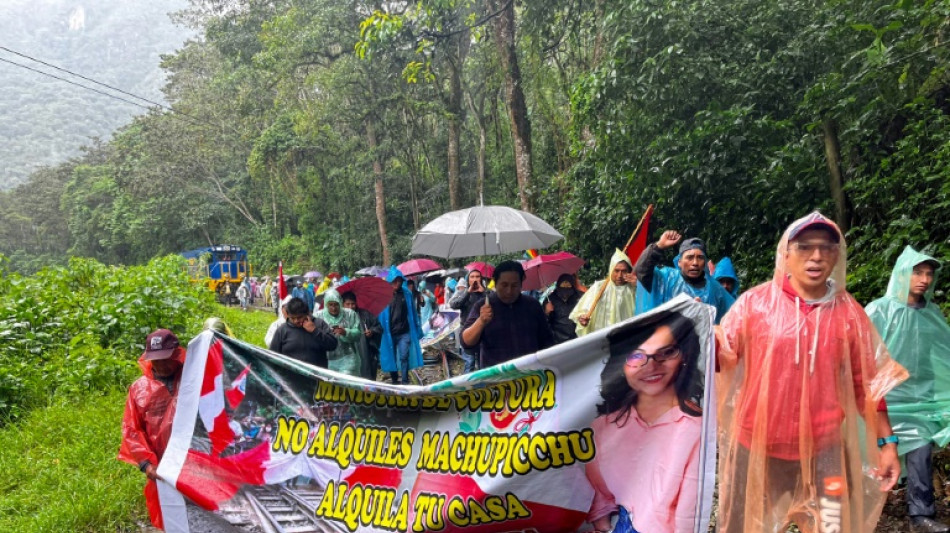
Machu Picchu protesters block tourist train tracks / Photo: Carolina Paucar - AFP
 Brussels Education Unions Schedule Major November Protest Over Funding and Reforms

 iPS Cell Research Accelerates Drug Discovery for ALS and Spinal Cord Injury

 Rene Eyre Revisits Autobiographical Performance 'Say A Little Prayer' in London

 UAE's HCT Holds Record Graduation and Announces Major Training Expansion

 NASA Awards $10B Lunar Contract Framework to SpaceX, Blue Origin

 Katy Perry Tells Fans Ex-Husband Russell Brand 'Should Be in Jail' During UK Concert

Visitors to Peru's iconic Machu Picchu site had their trip briefly interrupted Thursday by protesters angry with the government for privatizing ticket sales at the Inca citadel.
Tour operators and residents closed shops in protest and blocked the tracks of a tourist train, compelling those on board to walk the remaining three kilometers (1.8 miles) to the entrance.
"We are against the systematic privatization of Machu Picchu. The people are not in agreement; this (ticketing) company was contracted illegally," community representative Darwin Baca told AFP.
The culture ministry said the protest had not severely disrupted Thursday's visits.
"No one can say that we are privatizing cultural heritage," minister Leslie Urtega said at the weekend in response to the community's concerns.
"I myself am against it. Machu Picchu belongs to all Peruvians."
A local collective claims the company granted the contract for ticket sales, Joinnus, will make as much as $3.2 million per year in commissions.
Machu Picchu, 130 kilometers (80 miles) from the city of Cusco, was built in the 15th century at an altitude of 2,500 meters (8,200 feet) on orders from the Inca ruler Pachacutec.
It is considered a marvel of architecture and engineering and was declared a UNESCO World Heritage site in 1981.
Tourism is key to Peru's economy, with the country attracting about 4.5 million visitors prior to the coronavirus pandemic in 2020.
The number of daily access tickets to the citadel were increased to 4,500 per day starting this month, from an earlier maximum of 3,800.
B.Finley--AMWN

