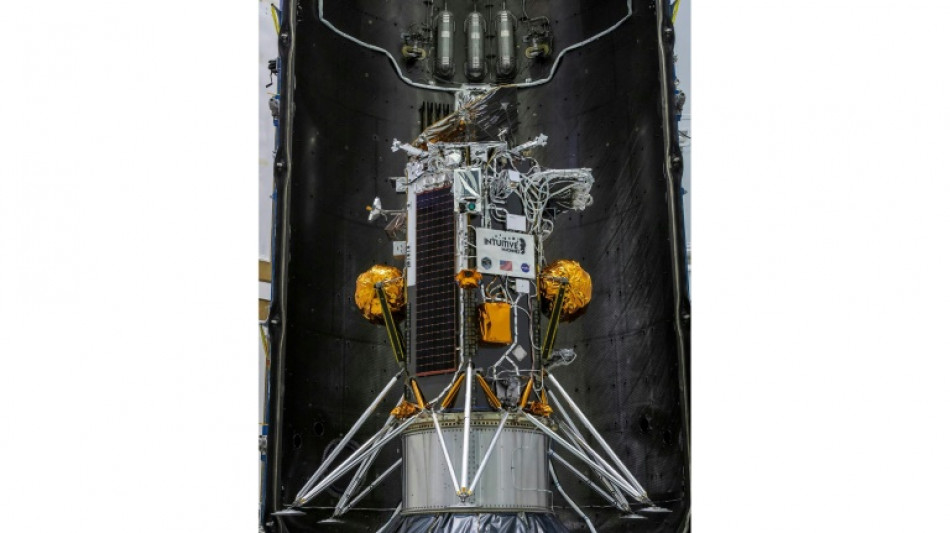
US to launch next Moon mission on Valentine's Day / Photo: Handout - NASA/AFP
 Brussels Education Unions Schedule Major November Protest Over Funding and Reforms

 iPS Cell Research Accelerates Drug Discovery for ALS and Spinal Cord Injury

 Rene Eyre Revisits Autobiographical Performance 'Say A Little Prayer' in London

 UAE's HCT Holds Record Graduation and Announces Major Training Expansion

 NASA Awards $10B Lunar Contract Framework to SpaceX, Blue Origin

 Katy Perry Tells Fans Ex-Husband Russell Brand 'Should Be in Jail' During UK Concert

US companies are set to launch for the Moon on February 14, less than a month since a similar mission ended in failure with the spaceship burning up in the Earth's atmosphere, NASA said Wednesday.
The upcoming attempt features a lander built by Houston-based Intuitive Machines fixed to the top of a SpaceX rocket, while the last try involved a United Launch Alliance rocket and Astrobotics lander.
But the stakes remain just as high: achieving America's first soft touchdown on the lunar surface since the end of the Apollo-era five decades ago, and the first ever by private industry.
SpaceX is targeting a 12:57 am (0557 GMT) blast off from the Kennedy Space Center in Florida, with Intuitive Machines' Nova-C lander expected to land on the Moon on February 22, at an impact crater near the lunar south pole.
NASA paid Intuitive Machines more than $100 million to ship its scientific hardware on the mission, part of a broader strategy to stimulate a lunar economy and delegate routine cargo missions to the private sector.
The "Nova-C" lander's payload includes instruments to better understand the lunar environment as NASA prepares to send human crew members back to the celestial body under the Artemis program later this decade.
It also includes more colorful cargo, including sculptures by the artist Jeff Koons.
Only five nations have achieved soft lunar landings. The Soviet Union was first, followed by the United States, which is still the only country to put people on the Moon. China achieved the feat three times in the past decade, followed by India, and most recently Japan.
Japan's lander touched down on January 20 but ended up on its side, leaving its solar panels off kilter.
Astrobotic's failure was the third botched effort by non-government missions, after an Israeli nonprofit and Japanese company both crash-landed in 2019 and 2023, respectively.
Landing on the Moon is complicated by treacherous terrain and the lack of atmosphere, which means parachutes aren't an option and a spaceship has to use its thrusters to achieve a controlled descent.
C.Garcia--AMWN

