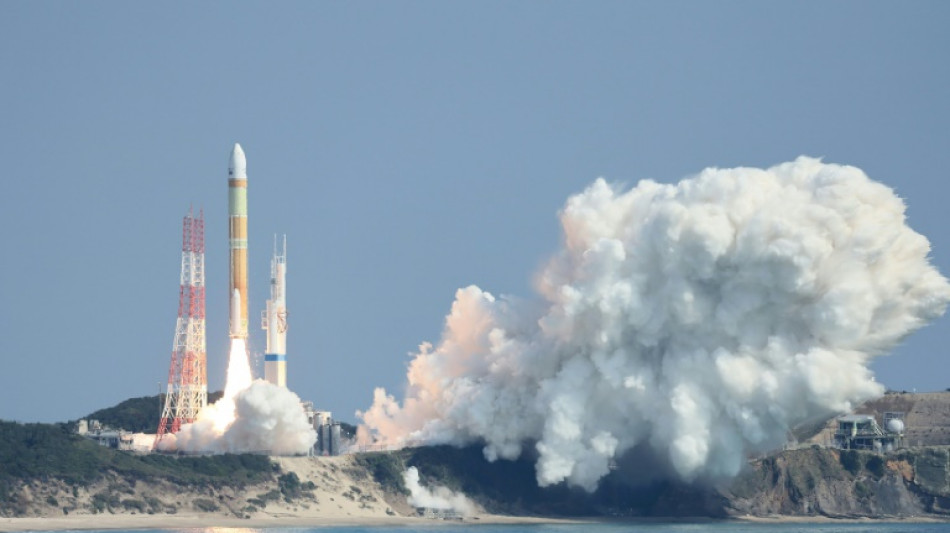
Japan postpones next-gen rocket launch over weather / Photo: STR - JIJI Press/AFP
 Brussels Education Unions Schedule Major November Protest Over Funding and Reforms

 iPS Cell Research Accelerates Drug Discovery for ALS and Spinal Cord Injury

 Rene Eyre Revisits Autobiographical Performance 'Say A Little Prayer' in London

 UAE's HCT Holds Record Graduation and Announces Major Training Expansion

 NASA Awards $10B Lunar Contract Framework to SpaceX, Blue Origin

 Katy Perry Tells Fans Ex-Husband Russell Brand 'Should Be in Jail' During UK Concert

Japan's space agency on Tuesday postponed the launch of its next-generation rocket planned for this week due to expected bad weather, after two previous attempts ended in failure.
The H3 rocket had been scheduled to lift off on Thursday from the southern island of Tanegashima.
Billed as a flexible and cost-effective new flagship, it was to carry two small satellites during the mission, intended to prove it can get into orbit.
"As the weather that day is expected to worsen, we decided to postpone the launch," the Japan Aerospace Exploration Agency (JAXA) said, adding that a new date would be announced "once a decision is made".
Japan succeeded in landing its SLIM spacecraft nicknamed the "Moon Sniper" on the lunar surface last month, although the craft's solar panels were facing the wrong way.
Before that, the country suffered a series of space failures.
They included the first H3 launch attempt in February last year -- already delayed by several years -- which was abandoned when the solid rocket boosters did not ignite.
Then, at the second attempt in March, the spacecraft was ordered to self-destruct when the command centre concluded its mission could not succeed.
Developed by Mitsubishi Heavy Industries, the H3 is the successor to Japan's H-IIA launch system, which debuted in 2001.
L.Davis--AMWN

