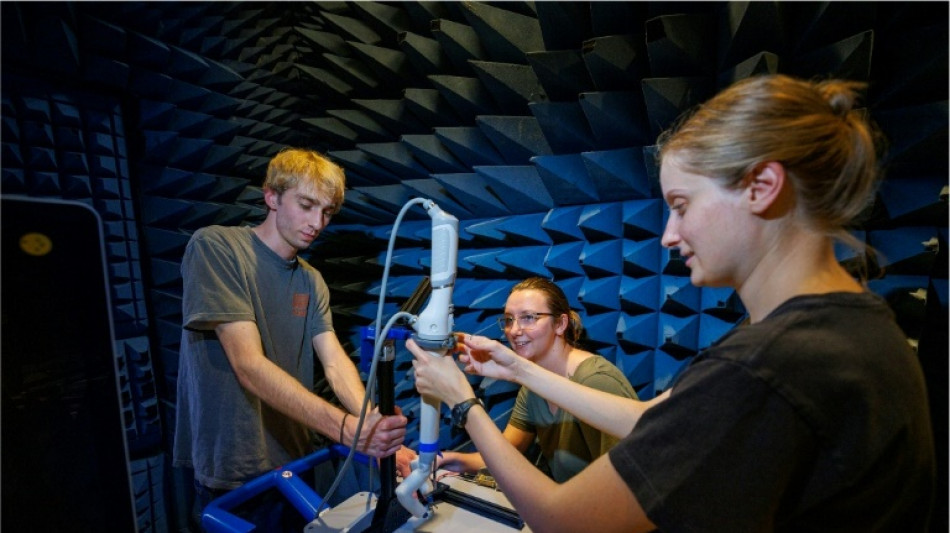
Space surgery: Doctors on ground operate robot on ISS for first time / Photo: Craig Chandler - Virtual Incision/AFP
 Brussels Education Unions Schedule Major November Protest Over Funding and Reforms

 iPS Cell Research Accelerates Drug Discovery for ALS and Spinal Cord Injury

 Rene Eyre Revisits Autobiographical Performance 'Say A Little Prayer' in London

 UAE's HCT Holds Record Graduation and Announces Major Training Expansion

 NASA Awards $10B Lunar Contract Framework to SpaceX, Blue Origin

 Katy Perry Tells Fans Ex-Husband Russell Brand 'Should Be in Jail' During UK Concert

Earth-bound surgeons remotely controlled a small robot aboard the International Space Station over the weekend, conducting the first-ever such surgery in orbit -- albeit on rubber bands.
The experiment, deemed a "huge success" by the participants, represents a new step in the development of space surgery, which could become necessary to treat medical emergencies during multi-year manned voyages, such as to Mars.
The technology could also be used to develop remote-control surgery techniques on Earth, to serve isolated areas.
The robot, developed by Virtual Incision (VIC) and the University of Nebraska, is called spaceMIRA.
It took off for the International Space Station at the end of January, aboard a payload carried by a SpaceX rocket.
Stored inside a compact box the size of a microwave oven, the robot was installed last Thursday by NASA astronaut Loral O'Hara, who has been in space since last September.
The experiment then took place on Saturday, conducted from Virtual Incision's headquarters in Lincoln, Nebraska.
It lasted around two hours, with six surgeons taking a go at operating the robot, which is equipped with a camera and two arms.
"The experiment tested standard surgical techniques like grasping, manipulating and cutting tissue. The simulated tissue is made up of rubber bands," Virtual Incision said in a statement.
In a video shared by the company, one arm equipped with pincers can be seen gripping the band and stretching it, while the other arm equipped with scissors makes a cut -- mimicking a dissection.
A key difficulty is the time lag -- about 0.85 seconds -- between the operation center on Earth and the ISS.
For a control experiment, the same process will take place with the same equipment, but on Earth.
"The experiment was deemed a huge success by all surgeons and researchers, and there were little to no hiccups," Virtual Incision said in a statement, claiming it will "change the future of surgery."
NASA, which provided some financial support for the project, said that with longer space missions, "the potential need for emergency care increases, including surgical procedures from simple stitching of lacerations to more complex activities."
D.Sawyer--AMWN

