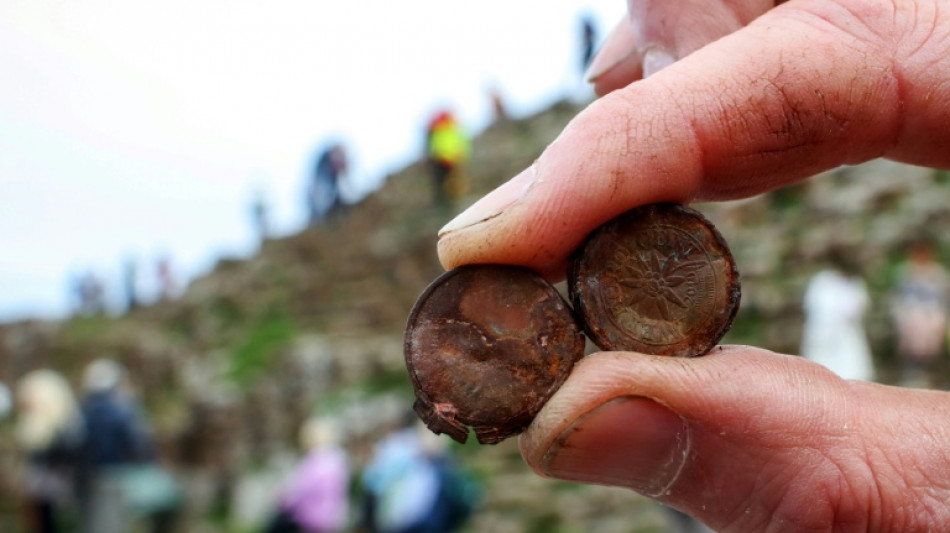
Tourist coins pose giant problem at N. Ireland's famous causeway site / Photo: PAUL FAITH - AFP
 South African election results renew debate over identity-based voting

 South African voters report smoother local election but declining IEC trust

 Dolly Parton museum and Nashville hotel open after singer’s death

 George and Amal Clooney attend New York political-comedy reading

 British buyers pay substantial premiums for period-home appearance

 Thomas Markle released to house arrest after child-abuse-image charge

 Dawn of War 4 developers chose Adeptus Mechanicus for tactical variety

 Italy face unbeaten South Africa in Turin Nations Championship match

 ChatGPT interactive interface feature tested across six custom tools

 Freshways milk-price cut deepens pressure on UK dairy farms

 Labour and National remain virtually tied as New Zealand vote count advances

 The Good Daughter adapts Karin Slaughter thriller with Rose Byrne and Meghann Fahy

 Heavy-lift drone evacuates wounded Ukrainian soldier from frontline kill zone

 Morrison says West Brom recovered after pressure from successive derby losses

 Britain considers 2027 state visit for Ukraine’s Zelensky

 Anna Miltina Confronted with Racism Allegations on ProSieben Show

Northern Ireland's Giant Causeway draws close to one million visitors a year but their habit of wedging tiny coins in cracks between the rocks -- to bring love or luck -- is damaging the world-famous wonder.
Now authorities are urging tourists to keep their coins in their pockets to preserve the spectacular landscape.
Some 40,000 columns mark the causeway, Northern Ireland's first UNESCO World Heritage Site.
Geologists say the natural phenomenon was created by an outpouring of basalt lava 60 million years ago.
Legend has it that the causeway was formed by Irish giant Finn McCool.
In recent decades, visitors have pushed thousands of coins into fissures in the rocks.
The gesture is "a token of love or luck", according to Cliff Henry, the causeway's nature engagement officer.
But the coins rapidly corrode and expand, causing the basalt to flake and leaving "unsightly" rust-coloured streaks, Henry told AFP.
He pointed to streaks on a rock and gingerly prised out a US cent with a set of keys.
"We get a lot of euros and dollar cents. But coins from literally all over the world -- any currency you can think of, pretty much -- we have had it here," he said.
A report by the British Geological Survey in 2021 revealed that the coins were "doing some serious damage" and something had to be done about it, he noted.
Signs are now in place around the site appealing to tourists to "leave no trace".
- 'Distressed' -
"Once some visitors see other people have done it, they feel that they need to add to it," causeway tour guide Joan Kennedy told AFP.
She and her colleagues now gently but firmly tell tourists to desist.
At the exit from the causeway, a US couple said they were "distressed" to hear of the damage the metal caused.
"Our guide mentioned as we came up that people had been putting coins into the stones. It's really terrible to hear that," said Robert Lewis, a 75-year-old from Florida.
"It's kind of like damaging any kind of nature when you are doing something like that, putting something foreign into nature. It's not good," said his wife, Geri, 70.
As part of a £30,000 ($40,000) conservation project, stone masons recently removed as many coins as they could -- without causing further damage -- from 10 test sites around the causeway.
Henry said the trial was successful and is to be expanded across the causeway.
"If we can get all those coins removed to start with that will help the situation and hopefully no more coins will be put in," he said.
"If visitors see fewer coins in the stones and hear appeals to stop the damaging practice, the problem can maybe be solved.
"We know that visitors love and cherish the Giant's Causeway,and many form deep personal connections to it, so we want this natural wonder to remain special for future generations."
Th.Berger--AMWN