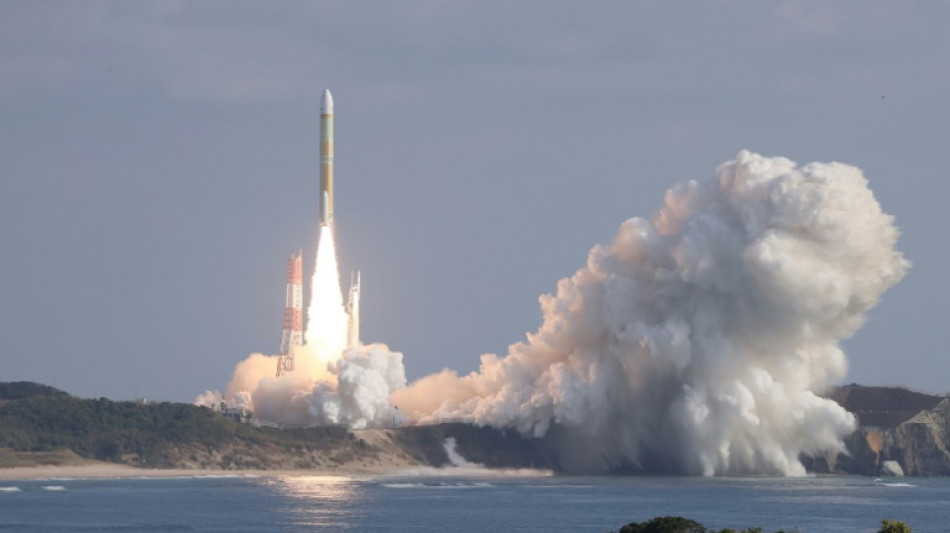
Japan announces successful launch of next-gen H3 rocket / Photo: STR - JIJI Press/AFP
 Brussels Education Unions Schedule Major November Protest Over Funding and Reforms

 iPS Cell Research Accelerates Drug Discovery for ALS and Spinal Cord Injury

 Rene Eyre Revisits Autobiographical Performance 'Say A Little Prayer' in London

 UAE's HCT Holds Record Graduation and Announces Major Training Expansion

 NASA Awards $10B Lunar Contract Framework to SpaceX, Blue Origin

 Katy Perry Tells Fans Ex-Husband Russell Brand 'Should Be in Jail' During UK Concert

Japan's space agency announced the successful launch of its new flagship rocket on Saturday, making it third time lucky for the H3 after years of delays and two previous failed attempts.
The H3 rocket, billed as flexible and cost-effective by space agency JAXA, "was put into orbit", a JAXA official told AFP, after the rocket launched from the Tanegashima Space Center in southwestern Japan at 9:22 am (0022 GMT).
The next-generation H3 rocket has been mooted as a possible competitor to Space X's Falcon 9, and could one day be used to deliver cargo to bases on the Moon.
The latest launch follows Japan's successful landing last month of an unmanned probe on the Moon -- albeit at a wonky angle -- making it just the fifth country to land a craft on the Earth's satellite.
Cheers and applause could be heard from the JAXA control centre after the agency's livestream announced the H3 engines had successfully burned, meaning the rocket had made it into orbit.
Developed jointly by JAXA and Mitsubishi Heavy Industries, the H3 is the successor to the H-IIA launch system, which debuted in 2001.
Designed for "high flexibility, high reliability, and high cost performance", the craft will "maintain Japan's autonomous access to space", JAXA says.
The first H3 launch in February 2023 was abandoned after ignition issues left the rocket standing motionless on the ground.
On the second try in March last year, technical problems meant a destruct command was issued shortly after blast-off.
Improvements were made subsequently to the ignition system of the H3, which carries two small satellites.
One of the microsatellites is expected to contribute to disaster prevention by taking photos and videos.
The other, equipped with a sensor to detect infrared rays, is intended to detect the operation conditions of factories on the ground.
Separation of the microsatellites was also confirmed, according to JAXA's livestream.
"We will keep analysing the sequences after successfully putting the rocket into orbit," the JAXA official added.
The latest launch was postponed from February 13 due to bad weather.
- Greater thrust -
H3 will be "an all-rounder -- able to launch satellites into Earth orbit, serve as a supply vehicle for space stations, and go to the Moon", said associate professor Alice Gorman, a space exploration expert at Flinders University.
The successful launch on Saturday bolsters JAXA's reputation after a string of failures, including of a different rocket, a solid-fuel model called the Epsilon-6.
Japan succeeded in landing its SLIM spacecraft nicknamed "Moon Sniper" on the lunar surface last month, although the craft's solar panels were facing the wrong way.
Despite its series of past failures, overall, Japan's space programme punches above its weight, said Adrian Michael Cruise, an honorary professor of astrophysics at the University of Birmingham.
The country "has future ambitions for space exploration challenging some of the major players", he said.
"However, space payloads are getting heavier and heavier, and to remain competitive in the missions it can mount, Japan needs access to more powerful launch vehicles, like H3."
Unlike the reusable Falcon 9, the H3 is expendable, but scientists say the trial of its world-first technology is significant.
"The H3 rocket has a unique and novel first stage engine that delivers greater thrust compared to state-of-the-art rockets," said Michele Trenti, director of the Melbourne Space Laboratory at the University of Melbourne.
The H3 "has the potential to be the most cost-effective rocket", making the exploration of the solar system more affordable.
F.Pedersen--AMWN

