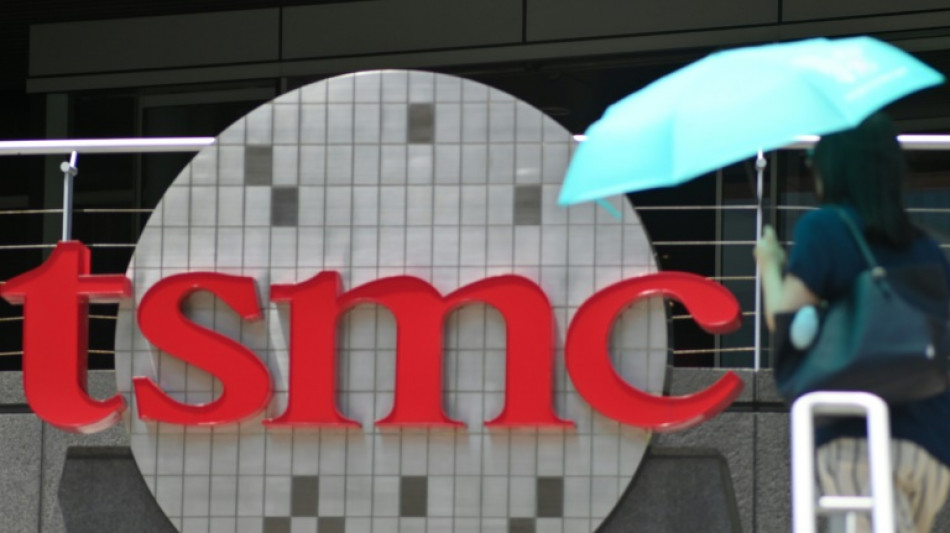
Chip giant TSMC's April revenue jumps 60% on-year / Photo: Sam Yeh - AFP/File
 Brussels Education Unions Schedule Major November Protest Over Funding and Reforms

 iPS Cell Research Accelerates Drug Discovery for ALS and Spinal Cord Injury

 Rene Eyre Revisits Autobiographical Performance 'Say A Little Prayer' in London

 UAE's HCT Holds Record Graduation and Announces Major Training Expansion

 NASA Awards $10B Lunar Contract Framework to SpaceX, Blue Origin

 Katy Perry Tells Fans Ex-Husband Russell Brand 'Should Be in Jail' During UK Concert

Taiwanese chip giant TSMC's April revenue jumped nearly 60 percent on-year, the firm said Friday, riding a huge wave of demand for the advanced semiconductors used in AI hardware.
The Taiwan Semiconductor Manufacturing Company controls more than half the world's output of chips, and supplies them for everything from Apple's iPhones to Nvidia's cutting-edge artificial intelligence hardware.
Consolidated revenues for April were "approximately NT$236.02 billion ($7.2 billion)... an increase of 59.6 percent from April 2023", TSMC said in a statement.
This compares with a 34.3 percent on-year jump in March 2024.
The company said last month that first-quarter revenues had increased by 13 percent on-year to $18.87 billion, and expects a 27.6 percent rise in the second.
The wild success of OpenAI's ChatGPT has sparked an AI gold rush, with demand surging around the world for the cutting-edge chips needed to train and run AI services.
TSMC dominates the global chip industry, and the bulk of its fabrication plants are based in Taiwan, a self-ruled island that is claimed by neighbouring China.
The semiconductor supply chain is highly vulnerable to shocks, and concerned governments have lobbied TSMC to move more production away from Taiwan.
TSMC announced plans in April for a third factory in the United States.
Its US projects have faced obstacles in the past year, which the company had attributed to a lack of human resources, as making chips requires highly specialised skills.
But if successful, the TSMC fabs in Arizona would be the "first time" that super-advanced chips will be made on American soil, according to US Commerce Secretary Gina Raimondo.
This year, TSMC also launched a new $8.6 billion plant in the southern Japanese island of Kyushu -- a coup for Japan as it vies with the United States and Europe to woo semiconductor firms with huge subsidies.
It is also planning another Japan facility in Kumamoto for more advanced chips.
On top of geopolitical worries, natural disasters are a threat too.
A major earthquake last month in Taiwan also saw a flurry of emails sent out by TSMC to assure customers that there was minimal impact on its production lines.
A.Jones--AMWN

