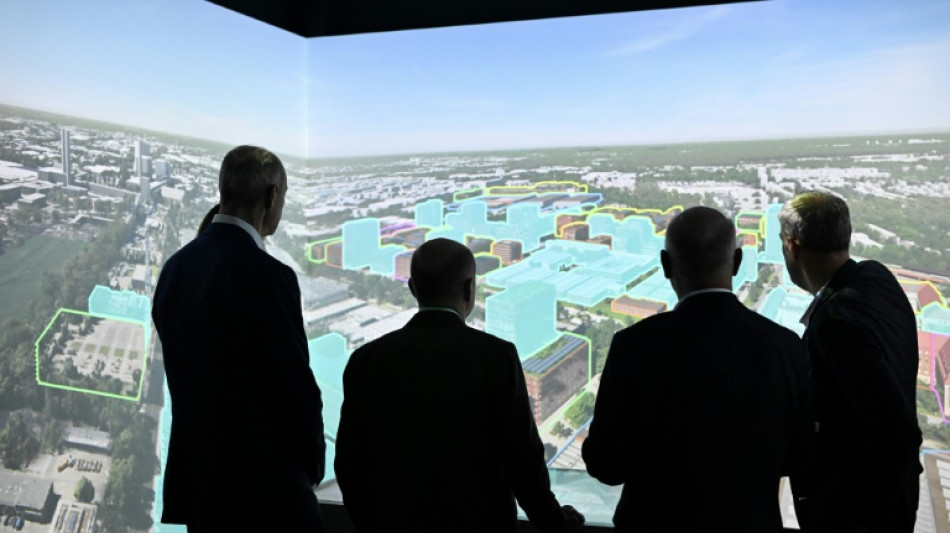
German giant Siemens to revive historic base in Berlin / Photo: RALF HIRSCHBERGER - POOL/AFP
 Brussels Education Unions Schedule Major November Protest Over Funding and Reforms

 iPS Cell Research Accelerates Drug Discovery for ALS and Spinal Cord Injury

 Rene Eyre Revisits Autobiographical Performance 'Say A Little Prayer' in London

 UAE's HCT Holds Record Graduation and Announces Major Training Expansion

 NASA Awards $10B Lunar Contract Framework to SpaceX, Blue Origin

 Katy Perry Tells Fans Ex-Husband Russell Brand 'Should Be in Jail' During UK Concert

German industrial giant Siemens on Tuesday launched an urban development project worth 4.5 billion euros ($4.8 billion) in the area of Berlin known as Siemensstadt, where the company enjoyed its pre-war heyday.
The Siemensstadt Square "district of the future" will include new living space for up to 7,000 people and create 20,000 additional jobs at the site, where Siemens still manufactures today, the company said.
Siemensstadt Square "aims to link the worlds of work and research, housing and life in a new way -- worlds that were already brought together in the historic Siemensstadt", Chancellor Olaf Scholz said at the launch of the project.
The development embodies "the future of Berlin and German industry", he said.
The 76-hectare site, due to be completed by 2035, will include homes, factories and research centres as well as offices, shops and educational, sports and leisure facilities.
The project is a way of "reconciling uses" and showing that "industrial activity still has a place in our cities", said Roland Busch, CEO of Siemens.
Siemens built a series of factories on the outskirts of Berlin at the turn of the 20th century, with thousands of employees working in them to produce cables, motors and electric pumps.
They were soon followed by housing for workers and the area became known as Siemensstadt (Siemens town) from 1914, a name it still bears today.
The area prospered until the 1930s but the destruction of World War II, the division of the city and then the building of the Berlin Wall in 1961 put the brakes on further development.
With some 380,000 employees, Siemens has in recent years refocused its business towards digital technology, moving away from the production of heavy industrial equipment.
In another sign of the changing times, the group will not be building housing for its employees in the new development as it did a century ago.
Instead, the 2,500 homes planned will be built by developers.
But Siemens is still billing the development as a return to its Berlin roots, stressing that the company's 750- million-euro contribution to the project is its "largest-ever single investment in Berlin".
A.Rodriguezv--AMWN

