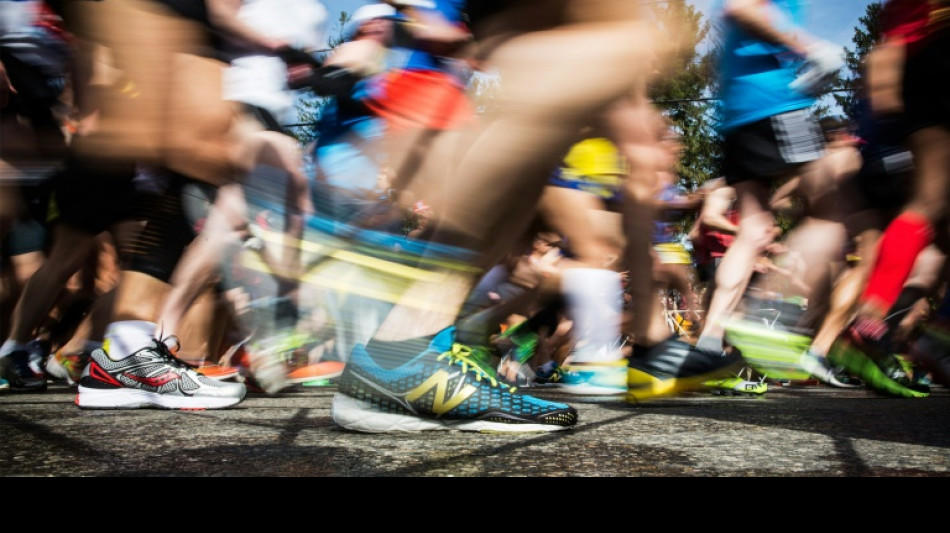
'Wake-up call': third of adults not doing enough physical activity / Photo: Andrew Burton - GETTY IMAGES NORTH AMERICA/AFP/File
 India's top court drops criminal cases against protesters
 Philippine couple married in hip-deep floodwaters

 Villa sign Senegal winger Mbaye from PSG
 Former Peru minister last-minute contender for UN labour agency helm

 Messi legacy will 'live forever', says Beckham

 'Literally tasting the smoke': Malaysians suffer as haze worsens
 Kyiv's defences, 'hybrid' threat from Moscow headline EU talks

 Oil extends gains, stocks mostly down as Trump issues fresh Iran warning

 ThinkMarkets Expands Weekend Trading Offering, Launches Weekend League Competition

 Tibet activists accuse China of downplaying floods

 Afghanistan war victims left 'without justice', UN says

 Iran president offers US olive branch before Putin meeting

 China-Nepal flood toll tops 1,000 as tunnel rescue offers last hope

 Japan to relax overtime regulation under workaholic PM

 Thwarted Niger mutiny exposes junta's Russia dependence

 Illegal mining ravages S.Africa's economic hub

 Nepal's wall of missing offers last hope after Himalayan flood

 US to press G20 on light-touch AI regulation

 2 die in Grand Canyon flash flood, only 1 person unaccounted for
 US Army Secretary Driscoll submits resignation: White House
 Oil extends gains, stocks drop as Trump issues fresh Iran warning

 Tsitsipas says Kyrgios's positive cocaine test 'kind of expected'

 In Japan's mountains, a different way to manage bears

 Middle East war a boon for UAE defence giant with global ambitions

 Former gang member found guilty of murdering Tupac Shakur

Nearly a third of all adults are not doing enough physical activity, posing a growing threat to health across the world, a major study said on Wednesday.
More than 31 percent of adults -- 1.8 billion people -- did not get the recommended amount of physical exercise in 2022, an increase of five percentage points from 2010, according to a study by the World Health Organization and other researchers.
"Physical inactivity is a silent threat to global health, contributing significantly to the burden of chronic diseases," said Ruediger Krech, director of the WHO's health promotion department.
"Unfortunately the world is not going in the right direction," he told an online press conference.
To be healthy, the WHO recommends all adults spend at least 150 minutes every week doing moderate-intensity physical activity -- which can include walking, cycling or even household chores -- or at least 75 minutes of more vigorous exercise, such as running or competing in sport.
A combination of the two will also get people over the line.
Not getting this level of exercise increases the risk of people developing heart disease, diabetes, some cancers as well as mental health problems, Krech said.
If current trends continue, adult inactivity levels are projected to rise to 35 percent by 2030, according to the study in The Lancet Global Health.
This would fall far short of the WHO's goal of reducing physical inactivity by 15 percent by the end of the decade.
Fiona Bull, head of the WHO's physical activity unit, said the research was "a wake-up call that we're not doing enough".
- 'Every step counts' -
Inactivity rates varied widely between countries. For example, 66 percent of adults do not get enough physical activity in the United Arab Emirates, while the figure was under three percent in Malawi.
There was also a gender gap. Nearly 34 percent of women worldwide do not reach the activity threshold, compared to 29 percent of men.
There are "multiple causes" for activity rates declining overall, including that people are walking less, working at computers more and generally spending more leisure time looking at screens, Bull said.
During a busy few months of world sport which includes the Olympics and the European and Copa America football championships, Krech reminded people that "watching sports does not equal being physically active".
"Don't just sit on (your) chairs, get up and be active -- every step counts," he said.
The WHO emphasised that changing individual behaviour is not enough, calling on countries to promote physical activity by boosting community sport as well as walking, cycling and public transport.
For the study, billed as the most comprehensive to look at the subject yet, an international team of researchers combined the findings from more than 500 studies involving 5.7 million people across 163 countries and territories.
It was not all bad news.
Almost half of the countries had made progress over the last decade, and 22 are on track to reach the 2030 target -- as long as they keep moving in the right direction.
A.Mahlangu--AMWN