Musk's Neuralink eyes more test subjects for its brain tech / Photo: - - Neuralink/AFP/File
 India's top court drops criminal cases against protesters
 Philippine couple married in hip-deep floodwaters

 Villa sign Senegal winger Mbaye from PSG

 Former Peru minister last-minute contender for UN labour agency helm

 Messi legacy will 'live forever', says Beckham

 'Literally tasting the smoke': Malaysians suffer as haze worsens

 Kyiv's defences, 'hybrid' threat from Moscow headline EU talks

 Oil extends gains, stocks mostly down as Trump issues fresh Iran warning

 ThinkMarkets Expands Weekend Trading Offering, Launches Weekend League Competition

 Tibet activists accuse China of downplaying floods

 Afghanistan war victims left 'without justice', UN says
 Iran president offers US olive branch before Putin meeting

 China-Nepal flood toll tops 1,000 as tunnel rescue offers last hope
 Japan to relax overtime regulation under workaholic PM

 Thwarted Niger mutiny exposes junta's Russia dependence
 Illegal mining ravages S.Africa's economic hub

 Nepal's wall of missing offers last hope after Himalayan flood
 US to press G20 on light-touch AI regulation

 2 die in Grand Canyon flash flood, only 1 person unaccounted for
 US Army Secretary Driscoll submits resignation: White House
 Oil extends gains, stocks drop as Trump issues fresh Iran warning

 Tsitsipas says Kyrgios's positive cocaine test 'kind of expected'
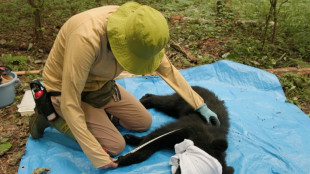 In Japan's mountains, a different way to manage bears
 Middle East war a boon for UAE defence giant with global ambitions

 Former gang member found guilty of murdering Tupac Shakur

Elon Musk on Wednesday said his Neuralink startup is "moving on" to a second test patient as its tech for linking brains and computers improves.
Musk and members of the Neuralink team fielded questions during an update streamed on X, formerly Twitter, discussing where it is on the path to making its brain implants commonplace.
"We're only just moving now to our second Neuralink patient," Musk said. "But we hope to have, if things go well, high single digits this year."
Musk's neurotechnology company in January installed a brain implant in Noland Arbaugh, which the billionaire head of Tesla and X touted as a success.
Arbaugh was left paralyzed from the shoulders down by a diving accident eight years ago.
Since the implant operation, he has told of playing chess and the video game "Civilization," as well as taking Japanese and French lessons by controlling a computer screen cursor with his brain.
Musk and members of the Neuralink team detailed fixing an issue that saw Arbaugh's ability to move a computer cursor with his mind greatly reduced.
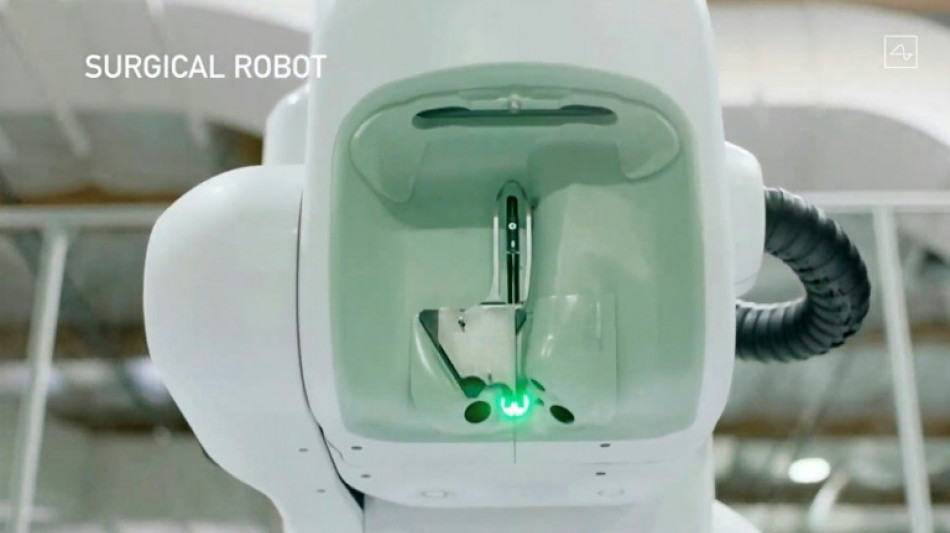
Neuralink's technology works through a device about the size of five stacked coins that is placed inside the human brain by a robotic surgeon.
Threads connecting the implant to Arbaugh's brain had "retracted," becoming less effective at picking up signals.
Threads will be implanted deeper in the brain and at varying depths, with ramped-up precision to maximize effectiveness, according to the Neuralink team.
Musk promised "it's only going to get better from here."
One goal is to escalate the bandwidth of the link between the brain and computer, allowing more data to move faster, according to Musk.
"Quite important for human-AI symbiosis is just being able to communicate at a speed AI can follow," Musk said of brains being connected to computers with artificial intelligence.
Musk envisions Neuralink implants going beyond restoring sight to the blind to giving people infrared or ultraviolet vision or letting them share concepts with others telepathically.
"We want to give people superpowers," Musk said. "Not just that we're restoring your prior functionality, but that you actually have functionality far greater than a normal human."
Musk spoke of developing an automated process in which Neuralink's surgery robot could quickly install custom implants in people seeking "upgrades."
"It's very sort of 'Cyberpunk' or 'Deus Ex,' if you play those games," Musk said of the idea.
"An exciting possibility long term also is to take parts of the Optimus humanoid robot and combine that with a Neuralink - you could have basically cybernetic superpowers," he said.
Musk cofounded Neuralink in 2016.
The ambition is to supercharge human capabilities, treat neurological disorders like ALS or Parkinson's, and maybe one day achieve a symbiotic relationship between humans and AI.
Musk is not alone in trying to make advances in the field, which is officially known as brain-machine or brain-computer interface research.
T.Ward--AMWN