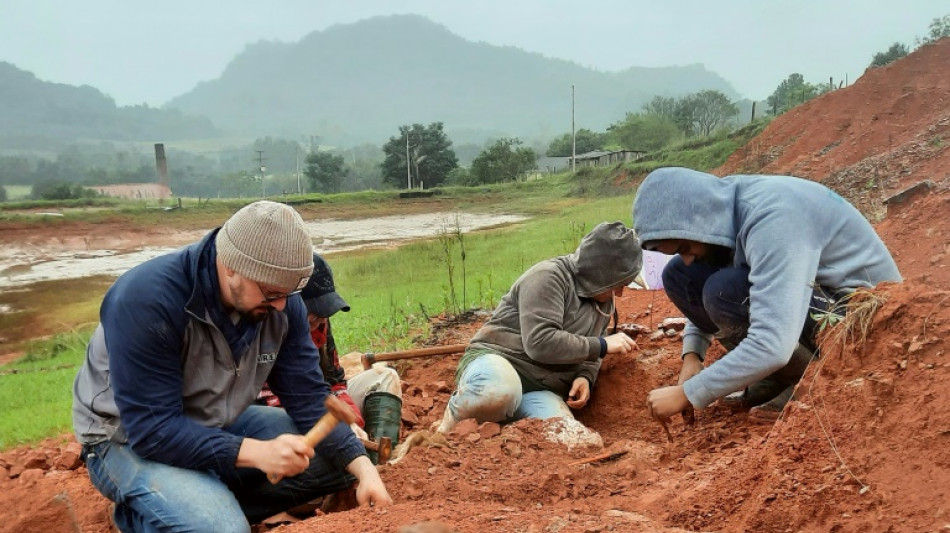
'Well-preserved' dinosaur fossil revealed by Brazilian flood / Photo: Handout - Federal University of Santa Maria/AFP
 Brussels Education Unions Schedule Major November Protest Over Funding and Reforms

 iPS Cell Research Accelerates Drug Discovery for ALS and Spinal Cord Injury

 Rene Eyre Revisits Autobiographical Performance 'Say A Little Prayer' in London

 UAE's HCT Holds Record Graduation and Announces Major Training Expansion

 NASA Awards $10B Lunar Contract Framework to SpaceX, Blue Origin

 Katy Perry Tells Fans Ex-Husband Russell Brand 'Should Be in Jail' During UK Concert

Torrential rains causing historic flooding in southern Brazil have revealed a "very well-preserved" dinosaur fossil dating back some 200 million years, according to the research team who discovered it.
The fossil was first identified in May near the city of Sao Joao do Polesine, some 280 kilometres (170 miles) west of Porto Alegre, in a part of the Brazilian pampas dubbed the country's 'El Dorado' of palaeontology.
A team of palaeontologists from the Federal University of Santa Maria spent four days excavating the fossil to remove the block of rock containing a "near complete" dinosaur fossil to take back to their research centre for study.
Initial findings have determined the fossil was a specimen of the Herrerasauridae family, which were bipedal carnivores with long tails found in the area of modern-day Brazil and Argentina.
The fossil dates to the Triassic period, between 250 to 200 million years ago.
Rodrigo Temp Muller, who's leading the research effort, told AFP that the fossil is possibly the second most complete fossil of a Herrerasauridae specimen to date.
The most complete was found in the same part of Brazil in 2014, leading to the identification of a new species with hooked claws, dubbed gnathovorax cabreirai.
The fossil will undergo several rounds of analysis before researchers can determine whether the specimen is a member of the same species.
"We have to be very careful with this work, it's very meticulous, almost surgical," Muller said, adding the process could take "several months."
"Every little part that we might damage will be a bit of information that we might not be able to recover."
Once the analysis is done, Muller's team will publish the results in a scientific journal.
- Erosion acceleration -
The heavy rains that affected the pampas in May killed more than 180 people in Brazil and caused major damage to infrastructure.
The floods revealed the fossil much earlier by "accelerating erosion," a silver lining to researchers, who would not have discovered it until much later, according to Muller.
The downpour is not without its drawbacks, however, as heavy rainfall "also destroys a lot of the material" from the fossils, especially small fragments.
Palaeontologists maintain a close watch on the fossil deposits as a result, especially any fragments that may be exposed, and focus their efforts during excavations to recover these fossils in the best possible condition.
M.Fischer--AMWN

