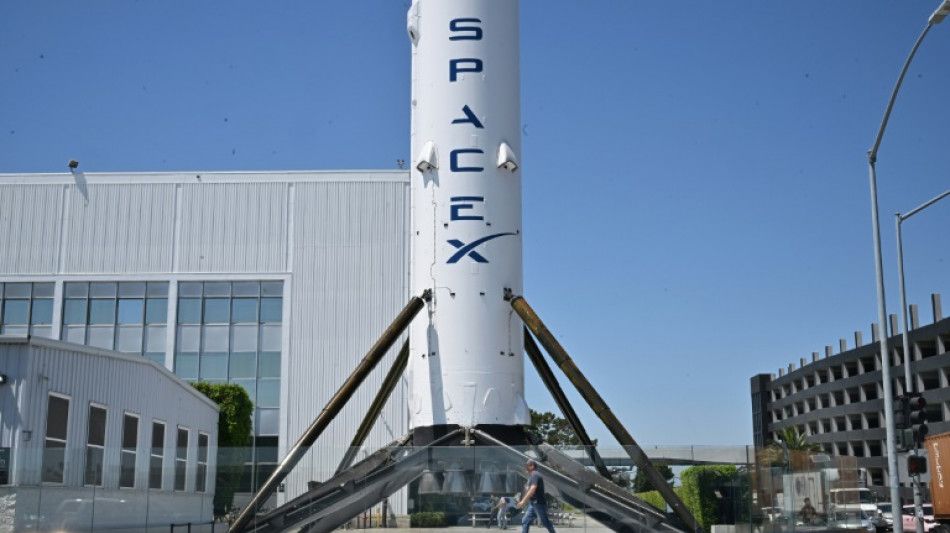
SpaceX cleared to launch Falcon 9 rocket again / Photo: Frederic J. BROWN - AFP/File
 Brussels Education Unions Schedule Major November Protest Over Funding and Reforms

 iPS Cell Research Accelerates Drug Discovery for ALS and Spinal Cord Injury

 Rene Eyre Revisits Autobiographical Performance 'Say A Little Prayer' in London

 UAE's HCT Holds Record Graduation and Announces Major Training Expansion

 NASA Awards $10B Lunar Contract Framework to SpaceX, Blue Origin

 Katy Perry Tells Fans Ex-Husband Russell Brand 'Should Be in Jail' During UK Concert

SpaceX's stalwart Falcon 9 rocket has been cleared for launch after experiencing a rare failure earlier this month, officials said Thursday.
The rocket, a prolific launch vehicle that propels both satellites and astronauts into orbit, experienced an anomaly during a launch on July 11 in its second stage booster that meant it failed to deploy 20 Starlink satellites at a high enough altitude, and all burnt up on re-entry through Earth's atmosphere.
"During the first burn of Falcon 9's second stage engine, a liquid oxygen leak developed within the insulation around the upper stage engine," Elon Musk's company said in a statement.
"The cause of the leak was identified as a crack in a sense line for a pressure sensor attached to the vehicle's oxygen system."
After investigating the mishap, the Federal Aviation Administration said it had determined "no public safety issues were involved in the anomaly" and that the Falcon 9 vehicle "may return to flight operations while the overall investigation remains open."
The last time a Falcon 9 experienced a serious incident was in September 2016, when one blew up on the launchpad.
And in June 2015, the second stage of a Falcon 9 disintegrated two minutes after lift-off, resulting in the loss of important equipment bound for the International Space Station.
The new mishap notably came as the first crew of Boeing's problem-plagued Starliner spaceship are stuck waiting for ground teams to give a green light for them to return from the ISS.
With Falcon 9 cleared, the next scheduled resupply of the orbiting outpost in early August can now take place as planned, using a Northrop Grumman Cygnus cargo ship.
D.Sawyer--AMWN

