Europe climate report signals rising extremes / Photo: Fabrice COFFRINI - AFP/File
 Ian Wright and Jamie Carragher split on Liverpool-Arsenal prediction

 The Duskbloods delayed as Nintendo Switch 2 release moves to 2027

 Russia turns to NATO countries for prosthetics amid war-related shortages

 Researchers on island encounter giant spider legs emerging from a burrow

 Britain's King Charles lands in ex-colony Guyana

 Arsenal assess Bukayo Saka fitness concerns before Liverpool meeting
 £10,000 garden project transforms a UK home into a miniature Greece

 Forest destruction tests Armenia-Azerbaijan peace push

 Deal still eludes nations on final day of UN nature talks

 Teen rallies take to the streets across Italy

 Netanyahu bloc finishes ahead in Israel vote, but well short of majority

 Rural US hospitals, collateral victims of Trump politics

 How Trump could interfere in US midterm elections

 As Republicans downplay abortion for midterms, four US states to vote

 No. 4 Indiana looks to revive offense against improving Minnesota

 Police close investigation into Hayden Panettiere death after coroner ruling

 Australian mushroom killer loses appeal, has sentence extended

 How to Build a "Fun Fund" Without Guilt

 Lethbridge students learn how city transit and transportation systems work

 India highlights defence ties with Japan and Australia at Cebu meetings

 Horoscope for October 30, 2026: communication and patience shape the day

 Amazon cloud business accelerates but shares drop on profit miss

 Wesley Fofana under scrutiny after Chelsea penalty miss in Carabao Cup

 Russell admits absence of rivalry because he cannot match Antonelli

 DR Congo says Rwanda flouting pact, US sanctions justified

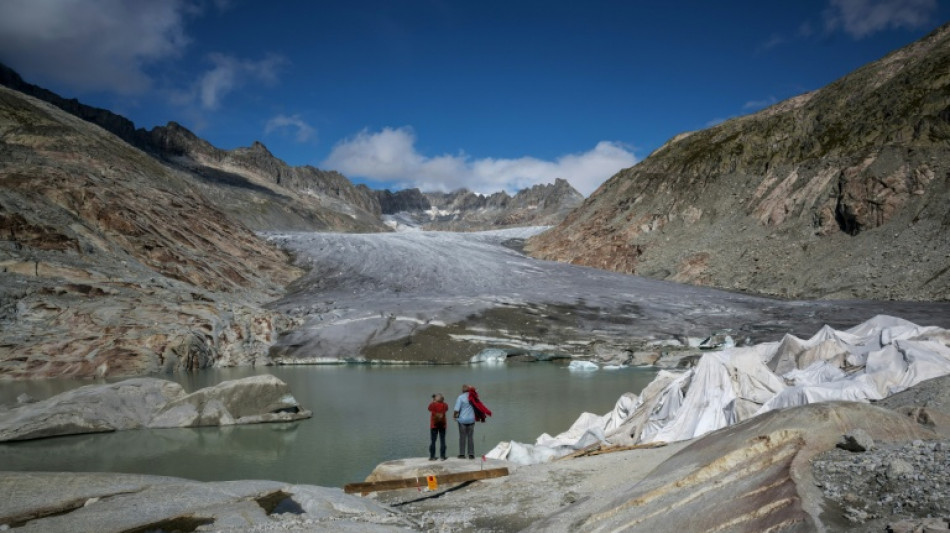
Europe endured a historic heatwave across Nordic countries, shrinking glaciers and record sea temperatures in 2025 as the fast-warming continent faces more frequent climate extremes, a new report showed Wednesday.
"The climate indicators ... are quite worrying," Mauro Facchini, a European Commission official, told journalists.
The European State of the Climate report underscores the urgent need for the region to adapt to global warming and accelerate its transition to clean energy, another EU official said.
Here are some key findings of the report published by the EU's Copernicus Climate Change Service and the World Meteorological Organization (WMO):
- Record heatwaves -
At least 95 percent of the region experienced above-average annual temperatures, with Britain, Norway and Iceland recording their warmest year on record, according to the report.
"Since 1980, Europe has been warming twice as fast as the global average, making it the fastest warming continent on Earth," WMO Secretary-General Celeste Saulo said in a briefing on the report.
"Heatwaves are becoming more frequent and severe. And in 2025, we saw long duration heatwaves from the Mediterranean to the Arctic Circle," Saulo said.
Sub-Arctic Finland, Norway and Sweden -- a region dubbed Fennoscandia -- experienced a record three-week heatwave in July, with temperatures reaching 30C within the Arctic Circle.
Parts of Fennoscandia had almost two weeks of "strong heat stress" -- when temperatures feel hotter than 32C. In an average year, the region will normally have up to two days of strong heat stress.
In Turkey, temperatures reached 50C for the first time in July while 85 percent of the Greek population was affected by extreme temperatures close to or above 40C.
Large parts of western and southern Europe were hit with two significant heatwaves in June, including most of Spain, Portugal, France and southern parts of Britain.
A third major heatwave struck Portugal, Spain and France in August.
Europe and the rest of the world could face another extremely hot summer as the El Nino weather phenomenon, which pushed global temperatures to record highs in 2024, is expected to return in the middle of the year.
- Melting ice -
Glaciers across Europe recorded a net mass loss in 2025, with Iceland experiencing its second-largest ever melt.
Europe's glaciers are found in mountainous areas such as the Alps, northern Scandinavia, Iceland and Greenland's periphery.
"Glaciers across Europe and globally are projected to continue to lose mass throughout the 21st century, regardless of the emission scenario," the report said.
The Greenland Ice Sheet lost round 139 billion tonnes of ice -- "equivalent to losing 100 Olympic-sized swimming pools every single hour", said Samantha Burgess, strategic lead for climate at the European Centre for Medium-Range Weather Forecasts (ECMWF), which operates Copernicus.
It raised the global mean sea level by 0.4 mm.
Europe's snow cover, meanwhile, was the third lowest on record.
- Renewables rise -
For the third year running, renewable energy produced more of Europe's electricity than fossil fuels, accounting for 46.4 percent of the continent's power generation.
Solar power's contribution reached a record 12.5 percent.
"But that's not sufficient. We need to speed up," said Dusan Chrenek, principal advisor at the European Commission's climate office. "We need to work on transitioning away from fossil fuels."
- Other extremes -
Europe's annual sea surface temperature was the highest on record for the fourth consecutive year.
A record 86 percent of the European ocean region had at least one day with "strong" marine heatwave conditions.
Such heatwaves have an impact on biodiversity, notably on seagrass meadows in the Mediterranean which act as natural sea barriers and are sensitive to high temperatures.
"They are biodiversity hotspots housing thousands of fish per acre and are critical nursery habitats," said Claire Scannell, one of the report's authors and principal meteorologist officer at Ireland's weather service.
The area burnt by wildfires, meanwhile, reached a record 1,034,550 hectares.
Storms and floods killed at least 21 people and affected 14,500 across Europe, though flooding and extreme rainfall were less widespread than in recent years.
O.M.Souza--AMWN