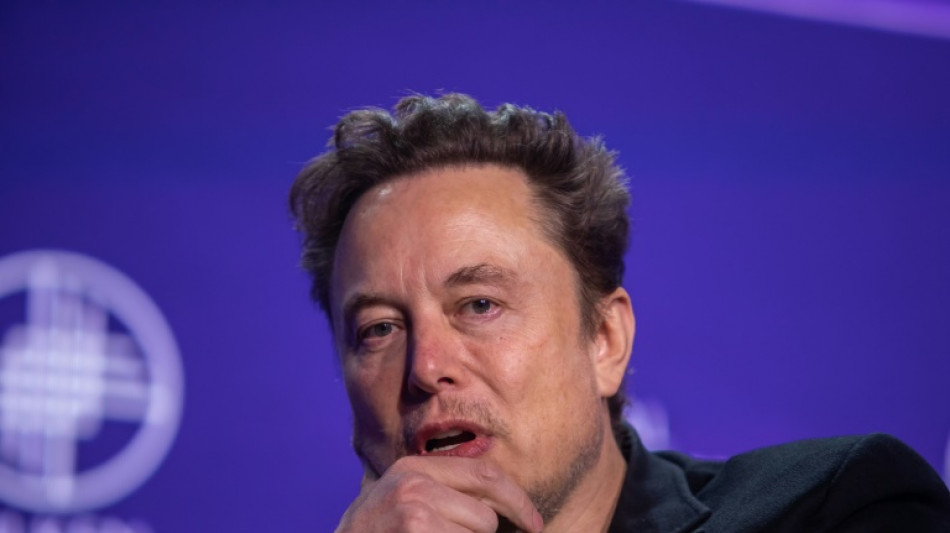
Musk faces criticism over deepfake Kamala Harris video / Photo: Apu Gomes - GETTY IMAGES NORTH AMERICA/AFP/File
 Brussels Education Unions Schedule Major November Protest Over Funding and Reforms

 iPS Cell Research Accelerates Drug Discovery for ALS and Spinal Cord Injury

 Rene Eyre Revisits Autobiographical Performance 'Say A Little Prayer' in London

 UAE's HCT Holds Record Graduation and Announces Major Training Expansion

 NASA Awards $10B Lunar Contract Framework to SpaceX, Blue Origin

 Katy Perry Tells Fans Ex-Husband Russell Brand 'Should Be in Jail' During UK Concert

Billionaire X owner Elon Musk was facing criticism Monday for sharing a deepfake video featuring US Vice President Kamala Harris, which tech campaigners said violated the platform's own policies.
Musk reposted a manipulated Harris campaign video in which a voiceover mimicking her calls President Joe Biden senile, and declares that she does not "know the first thing about running the country," adding that as a woman and a person of color, she is the "ultimate diversity hire."
The video was originally posted by an X account linked to the conservative podcaster Chris Kohls and labeled a "parody."
But Musk's repost on Friday made no such disclosure, stating only: "This is amazing," along with a laughing emoji.
Musk's repost garnered more than 130 million views and comes amid growing alarm over AI-enabled political disinformation ahead of the US presidential election in November.
"We believe the American people want the real freedom, opportunity, and security Vice President Harris is offering; not the fake, manipulated lies of Elon Musk and Donald Trump," Harris's presidential campaign said in a statement.
With nearly 192 million followers, Musk is a highly influential voice on the platform, previously called Twitter, which he purchased in 2022 in a $44 billion deal.
Earlier this month, Musk endorsed Trump in a post on X shortly after the Republican narrowly escaped an assassination attempt during a campaign rally in Pennsylvania.
Gavin Newsom, the Democratic governor of California, posted on X that the manipulated Harris video "should be illegal" and that he would soon sign a bill banning such media.
A defiant Musk responded to his post, saying "parody is legal in America," while including the original video below it.
Musk's repost appeared to violate X's policies, which prohibit sharing "synthetic, manipulated or out-of-context media that may deceive or confuse people and lead to harm."
X did not respond to AFP's request for comment.
"Ignoring the rules of the road (because) he bought the road," Nora Benavidez, senior counsel at the watchdog Free Press, wrote on X, referring to Musk's apparent violation of the site's policies.
Disinformation researchers are fearful of rampant misuse of AI technology in a major election year, thanks to proliferating online tools that are cheap and easy to use while lacking sufficient guardrails.
AI-generated content -- particularly audio, which experts say is difficult to identify -- sparked national alarm in January when a fake robocall posing as Biden urged New Hampshire residents not to vote in the state's primary.
"Platforms play an outsized role in election cycles," Benavidez wrote. "They must do better."
J.Williams--AMWN

