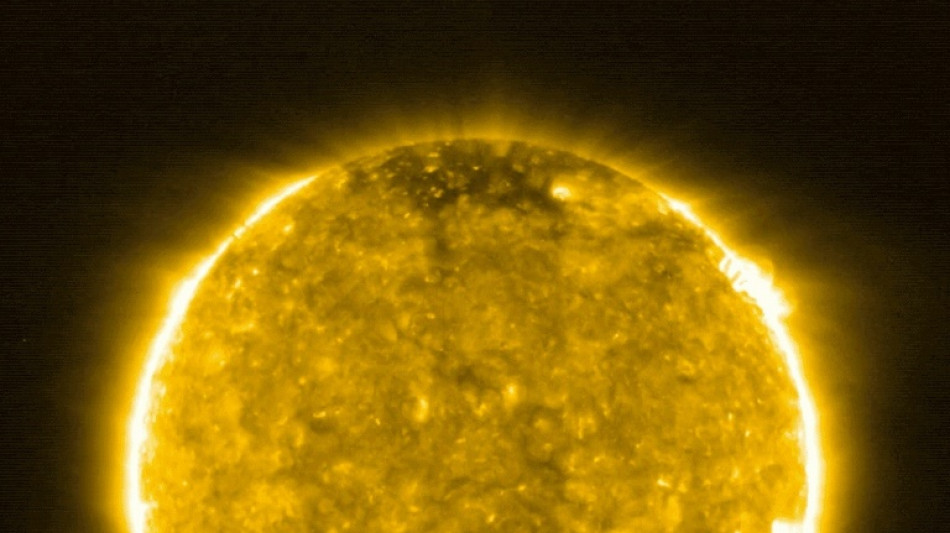
Earth hit by 'severe' solar storm / Photo: - - Solar Orbiter/EUI/ESA/NASA/AFP
 Bellingham savours 'best night of England career' after Mexico heroics

 Ancelotti fails in mission to end Brazil's World Cup woe

 Bellingham powers 10-man England past Mexico, into World Cup quarters

 Canada's McIntosh breaks 200 fly world record, oldest in women's swimming
 Norway dance to Haaland's beat in 'surreal' World Cup run
 Daddy issues? NATO's Rutte sticks to charm to keep Trump on side

 Norway's World Cup win over Brazil beyond my dreams, says Haaland

 Neymar calls time on Brazil career after World Cup elimination

 Ancelotti promises Brazil will bounce back after World Cup exit

 Mexico-England World Cup match delayed one hour due to storms

 Gotterup wins PGA John Deere after Kohles splashdown

 Haaland knocks Brazil out of World Cup as Norway reach quarters

 'Catastrophic' Super Typhoon Bavi hits US island of Rota

 West Indies trail Sri Lanka by 231 runs

 FIFA clear US star Balogun to play after Trump call

 Venezuela quake survivor 'reborn' after eight days in rubble

 Red-card U-turn rocks World Cup as England face Azteca test

 Struff oldest first-time men's Slam quarter-finalist in Open era

 Banana!: 'Minions' knocks 'Toy Story' off N.America box office perch

 Sabalenka wants to drink, 'forget about tennis' after Wimbledon exit

 Mooney stars as Australia hammer England in women's World Cup final

 Djokovic makes history, Osaka sends Sabalenka crashing out of Wimbledon

 Osaka beats world number one Sabalenka in Wimbledon last 16

 Eala eyeing Wimbledon quarters, Dimitrov faces Fery

 'Privileged' Del Toro wins Tour de France stage, Pogacar up to 2nd

The Earth was hit Monday by an intense solar storm that could bring the northern lights to night skies further south than normal, a US agency announced.
Conditions of a level-four geomagnetic storm -- on a scale of five -- were observed Monday from 1500 GMT, according to a specialized center at the US National Oceanic and Atmospheric Administration (NOAA).
These conditions may persist for several hours, but were not expected to increase further in intensity, NOAA added in a statement.
"A severe geomagnetic storm includes the potential for aurora to be seen faintly as far south as Alabama and northern California," NOAA said in a statement, referring to US states.
The new solar storm is caused by coronal mass ejections (CMEs), which are explosions of particles leaving the Sun. When these particles arrive on Earth, they disrupt its magnetic field.
"There are a lot of auroras now... If it lasts until nightfall here, we might be able to see some," Eric Lagadec, an astrophysicist at the Cote d'Azur Observatory in France, said on X.
On Sunday, NASA astronaut Matthew Dominick published on X a superb photo of the aurora borealis -- or Northern Lights -- taken from the International Space Station, where he is currently stationed.
But solar or geomagnetic storms can also trigger undesirable effects.
For example, they can degrade high-frequency communications, disrupt satellites, and cause overloads on the electricity grid. Operators of sensitive infrastructure have been notified to put in place measures to limit these effects, NOAA said.
In May, the planet went through the most powerful geomagnetic storms recorded in 20 years. They caused auroras to light up the night sky in the United States, Europe, and Australia, at much lower latitudes than usual.
This type of event has increased recently because the Sun is currently close to its peak activity, as per its 11-year cycle.
J.Oliveira--AMWN