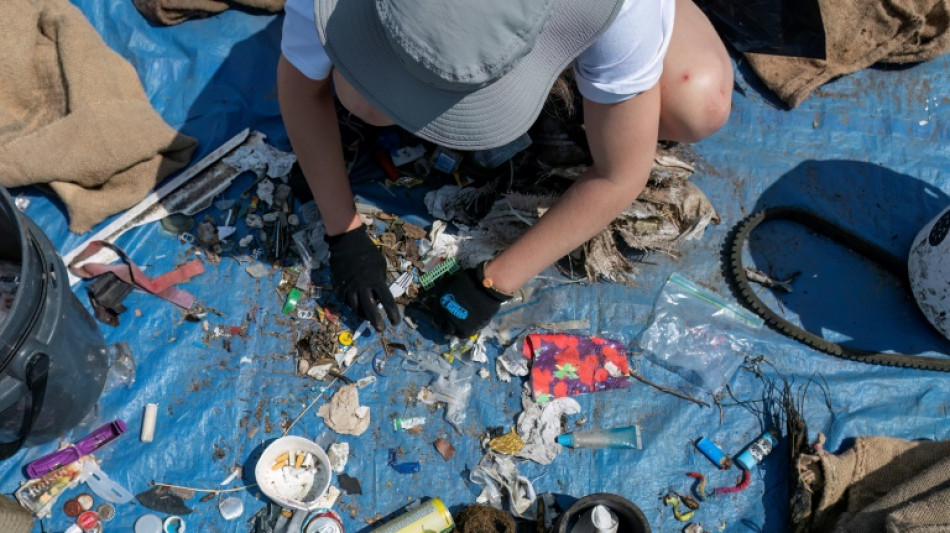
How plastic pollution poses challenge for Canada marine conservation / Photo: Sebastien ST-JEAN - AFP
 Canadian minister says Russia's G20 presence sparked 'discomfort'

 IMF reaches agreement with Senegal on new $2.2 bn loan programme
 Germany blames Russia for airport drone incident, hits back with sanctions

 Iran president urges return to truce, hails Russian support

 Aster and World Liberty Financial Launch USD1 RWA Boost: Phase 1, Offering 125M $WLFI + 6.25M USD1 in Rewards

 Tronchon sprints to Vuelta stage 10 win, Mas keeps red jersey

 Germany defender Rudiger announces international retirement

 Musk defends AI data centers, slams EU rules at G20
 Activists blame Kenya for Ugandan opposition figure's plight
 Iran president offers US olive branch, hails Russian support

 TrustFinance Community Choice Awards 2026 Opens Global Voting

 Nepal disaster a climate 'warning signal': foreign minister

 France winger Diaby returns to Leverkusen until 2031

 Barcelona confirm Jesus arrival from Arsenal

 EU official says it's not time to 'normalize' Russia at G20 finance talks

 RedHill Announces Transformational Acquisition of Commercialization Rights to Ferring’s Rebyota® and Clenpiq®
 TrendEadvisor Launches Global Multi-Asset Platform Combining Online Investing with Social Trading

 India's top court drops criminal cases against protesters

 Philippine couple married in hip-deep floodwaters

 Villa sign Senegal winger Mbaye from PSG

 Former Peru minister last-minute contender for UN labour agency helm

 Messi legacy will 'live forever', says Beckham
 'Literally tasting the smoke': Malaysians suffer as haze worsens

 Kyiv's defences, 'hybrid' threat from Moscow headline EU talks
 Oil extends gains, stocks mostly down as Trump issues fresh Iran warning

One of the largest producers of plastic waste per capita, Canada is struggling to protect its designated marine protected areas from this pollution, experts warn.
Here are some key points about the issue facing the North American country.
- Significant plastic pollution -
With more than four million tonnes produced each year, Canada generates "two to four times more" plastic pollution per person than the global average, said Anthony Merante of the NGO Oceana.
In 2020, more than 90 percent of plastic waste ended up in landfills or was incinerated, and only seven percent was recycled, according to the Canadian environment ministry.
The remaining roughly two percent, or 90,000 tonnes, ended up in the environment.
"Plastic pollution is so ubiquitous at this point, we can't protect marine protected areas from plastic pollution unless we stop plastic pollution at the source," said Merante, head of Oceana Canada's plastics campaign.
Globally, annual plastic production has more than doubled in 20 years to reach 460 million tonnes.
Only nine percent is recycled, according to the Organization for Economic Co-operation and Development (OECD).
And more than half of it is single-use packaging -- "things that we use for a few moments and that end up lasting hundreds of years," said Merante.
- New regulations -
In June 2022, Prime Minister Justin Trudeau's federal government banned six types of single-use plastics with the goal of achieving zero plastic waste by 2030.
The regulation is being challenged in court by Canadian and American plastics manufacturers, as well as petrochemical firms.
Several municipalities, including Montreal, Vancouver and Edmonton, have already banned certain single-use plastics.
More biodegradable utensils are being found on the banks near the island city of Montreal, said Anne-Marie Asselin, a marine biologist who has been carrying out collection campaigns along the Saint Lawrence River for five years.
This shows that people's "behaviors have not changed," but the kind of waste now generated has "much less impact on the environment," she noted.
Ottawa is also working on creating a federal plastics registry.
The goal is to hold manufacturers accountable by requiring them to report on the life cycle of the plastics they put into circulation.
In the case of federal marine protected areas, few measures have been put in place against plastic pollution.
The Department of Fisheries and Oceans maintains that it is, however, "taken into account" when creating new marine protected areas and that since 2019, it has been prohibited to dump waste in protected areas.
F.Dubois--AMWN