
Can an ambitious Milei make Argentina an AI giant? / Photo: Handout - Argentinian Presidency/AFP
 Canadian minister says Russia's G20 presence sparked 'discomfort'

 IMF reaches agreement with Senegal on new $2.2 bn loan programme

 Germany blames Russia for airport drone incident, hits back with sanctions

 Iran president urges return to truce, hails Russian support

 Aster and World Liberty Financial Launch USD1 RWA Boost: Phase 1, Offering 125M $WLFI + 6.25M USD1 in Rewards

 Tronchon sprints to Vuelta stage 10 win, Mas keeps red jersey

 Germany defender Rudiger announces international retirement

 Musk defends AI data centers, slams EU rules at G20

 Activists blame Kenya for Ugandan opposition figure's plight

 Iran president offers US olive branch, hails Russian support

 TrustFinance Community Choice Awards 2026 Opens Global Voting

 Nepal disaster a climate 'warning signal': foreign minister

 France winger Diaby returns to Leverkusen until 2031

 Barcelona confirm Jesus arrival from Arsenal

 EU official says it's not time to 'normalize' Russia at G20 finance talks

 RedHill Announces Transformational Acquisition of Commercialization Rights to Ferring’s Rebyota® and Clenpiq®

 TrendEadvisor Launches Global Multi-Asset Platform Combining Online Investing with Social Trading

 India's top court drops criminal cases against protesters
 Philippine couple married in hip-deep floodwaters

 Villa sign Senegal winger Mbaye from PSG

 Former Peru minister last-minute contender for UN labour agency helm

 Messi legacy will 'live forever', says Beckham

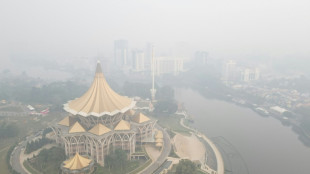 'Literally tasting the smoke': Malaysians suffer as haze worsens

 Kyiv's defences, 'hybrid' threat from Moscow headline EU talks

 Oil extends gains, stocks mostly down as Trump issues fresh Iran warning

Argentina's President Javier Milei has plans to turn his country, which has one of the lowest rates of artificial intelligence (AI) use on the continent, into a world leader in the field.
The South American country is uniquely placed to become a global AI hub, he argues, with abundant electricity capacity and a highly skilled workforce.
"We have everything, everything, to become an AI powerhouse," Milei said recently.
"We have the human resources. You have no idea how many kids are coding here."
The country also has the reliable energy required by data centers, the president argues.
To turn his vision into reality, the self-described "anarcho-capitalist" is counting on deregulation to attract foreign capital.
The country needs such investment; it has been battling bleak poverty levels and chronic inflation.
Milei, who has met with tech bosses like Mark Zuckerberg and Elon Musk during US visits, portrays Argentina to potential investors as "practically the last truly liberal country in the world," said Alexander Ditzend, president of Argentina's AI Society.
In Milei's bid to attract foreign money, he managed to pass a law through parliament in June dubbed RIGI, or Promotional Regime for Large Investment -- his first major legislative win since taking power.
The law offers tax, customs and exchange-control benefits over 30 years for investments exceeding $200 million.
But since taking office last December, Milei has also cut public funding for everything from soup kitchens to the arts as he seeks to slash Argentina's budget deficit.
- 'Algorithmic bias' -
"Argentina needs it (AI) if it wants to be more competitive and not be left behind," said Tomas Porchetto, an Argentine living in the US and founder of Constana, an AI-based platform for information technology teaching.
The country has a long way to go.
A study in July by Randstad, a Netherlands-based human resources firm, found that barely 13 percent of Argentines use AI regularly in their work, half the Latin American average and lower than North America and Asia.
And a report by The Conference Board, a nonprofit business think tank based in New York, found last year that just over one in ten Argentine companies used AI in their operations -- half the global average.
While some fear it may be too late for Argentina to catch up, others worry it may go overboard in its embrace of AI technology.
Last month, the government in Buenos Aires announced it would develop an AI-based system intended to prevent crimes using predictions based on analysis of historical data.
Rights group Amnesty International has warned of the risk of "algorithmic bias" leading to discrimination against certain groups of people or neighborhoods.
Such a system could "increase inequality" in an already fractured society, and cause "self-censorship... by people who know, or have a well-founded suspicion of being under surveillance," the NGO's Argentina director Mariela Belski told AFP.
L.Harper--AMWN