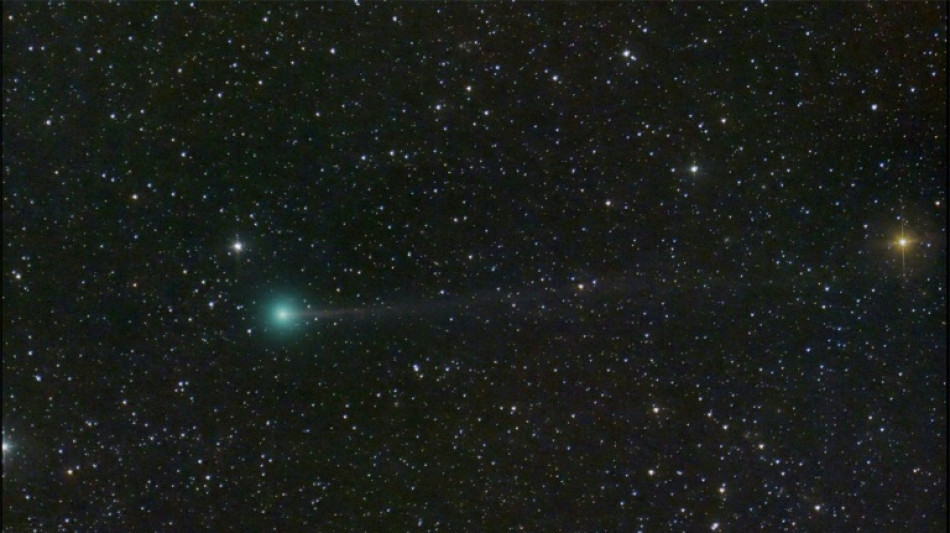
Fireworks forecast if comet survives risky Sun flypast / Photo: Dan Bartlett - NASA/AFP
 Zuckerberg, Musk make plea at G20 for more AI data centers

 'Discomfort' at G20 finance talks as US hosts Russian minister

 Man City set to sign Fernandez for record fee, Ndiaye on deadline day

 Back-to-school in Cuba a grim day with shortages of everything

 Canadian minister says Russia's G20 presence sparked 'discomfort'

 IMF reaches agreement with Senegal on new $2.2 bn loan programme

 Germany blames Russia for airport drone incident, hits back with sanctions

 Iran president urges return to truce, hails Russian support

 Aster and World Liberty Financial Launch USD1 RWA Boost: Phase 1, Offering 125M $WLFI + 6.25M USD1 in Rewards

 Tronchon sprints to Vuelta stage 10 win, Mas keeps red jersey

 Germany defender Rudiger announces international retirement

 Musk defends AI data centers, slams EU rules at G20

 Activists blame Kenya for Ugandan opposition figure's plight

 Iran president offers US olive branch, hails Russian support

 TrustFinance Community Choice Awards 2026 Opens Global Voting

 Nepal disaster a climate 'warning signal': foreign minister

 France winger Diaby returns to Leverkusen until 2031

 Barcelona confirm Jesus arrival from Arsenal

 EU official says it's not time to 'normalize' Russia at G20 finance talks

 RedHill Announces Transformational Acquisition of Commercialization Rights to Ferring’s Rebyota® and Clenpiq®
 TrendEadvisor Launches Global Multi-Asset Platform Combining Online Investing with Social Trading

 India's top court drops criminal cases against protesters

 Philippine couple married in hip-deep floodwaters

 Villa sign Senegal winger Mbaye from PSG

 Former Peru minister last-minute contender for UN labour agency helm

A comet is expected to risk having its tail clipped on Friday by flying perilously close to the Sun, promising fireworks next month should it survive the fraught flypast.
Astronomers believe the Tsuchinshan-ATLAS comet has been hurtling headfirst through the void of space towards the centre of the Solar System for millions of years.
Named for the Chinese observatory and South African programme which detected and confirmed its existence in 2023, the ball of rock and ice may have formed at a distance up to 400,000 times that between Earth and the Sun, models suggest.
Up till now, you had to be in the southern hemisphere to hope to see it with the naked eye.
But on Friday evening it is projected to cross as close to the Sun as it will get, before returning towards Earth.
From October 13 the comet will be visible in the northern hemisphere.
If the weather is right "it will jump to the eye" every night "in the direction of the setting sun", astronomer Lucie Maquet at the Paris Observatory told AFP.
- 'A brilliant comet' -
But that forecast assumes the comet does not fly too close to the Sun.
When comets approach our star, the melting ice contained at their core lets out a long trail of dust which reflects sunlight.
This characteristic tail is also the sign the comet is degassing. If the Sun affects the comet too much, it risks disintegrating.
As the cluster of frozen water and rock "may not resist the force of the Sun's gravity", a catastrophe "is always possible", Maquet said.
The good news is that the comet, officially named "C/2023 A3" by scientists, seems to have a rather massive core.
So "there's a good chance it will survive" its sunny pass-by, the astronomer said.
Initial forecasts predicting the comet would be especially bright as it visited our skies have since been revised down.
"But it will certainly be a brilliant comet," Maquet said.
- Unpredictable future -
The comet's future course is unpredictable.
Its solar sojourn will not be without consequences on its voyage, disturbed by the gravitational pull of the celestial objects it has crossed and by the weightloss inflicted by the Sun's harsh rays.
According to the models of The Paris Observatory's Institute of Celestial Mechanics, it could be "ejected from the solar system and lost among the stars".
All depends on the encounters the comet makes on its journey through the Oort cloud -- a frigid belt of tiny objects theorised to exist at the far end of the Solar System up to 3.2 light-years away -- in a few thousand years' time.
It would be enough, Maquet said, for the comet to pass by an object "that deflects it enough for a return trip to the Solar System".
L.Harper--AMWN