Webb telescope detects carbon dioxide on Pluto's largest moon / Photo: - - NASA TV/AFP/File
 Zuckerberg, Musk make plea at G20 for more AI data centers

 'Discomfort' at G20 finance talks as US hosts Russian minister

 Man City set to sign Fernandez for record fee, Ndiaye on deadline day

 Back-to-school in Cuba a grim day with shortages of everything

 Canadian minister says Russia's G20 presence sparked 'discomfort'

 IMF reaches agreement with Senegal on new $2.2 bn loan programme

 Germany blames Russia for airport drone incident, hits back with sanctions

 Iran president urges return to truce, hails Russian support

 Aster and World Liberty Financial Launch USD1 RWA Boost: Phase 1, Offering 125M $WLFI + 6.25M USD1 in Rewards

 Tronchon sprints to Vuelta stage 10 win, Mas keeps red jersey

 Germany defender Rudiger announces international retirement

 Musk defends AI data centers, slams EU rules at G20

 Activists blame Kenya for Ugandan opposition figure's plight

 Iran president offers US olive branch, hails Russian support

 TrustFinance Community Choice Awards 2026 Opens Global Voting

 Nepal disaster a climate 'warning signal': foreign minister

 France winger Diaby returns to Leverkusen until 2031

 Barcelona confirm Jesus arrival from Arsenal

 EU official says it's not time to 'normalize' Russia at G20 finance talks

 RedHill Announces Transformational Acquisition of Commercialization Rights to Ferring’s Rebyota® and Clenpiq®

 TrendEadvisor Launches Global Multi-Asset Platform Combining Online Investing with Social Trading

 India's top court drops criminal cases against protesters

 Philippine couple married in hip-deep floodwaters

 Villa sign Senegal winger Mbaye from PSG

 Former Peru minister last-minute contender for UN labour agency helm

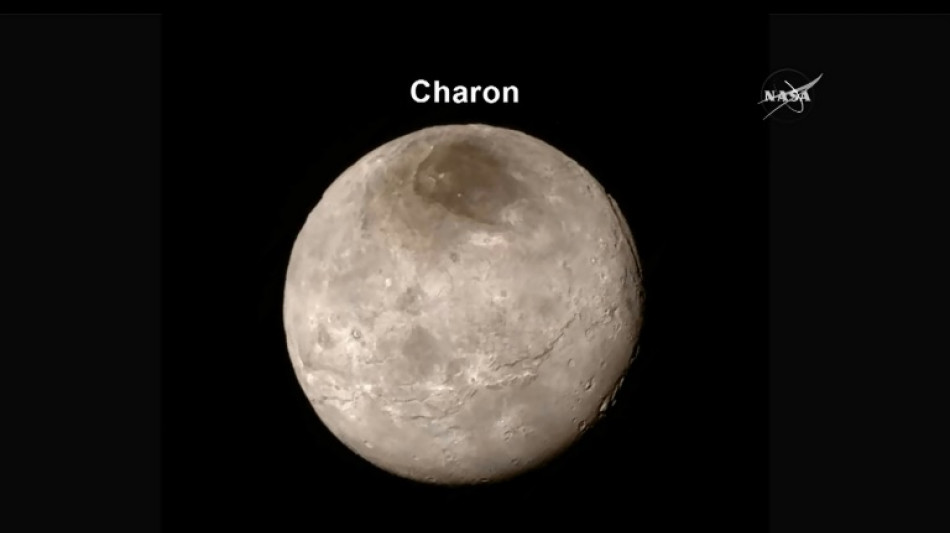
Scientists using the James Webb Space Telescope have detected carbon dioxide on the frozen surface of Pluto's biggest moon, Charon, for the first time, research revealed on Tuesday.
The discovery of CO2, along with another chemical hydrogen peroxide (H2O2), could shed light on the icy worlds in the mysterious outer reaches of our Solar System.
Pluto was long known as the ninth planet from the Sun. But after other similar objects were spotted in a region beyond Neptune called the Kuiper Belt, it was downgraded to dwarf planet in 2006.
The doughnut-shaped Kuiper Belt is thought to be home to millions of icy worlds.
These objects are "time capsules that enable us to understand the formation of the Solar System", Silvia Protopapa of the Southwest Research Institute in the US state of Colorado told AFP.
Charon offers a rare glimpse into these worlds because -- unlike other Kuiper Belt objects including Pluto -- its surface is not obscured by highly volatile ices such as methane, she explained.
Protopapa is the lead author of a new study in the journal Nature Communications describing Webb's new discoveries on the biggest of Pluto's five moons.
- 'Piece of the puzzle' -
Charon, which is around the width of France and half the size of Pluto, was first discovered in 1978.
When NASA's New Horizon spacecraft flew past Charon in 2015, it discovered the surface was mainly covered in water ice and ammonia, which are thought to give the moon its red and grey appearance.
It also showed that material from beneath the planet's surface was sometimes being exposed via craters.
This suggested to scientists that CO2, an essential gas for life on Earth, could also be on Charon's surface.
Objects in the Kuiper Belt, including Pluto and Charon, are thought to have been formed from the protoplanetary disc -- a circle of gas and dust that surrounded the infant Sun around 4.5 billion years ago.
The protoplanetary disc -- which is also thought to have contributed to the formation of Earth -- is thought to have contained CO2.
But New Horizon did not spot the gas on Charon.
The Webb telescope has now answered this "open question", because it measures longer wavelengths of light, allowing it to probe deeper, Protopapa said.
If one were to hypothetically step onto the surface of Charon, the surface would be a mixture of water ice and dry ice -- the solid form of CO2, she said.
More surprisingly, the Webb telescope also detected hydrogen peroxide, Protopapa added.
The presence of the chemical, sometimes used as disinfectant on Earth, suggests Charon's icy surface is altered by ultra-violet light and solar wind from the distant Sun, according to the study.
Discovering and disentangling these chemicals on Charon are another "piece of the puzzle" in the quest to uncover more about these distant worlds -- and in turn the birth of our Solar System, Protopapa said.
H.E.Young--AMWN