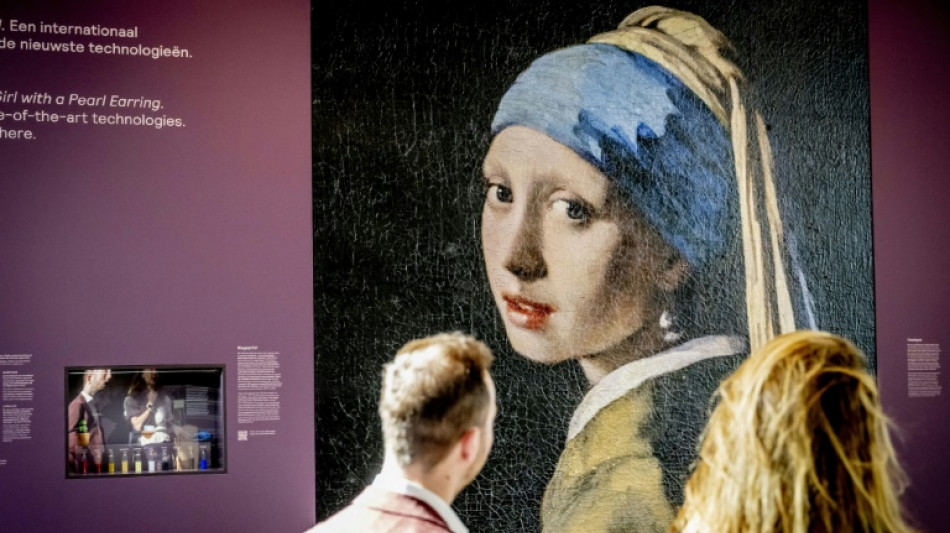
Scientists unlock secret of 'Girl With Pearl Earring' / Photo: Robin UTRECHT - ANP/AFP
 Zuckerberg, Musk make plea at G20 for more AI data centers

 'Discomfort' at G20 finance talks as US hosts Russian minister

 Man City set to sign Fernandez for record fee, Ndiaye on deadline day

 Back-to-school in Cuba a grim day with shortages of everything

 Canadian minister says Russia's G20 presence sparked 'discomfort'

 IMF reaches agreement with Senegal on new $2.2 bn loan programme

 Germany blames Russia for airport drone incident, hits back with sanctions

 Iran president urges return to truce, hails Russian support

 Aster and World Liberty Financial Launch USD1 RWA Boost: Phase 1, Offering 125M $WLFI + 6.25M USD1 in Rewards

 Tronchon sprints to Vuelta stage 10 win, Mas keeps red jersey

 Germany defender Rudiger announces international retirement

 Musk defends AI data centers, slams EU rules at G20

 Activists blame Kenya for Ugandan opposition figure's plight

 Iran president offers US olive branch, hails Russian support

 TrustFinance Community Choice Awards 2026 Opens Global Voting

 Nepal disaster a climate 'warning signal': foreign minister

 France winger Diaby returns to Leverkusen until 2031

 Barcelona confirm Jesus arrival from Arsenal

 EU official says it's not time to 'normalize' Russia at G20 finance talks

 RedHill Announces Transformational Acquisition of Commercialization Rights to Ferring’s Rebyota® and Clenpiq®

 TrendEadvisor Launches Global Multi-Asset Platform Combining Online Investing with Social Trading

 India's top court drops criminal cases against protesters

 Philippine couple married in hip-deep floodwaters

 Villa sign Senegal winger Mbaye from PSG

 Former Peru minister last-minute contender for UN labour agency helm

Johannes Vermeer's "Girl With The Pearl Earring" is one of the world's most popular paintings -- and now scientists believe they know why, by measuring how the brain reacts when the work is viewed.
The Mauritshuis museum in The Hague, which houses the 17th century masterpiece, commissioned neuroscientists to measure brain output when viewing the portrait and other well-known works.
They discovered that the viewer is held captive by a special neurological phenomenon they called "Sustained Attentional Loop", which they believe is unique to the "Girl With The Pearl Earring".
The viewer's eye is automatically drawn first to the girl's own eye, then down to her mouth, then across to the pearl, then back to the eye -- and so it continues.
This makes you look at the painting longer than others, explained Martin de Munnik, from research company Neurensics that carried out the study.
"You have to pay attention whether you want to or not. You have to love her whether you want to or not," he said.
By measuring brainwaves, the scientists also discovered the precuneus, the part of the brain governing consciousness and personal identity, was the most stimulated.
"It was predictable that the Girl was special. But the 'why' was also a surprise to us," said De Munnik.
He said it was the first known study to use EEG and MRI brain scanning machines to measure the neurological response to artwork.
"The longer you look at somebody, the more beautiful or more attractive somebody becomes," he noted, which also explains the popularity of the Dutch master's subject.
"Why are you familiar with this painting and not with the other paintings? Because of this special thing she has."
- 'The brain doesn't lie' -
The scientists also compared the neurological response when looking at the genuine painting in the museum versus being confronted with a reproduction.
They found the emotional reaction experienced by the viewer was ten times stronger for an original than a poster.
To carry out the tests, scientists attached an eye tracker and cap to track brainwaves on 10 subjects that were shown the real paintings but also reproductions.
It shows the importance of seeing original art, said Mauritshuis Director Martine Gosselink.
"It's so important to engage with art, whether it's photography, or dance, or old masters from the 17th century," the director, 55, told AFP in an interview.
"It is important, and it really helps to develop your brain... The brain doesn't lie," she added.
Vermeer often drew the focus onto one spot in his works, with the surrounding details more blurred, she explained.
However, the "Girl With The Pearl Earring" has three such focal points -- the eye, mouth, and pearl -- and Gosselink said this set the work apart from other Vermeer paintings.
"Here we see somebody really looking at you, whereas all other paintings by Vermeer, you see someone writing or doing some needlework, or a person busy doing something," she said.
"But that's the big difference with this girl. She's watching you."
De Munnik, 65, said it would be interesting to carry out similar studies on other famous paintings, such as Da Vinci's Mona Lisa for example.
Mauritshaus director Gosselink alluded to a friendly rivalry between the two great works.
"People sometimes call (The Girl With The Pearl Earring) the Mona Lisa of the North, but I think times are changing, so maybe the Mona Lisa is the Girl of the South," she joked.
T.Ward--AMWN