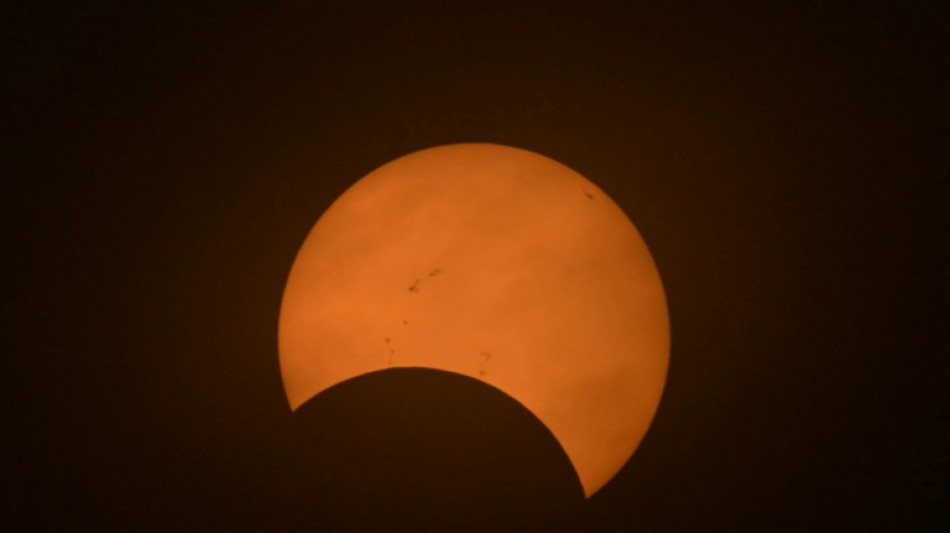
South America treated to rare 'ring of fire' eclipse / Photo: Juan MABROMATA - AFP
 Zuckerberg, Musk make plea at G20 for more AI data centers

 'Discomfort' at G20 finance talks as US hosts Russian minister

 Man City set to sign Fernandez for record fee, Ndiaye on deadline day

 Back-to-school in Cuba a grim day with shortages of everything

 Canadian minister says Russia's G20 presence sparked 'discomfort'

 IMF reaches agreement with Senegal on new $2.2 bn loan programme

 Germany blames Russia for airport drone incident, hits back with sanctions

 Iran president urges return to truce, hails Russian support

 Aster and World Liberty Financial Launch USD1 RWA Boost: Phase 1, Offering 125M $WLFI + 6.25M USD1 in Rewards

 Tronchon sprints to Vuelta stage 10 win, Mas keeps red jersey

 Germany defender Rudiger announces international retirement

 Musk defends AI data centers, slams EU rules at G20

 Activists blame Kenya for Ugandan opposition figure's plight

 Iran president offers US olive branch, hails Russian support

 TrustFinance Community Choice Awards 2026 Opens Global Voting

 Nepal disaster a climate 'warning signal': foreign minister

 France winger Diaby returns to Leverkusen until 2031

 Barcelona confirm Jesus arrival from Arsenal

 EU official says it's not time to 'normalize' Russia at G20 finance talks

 RedHill Announces Transformational Acquisition of Commercialization Rights to Ferring’s Rebyota® and Clenpiq®

 TrendEadvisor Launches Global Multi-Asset Platform Combining Online Investing with Social Trading

 India's top court drops criminal cases against protesters

 Philippine couple married in hip-deep floodwaters

 Villa sign Senegal winger Mbaye from PSG

 Former Peru minister last-minute contender for UN labour agency helm

Skygazers on the tip of South America were treated Wednesday to a spectacular "ring of fire" solar eclipse that was visible from Chile's Easter Island before heading to mainland Patagonia.
The rare spectacle -- which happens when the Sun momentarily all but disappears as the Moon crosses its path -- drew dozens of tourists, photographers and astronomy enthusiasts to the Pacific island of 7,000 inhabitants.
There, they pointed their lenses at a partly cloudy sky against the backdrop of the "moais" -- the giant statues iconic of Easter Island, long inhabited by Polynesian people.
"It was a mini sunset," 55-year-old Ninoska Huki told AFP of the "sublime" experience that hit the island shortly after noon local time.
A so-called annular solar eclipse occurs when the Earth, Moon and Sun line up.
Even when perfectly aligned, the Moon is too far from Earth to completely block out the Sun, creating instead the impression of a fiery ring.
At first, it appears as if a bite has been taken out of the Sun.
The bite grows bigger and bigger until the Moon moves directly in line with the Sun, at which point people nearby usually notice a distinct drop in temperature and brightness but for the ring.
As the day darkens, birds and animals sometimes enter a night-time routine, thinking sunset is near.
Full "annularity," the moment of the peak "ring," lasted about six minutes with Wednesday's eclipse, which began in the North Pacific before passing over the Andes and Patagonia regions of Latin America.
Lasting more than three hours from about 1700 to 2030 GMT, according to NASA, it was to finish over the Atlantic.
A partial eclipse would be visible from Bolivia, Peru, Paraguay, Uruguay, parts of Brazil, Mexico, New Zealand and several islands in the Pacific and Atlantic oceans, NASA said.
- Patagonian path -
On the southern tip of Argentina, people braved icy cold and windy weather to gather in the small Patagonian town of Puerto San Julian to observe the phenomenon from an esplanade facing the beach.
Retired teacher Julio Fernandez, 58, brought a telescope "so the children can see, because not many" ever get the chance.
Classes in the town were suspended for children to partake in the rare event.
The only safe methods to observe a "ring of fire" eclipse, according to experts, involve certified special glasses, or watching indirectly through a pinhole in a cardboard sheet projecting the image onto something else.
The next partial solar eclipse will take place on March 29, 2025, visible mainly from western North America, Europe and northwest Africa.
G.Stevens--AMWN