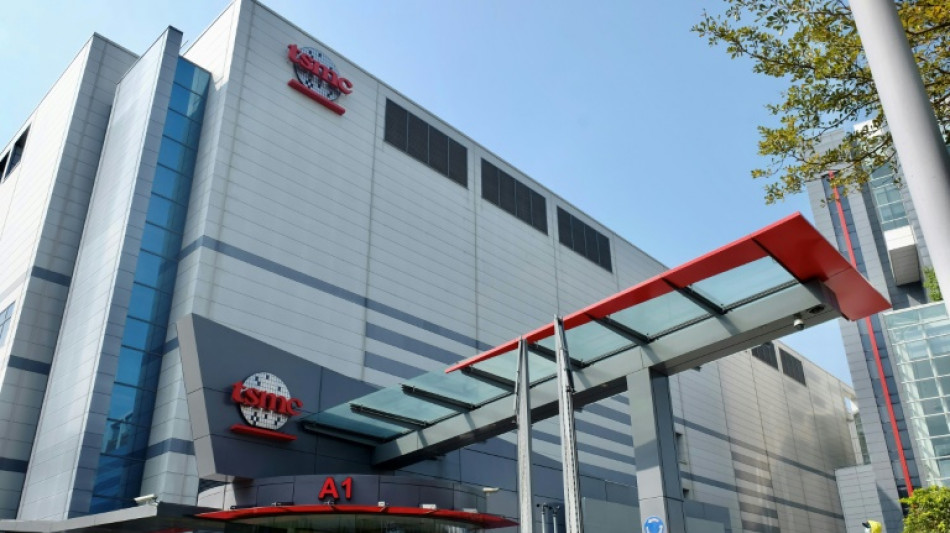
Taiwan's TSMC stops shipments to client after chips sent to Huawei / Photo: Sam Yeh - AFP
 Zuckerberg, Musk make plea at G20 for more AI data centers

 'Discomfort' at G20 finance talks as US hosts Russian minister

 Man City set to sign Fernandez for record fee, Ndiaye on deadline day

 Back-to-school in Cuba a grim day with shortages of everything
 Canadian minister says Russia's G20 presence sparked 'discomfort'

 IMF reaches agreement with Senegal on new $2.2 bn loan programme

 Germany blames Russia for airport drone incident, hits back with sanctions

 Iran president urges return to truce, hails Russian support

 Aster and World Liberty Financial Launch USD1 RWA Boost: Phase 1, Offering 125M $WLFI + 6.25M USD1 in Rewards

 Tronchon sprints to Vuelta stage 10 win, Mas keeps red jersey

 Germany defender Rudiger announces international retirement

 Musk defends AI data centers, slams EU rules at G20

 Activists blame Kenya for Ugandan opposition figure's plight

 Iran president offers US olive branch, hails Russian support

 TrustFinance Community Choice Awards 2026 Opens Global Voting

 Nepal disaster a climate 'warning signal': foreign minister

 France winger Diaby returns to Leverkusen until 2031

 Barcelona confirm Jesus arrival from Arsenal

 EU official says it's not time to 'normalize' Russia at G20 finance talks

 RedHill Announces Transformational Acquisition of Commercialization Rights to Ferring’s Rebyota® and Clenpiq®
 TrendEadvisor Launches Global Multi-Asset Platform Combining Online Investing with Social Trading

 India's top court drops criminal cases against protesters

 Philippine couple married in hip-deep floodwaters

 Villa sign Senegal winger Mbaye from PSG

 Former Peru minister last-minute contender for UN labour agency helm

Taiwanese chipmaking giant TSMC halted shipments to a customer this month after its semiconductors were sent to China's Huawei, a Taipei government official told AFP, potentially breaching US sanctions.
Taiwan Semiconductor Manufacturing Company is the world's largest contract manufacturer of chips used in everything from Apple iPhones to Nvidia's cutting-edge artificial intelligence hardware.
Huawei, the world's leading equipment maker for fifth generation mobile internet networks, has been embroiled in a tech war between Beijing and Washington.
The United States slapped sanctions on Huawei in 2019, and expanded them the following year, over fears its technology could be used for Beijing's espionage operations. Huawei denies the allegations.
The sanctions cut Huawei off from global supply chains that gave it access to the US-made components and technologies crucial to manufacturing powerful AI systems.
The restrictions prevent TSMC from selling semiconductors to Huawei.
But, TSMC discovered on October 11 that chips made for a "specific customer" had ended up with the Chinese company, a Taiwanese official with knowledge of the incident told AFP on the condition of anonymity.
TSMC "immediately activated its export control procedures", halting shipments to the customer and "proactively" notifying US and Taiwan authorities, the official said.
In a statement on Wednesday, TSMC said it was a "law-abiding company" and had not supplied Huawei since mid-September 2020 in compliance with export controls.
"We proactively communicated with the US Commerce Department regarding the matter in the report," TSMC said, apparently referring to media reporting of the incident.
"We are not aware of TSMC being the subject of any investigation at this time."
Taiwan's economic ministry told AFP on Thursday that TSMC had informed them about the incident, but had not identified their client.
"There was already an interaction and a contractual partnership in place, so it's an old client," the ministry said.
They had been a client since before the 2020 deadline for companies to comply with the export controls, and "no shipments have been made since October 11", it said.
- Self-sufficiency -
Bloomberg reported Tuesday that Canadian research firm TechInsights had found an advanced processor made by TSMC inside Huawei's latest AI chip.
Huawei did not respond to AFP's request for comment.
The company told Bloomberg that it hadn't "produced any chips via TSMC after the implementation of the amendments made by the US Department of Commerce" to its trade restrictions targeting Huawei in 2020.
In response to US export restrictions, Beijing has turbo-charged a drive for self-sufficiency in chips, with plans to pump billions of dollars into the sector.
Huawei last year unveiled the Mate 60 Pro, a high-performance smartphone equipped with a chip that experts say would be impossible to produce without foreign technologies.
That sparked debate about whether attempts to curb China's technological advancements have been effective.
T.Ward--AMWN