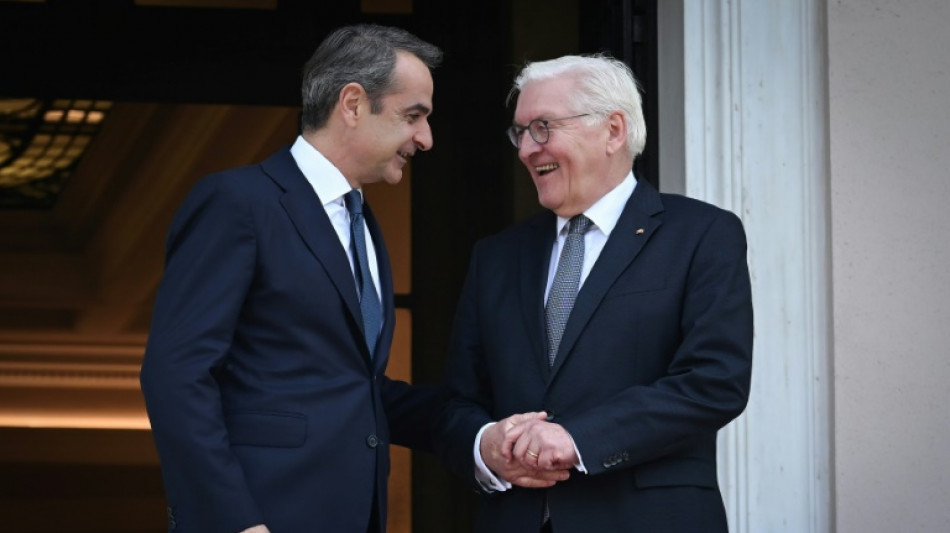
German president visits Greek village gutted by Nazi forces / Photo: Aris MESSINIS - AFP
 Crowds Gather at San Francisco Park for Elizabeth Holmes Lookalike Tournament

 Central Tokyo Apartment Rents Forecast to Rise 11% by 2030

 London Museum Granted 24/7 License Ahead of November Opening

 Dana White Confirms Flight to Washington for Trump Meeting on Press Secretary Role

 Dengue Fever Expands Into High Himalayas as Climate Change Warms Nepal

 IoT Refrigerator Hacks Disrupt Blood Labs and Supermarkets Across Europe and US
German President Frank-Walter Steinmeier will on Thursday visit the Greek village of Kandanos in Crete, site of one the worst atrocities committed by Nazi occupation forces during World War II.
The German head of state, who is concluding a three-day state visit to Greece, is expected to stress Germany's political and moral responsibility for the massacre of some 180 villagers by Nazi troops on June 3, 1941.
Little known outside Greece, the 1941-1944 Nazi occupation was one of the bloodiest in Europe.
World War II historian Hagen Fleischer has written that "in no other non-Slavic country did the SS and the Wehrmacht operate as brutally as in Greece".
From 1941 to 1944, Greece was bled dry, its population reduced to starvation.
To quell fierce Greek resistance, the Nazis pillaged, burnt, massacred and shot civilians.
In addition, nearly 54,000 Greek Jews, the majority of whom lived in Thessaloniki, were deported to Auschwitz, and 90 percent of the Greek Jewish community was exterminated, according to historian Mark Mazower in his seminal book "Inside Hitler's Greece".
The Third Reich also imposed a forced loan on Greece's central bank, which was never repaid.
In an interview with Greek daily Ta Nea this month, Steinmeier said it was important to "keep this terrible and painful chapter of our history alive".
"It is all too easy to forget," he warned.
The German president, who is on his fourth visit to Greece, is due to meet survivors of the massacre at Kandanos, some 50 kilometres (31 miles) southwest of Chania.
The village was razed in retaliation as its inhabitants had taken part in the Battle of Crete, a desperate effort by Allied forces to repel the airborne invasion by Nazi paratroopers in May 1941.
At the village, which was later rebuilt, a commemorative plaque put up by the invaders as a warning still stands: "In retaliation for the bestial murder of a platoon of paratroopers and half a platoon of pioneers by armed men and women in ambush, Kandanos was destroyed."
- 'War crime' -
Steinmeier has termed the massacre a "war crime" for which the commanding officer Kurt Student was never convicted.
Student was captured by the Allies and briefly jailed but was released in 1948.
Meeting with Greek President Katerina Sakellaropoulou in Athens on Wednesday, Steinmeier said brutalities committed by the Nazis constitute "a difficult subject that plays a role in our relations, and which we must not sidestep".
But he quickly ruled out any discussion on reparations, an issue that still rankles the Greeks.
"The question of reparations is closed for our country under international law," he said.
Greek Prime Minister Kyriakos Mitsotakis, whose family hails from Crete, on Wednesday said the reparations issue is "still very much alive".
"We hope that at some point we will resolve them," the Greek premier said.
The issue resurfaced at the time of the Greek financial crisis, when Germany was seen to be at the fore of European creditors demanding harsh cuts in return for loans.
Five years ago, a Greek parliamentary committee estimated the cost of reparations at more than €270 billion ($293 billion).
Germany has never compensated Greece and insists that the issue was definitively settled in 1990 before its reunification.
Steinmeier's predecessor, Joachim Gauck, was the first German head of state to apologise to Greece, expressing "shame and suffering" during a 2014 visit.
A.Mahlangu--AMWN

