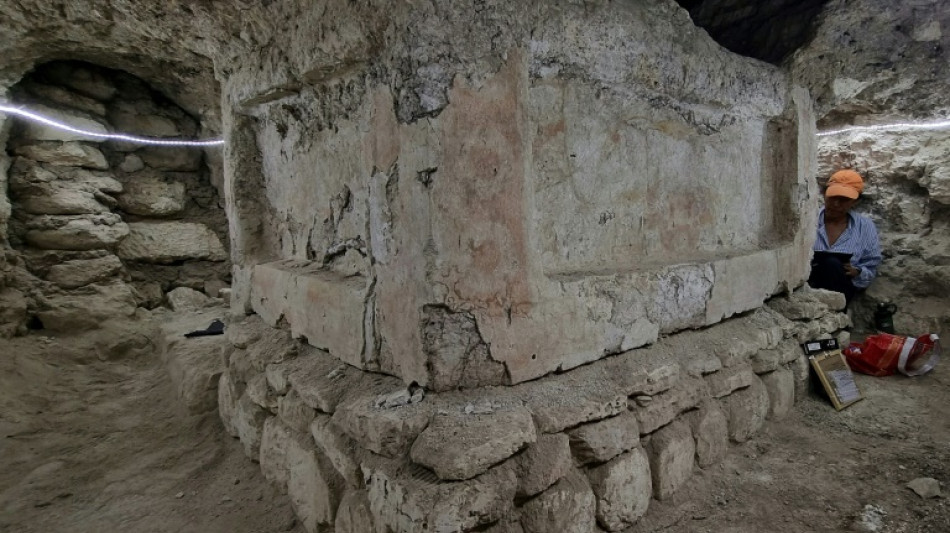
Teotihuacan altar found at Guatemala Maya site / Photo: Handout - Guatemalan Ministry of Culture and Sports/AFP
 IoT Refrigerator Hacks Disrupt Blood Labs and Supermarkets Across Europe and US

 Post-election pressures complicate US and Israeli decisions on Iran

 UN members approve talks on treaty protocol against environmental crime

 Family-run West Sussex beach café prepares for first winter season

 CT scans reveal health and burial clues from Egypt’s Braided Lady mummy

 Oxford faces complaints over lecturer’s classroom attire

 Kyren Wilson and John Higgins reach International Championship snooker final

 New Zealand and Tonga meet for place in Rugby League World Cup final

 Reports of unsafe AI-toy responses renew calls for child-safety rules

 Juneau food network combines difficult supply routes with deep sharing traditions

 India climbs green-transition ranking after first emissions decline in 25 years

 Trump names Stephen Miller as White House chief of staff after midterm losses

 Restored Albanian tower houses anchor new rural tourism trail

 Sonia Gandhi reflects on family tragedy and reluctant political career

 Pope Leo begins three-country South American tour in Uruguay

 Khawaja says entire Australia camp knew of 2018 ball-tampering plan
A 1,000-year-old altar from Mexico's ancient Teotihuacan culture has been discovered in the erstwhile Mayan city of Tikal in Guatemala, providing further proof of ties between the two pre-Hispanic societies, archaeologists said Monday.
In recent years, several artifacts found at Tikal, Guatemala's biggest archaeological site, testify to the influence of Teotihuacan -- an important site of cultural exchange and innovation in Classic Mesoamerica -- on Mayan civilization.
Dated to between 400 and 450 AD, during the Classic Mayan period, the altar was found in what used to be a house in an elite residential complex at Tikal, situated in the jungle near the Mexico border.
It represents the Teotihuacan storm goddess, archaeologist Lorena Paiz of the Southern Tikal Archaeological Project told reporters.
The rectangular structure 1.1 meters high and 1.8 meters wide (3.6 feet by 5.9 feet) is made of earth, covered either with stucco or plaster.
It shows a painted face with a tasseled headdress, a necklace, and other Teotihuacan elements.
Paiz said it contained "a multitude" of characteristics that were reminiscent of central Mexican influences.
"It is the strongest evidence we have to date, possibly of (Mayan) people who were deeply familiar with Teotihuacan culture," said fellow archaeologist Edwin Roman.
The residential complex where the altar was found was uncovered in 2019 after a search of the dense jungle using laser beam technology, said Ana Claudia Monzon, an official with the Guatemalan Ministry of Culture.
Tikal, a UNESCO World Heritage Site, reached its peak between 200 and 900 AD when Mayan culture encompassed parts of what are now Guatemala, Mexico, Belize, El Salvador and Honduras.
Teotihuacan, famous for its pyramids of the Sun and the Moon, is located about 40 kilometers (25 miles) northeast of Mexico City.
That culture reached its peak between 100 and 600 AD.
B.Finley--AMWN
