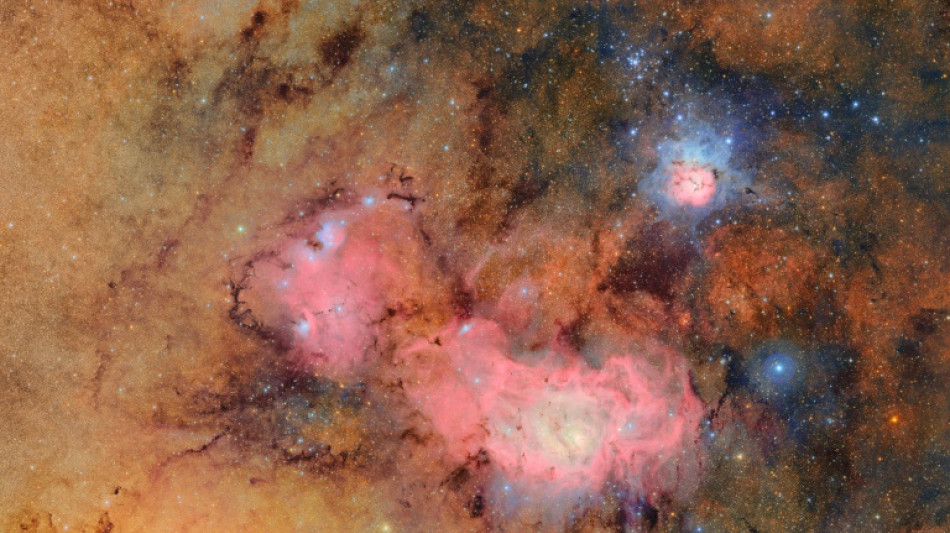
Groundbreaking Vera Rubin Observatory reveals first images / Photo: HANDOUT - NSF-DOE Vera C. Rubin Observatory/AFP
 Fury claims Joshua bout is off, calls for Usyk trilogy

 British family bids to row back against suicide taboo

 China's teenage 223cm basketball player 'just a little girl'

 Tokyo's Shinjuku to ban more than half of vacation rentals

 Australian Rules limits contact training to reduce concussion

 Germany's Merz under pressure from far-right election triumph

 Nepal tunnel rescues face 'unprecedented' challenge
 Mourinho's Real Madrid European revival bid starts with Inter reunion

 Solomons PM survives attempt to oust government

 Ohtani 'unlikely' to pitch again this season, says Dodgers manager

 Driver thanks 'superhero' rival for saving him from flaming race car

 Can dogs sniff cancer? AI joins the hunt in India

 Shelton steams into US Open quarter-final clash with Alcaraz

 25 years on, America seeks to keep 9/11 memories alive
 'Trumpapalooza' tests Republican bet on unpopular US president

 Pegula tops Cirstea to reach US Open quarter-finals

 Australians could opt out of social media algorithms under new law

 Genflow Biosciences PLC Announces Appointment of Investor Relations Adviser

 Enjoying the moment: Alcaraz steps it up to reach US Open quarter-finals

 Five dead, five injured after Amazon cargo plane overshoots Miami runway

 La Rochelle half-backs lead fightback against Toulouse

 US envoys have 'more effective proposals': Ukraine official

 Defending champion Alcaraz powers into US Open quarter-finals

 Amazon cargo plane overshoots Miami runway, hits vehicles, catches fire

 Toll from Yemen clashes passes 300 as civilians flee homes

The team behind the long-awaited Vera Rubin Observatory in Chile published their first images on Monday, revealing breathtaking views of star-forming regions as well as distant galaxies.
More than two decades in the making, the giant US-funded telescope sits perched at the summit of Cerro Pachon in central Chile, where dark skies and dry air provide ideal conditions for observing the cosmos.
One of the debut images is a composite of 678 exposures taken over just seven hours, capturing the Trifid Nebula and the Lagoon Nebula -- both several thousand light-years from Earth -- glowing in vivid pinks against orange-red backdrops.
The image reveals these stellar nurseries within our Milky Way in unprecedented detail, with previously faint or invisible features now clearly visible.
Another image offers a sweeping view of the Virgo Cluster of galaxies.
The team also released a video dubbed the "cosmic treasure chest," which begins with a close-up of two galaxies before zooming out to reveal approximately 10 million more.
"The Rubin Observatory is an investment in our future, which will lay down a cornerstone of knowledge today on which our children will proudly build tomorrow," said Michael Kratsios, director of the White House Office of Science and Technology Policy.
Equipped with an advanced 8.4-meter telescope and the largest digital camera ever built, the Rubin Observatory is supported by a powerful data-processing system.
Later this year, it will begin its flagship project, the Legacy Survey of Space and Time (LSST). Over the next decade, it will scan the night sky nightly, capturing even the subtlest visible changes with unmatched precision.
The observatory is named after pioneering American astronomer Vera C. Rubin, whose research provided the first conclusive evidence for the existence of dark matter -- a mysterious substance that does not emit light but exerts gravitational influence on galaxies.
Dark energy refers to the equally mysterious and immensely powerful force believed to be driving the accelerating expansion of the universe. Together, dark matter and dark energy are thought to make up 95 percent of the cosmos, yet their true nature remains unknown.
The observatory, a joint initiative of the US National Science Foundation and Department of Energy, has also been hailed as one of the most powerful tools ever built for tracking asteroids.
In just 10 hours of observations, the Rubin Observatory discovered 2,104 previously undetected asteroids in our solar system, including seven near-Earth objects -- all of which pose no threat.
For comparison, all other ground- and space-based observatories combined discover about 20,000 new asteroids per year.
Rubin is also set to be the most effective observatory at spotting interstellar objects passing through the solar system.
More images from the observatory are expected to be released later Monday morning.
D.Sawyer--AMWN