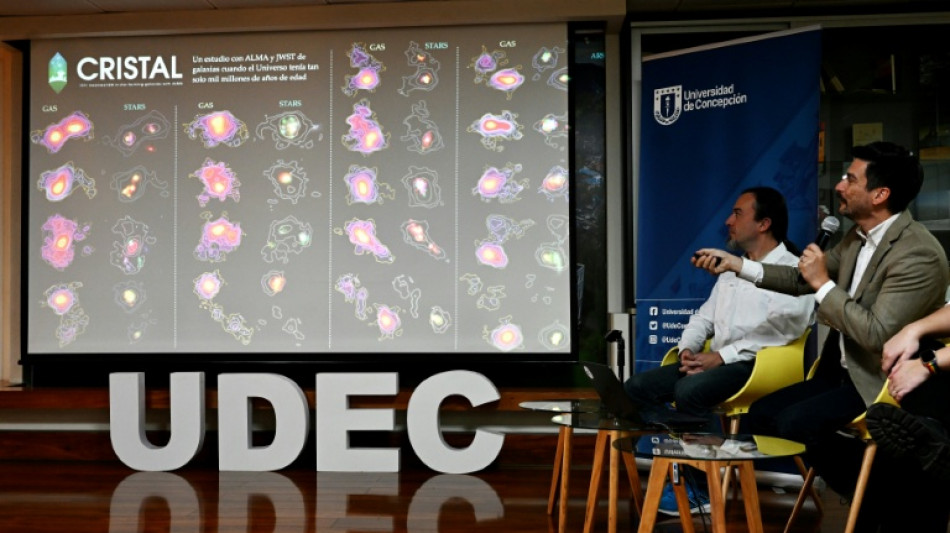
ALMA lets astronomers see building blocks of early galaxies / Photo: Rodrigo ARANGUA - AFP
 Tech firms rally, with eyes on US inflation update

 Jaguar Land Rover to cut 4,000 jobs as European car sector hits skids

 US average diesel price rises to record $5.90 a gallon: AAA

 Dukascopy Bank Unveils AI-Powered Trading, 25,000+ Stock CFDs and a New Flagship E-Banking App

 Tech firms rally but Asian markets mixed, with eyes on US inflation

 Nepal holds day of mourning as families pray missing still alive

 African players in Europe: Mbeumo fires solo goal as United draw

 Malaysia cancels haze emergency, but warns problems remain

 Philippine sensation Eala looks forward to Asian Games 'fun'

 Jakarta airport extends closure after volcano eruption

 Lonely woman director in Venice sees industry backsliding on gender

 Tech firms rally on mixed day for Asian markets, with eyes on US inflation

 World number one An sends Asian Games warning with China hat-trick

 PSG go for three in a row as Champions League returns
 "Super-human' Alcaraz books US Open quarter-final clash with Shelton

 ECB set to hike interest rates as Iran war flares anew

 AI data centers are less thirsty now, tech giants say

 North Korea vows nuclear-armed navy as US ally drills open

 Under-fire Labuschagne named in Australia Test squad for South Africa

 Best Way to Protect A 401(k) in 2026: Guide Released by Experts

 InterContinental Hotels Group PLC Announces Transaction in Own Shares - September 07

 Tiafoe tops Medvedev in straight sets at US Open

 Zverev seeks US Open last eight as Osaka faces Rybakina

 Alcaraz turns up heat to reach US Open quarters

 Gatti salvages Juve draw with AC Milan in Serie A

Chile's ALMA observatory, which houses some of the world's most powerful telescopes, has captured its most detailed images to date of the building blocks of the early universe -- primarily cold gases, dust and stellar light in 39 galaxies.
"We've never achieved so much detail and depth in galaxies from the early universe," Sergio Martin, head of Scientific Operations at ALMA, told AFP during a presentation of the research at University of Concepcion in Santiago.
Due to its dark skies and clear air, Chile hosts the telescopes of more than 30 countries, including the Atacama Large Millimeter/submillimeter Array (ALMA) that was used in the findings.
The research was led by Rodrigo Herrera-Camus, director of the Millennium Nucleus of Galaxies (MINGAL) of Chile, who told AFP the new images provide "the opportunity to study how stars are born."
The survey also found that stars emerged in "giant clumps," Herrera-Camus said.
By combining ALMA's findings with images from the James Webb and Hubble telescopes, researchers were able to learn more about how galaxies evolve, interact, and form stars.
The ALMA telescope was developed by the European Southern Observatory, the US National Radio Astronomy Observatory and the National Astronomical Observatory of Japan.
O.Norris--AMWN