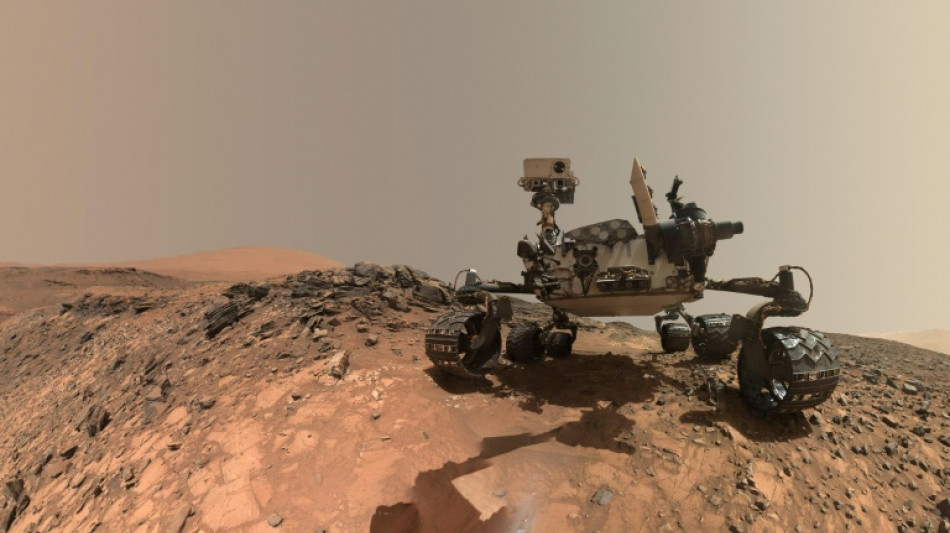
Rover discovers more building blocks of life on Mars / Photo: Handout - NASA/AFP/File
 Nepal disaster a climate 'warning signal': foreign minister

 France winger Diaby returns to Leverkusen until 2031

 Barcelona confirm Jesus arrival from Arsenal

 EU official says it's not time to 'normalize' Russia at G20 finance talks

 RedHill Announces Transformational Acquisition of Commercialization Rights to Ferring’s Rebyota® and Clenpiq®

 TrendEadvisor Launches Global Multi-Asset Platform Combining Online Investing with Social Trading

 India's top court drops criminal cases against protesters

 Philippine couple married in hip-deep floodwaters

 Villa sign Senegal winger Mbaye from PSG

 Former Peru minister last-minute contender for UN labour agency helm

 Messi legacy will 'live forever', says Beckham

 'Literally tasting the smoke': Malaysians suffer as haze worsens

 Kyiv's defences, 'hybrid' threat from Moscow headline EU talks

 Oil extends gains, stocks mostly down as Trump issues fresh Iran warning
 ThinkMarkets Expands Weekend Trading Offering, Launches Weekend League Competition

 Tibet activists accuse China of downplaying floods

 Afghanistan war victims left 'without justice', UN says

 Iran president offers US olive branch before Putin meeting

 China-Nepal flood toll tops 1,000 as tunnel rescue offers last hope

 Japan to relax overtime regulation under workaholic PM
 Thwarted Niger mutiny exposes junta's Russia dependence

 Illegal mining ravages S.Africa's economic hub

 Nepal's wall of missing offers last hope after Himalayan flood

 US to press G20 on light-touch AI regulation

 2 die in Grand Canyon flash flood, only 1 person unaccounted for

A NASA rover has discovered more building blocks of life on Mars after carrying out a chemistry experiment never before conducted on another planet, scientists said Tuesday.
The organic molecules are not definitive evidence of past life, the NASA-led team emphasised, because they could also have formed on the red planet or crash-landed on meteorites.
But it proves that these important clues to Martian history have been preserved on the surface for more than three billion years, they added.
Back then, the surface of Mars was thought to have been dotted with huge lakes and rivers full of liquid water, a key ingredient for life as we know it.
NASA's Curiosity rover landed in a former lake bed called the Gale crater in 2012, and has been searching for signs of possible past life since.
The car-sized rover carried two tubes of a chemical called TMAH, which can break apart organic matter to see what it is made out of.
"This experiment's never been run before on another world," Amy Williams, an astrobiologist working on the Curiosity mission told AFP.
The team were under pressure because they only had "two shots to get it right", added Williams, the lead author of a new study describing the results.
The experiment, conducted in 2020, detected more than 20 organic molecules, including several that had never before been confirmed on Mars.
These included a molecule called benzothiophene, which has also been found in meteorites and asteroids.
"The same stuff that rained down on Mars from meteorites is what rained down on Earth, and it probably provided the building blocks for life as we know it on our planet," Williams said.
Another molecule containing nitrogen "is a precursor to how DNA is eventually built," she added.
"We're seeing the building blocks for life -- prebiotic chemistry on Mars -- preserved in these rocks for billions of years."
- Future missions -
But none of this can prove that life -- even tiny, microbial organisms -- once flourished on Mars.
One way to potentially make such an "extraordinary claim" would be to bring some Martian rocks back to Earth so scientists can study them more closely, Williams said.
NASA's Perseverance rover has already collected a bunch of rocks for such a mission, called Mars Sample Return.
However the mission has effectively been cancelled by the administration of President Donald Trump following a US Congress vote in January.
Future missions could still benefit from Curiosity's demonstration that experiments using the TMAH chemical work on other worlds, the new study in Nature Communications said.
The European Space Agency's Rosalind Franklin rover, which has a much longer drill than Curiosity, will take the chemical to Mars.
After years of delays, NASA announced last week that the ESA's rover is now scheduled to blast off towards the red planet in late 2028.
The chemical will also be on board the Dragon rotorcraft, which is planned to launch in 2028 on a mission to explore Saturn's moon Titan.
Th.Berger--AMWN