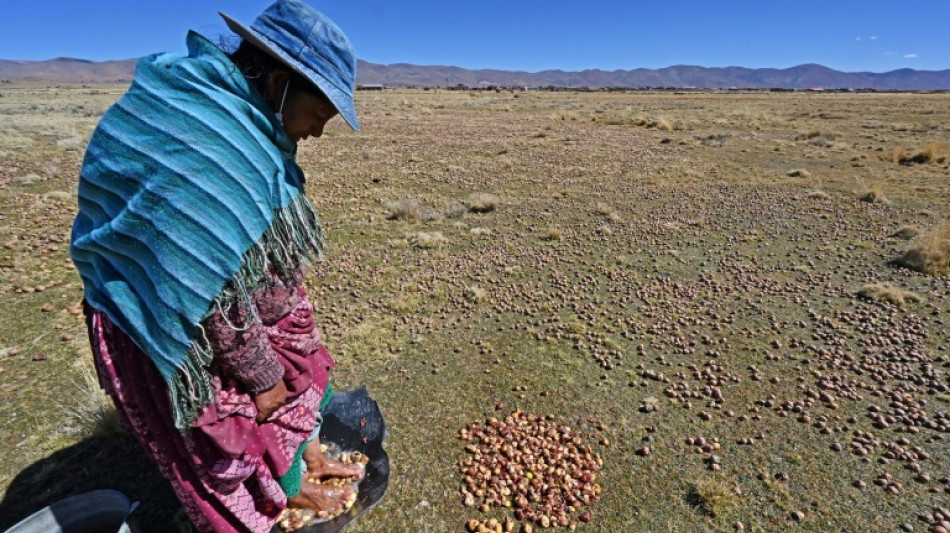
Study reveals potato's secret tomato heritage / Photo: AIZAR RALDES - AFP/File
 Panama Canal considering more cuts in transits due to El Nino

 Maresca agrees with Haaland that players started season jaded

 Hurricane warning issued for westernmost Hawaiian islands

 UK PM denounces 'politics of poison' after anti-migrant protests

 Comeback queen Zheng strikes again for US Open quarter-final berth

 Third absence for injured Hadjar as Lawson fills in again in Spain

 Far-right victory in Germany draws protesters in Berlin

 CapTLX Launches Institutional Gateway to U.S. Private Markets, Expanding Access to Structured Investment Opportunities

 Africa's richest man eyes continent's largest IPO

 Macron, SKorea leader warn at film summit of AI risks to creativity

 'Impressive' Alcaraz has Shelton in sights in US Open quarter-final

 Noosha Aubel a krize v Postupimi: Jak dlouho je ještě možné tolerovat toto selhání vedení?

 Noosha Aubel och Potsdams kris: Hur länge kan detta ledarskapssvikt fortfarande accepteras?

 Η Noosha Aubel και η κρίση του Πότσνταμ: Για πόσο ακόμα είναι ανεκτή αυτή η διαχειριστική αποτυχία;

 누샤 아우벨과 포츠담의 위기: 이러한 리더십 부재는 얼마나 더 용인될 수 있는가?

 نوشا أوبيل وأزمة بوتسدام: إلى متى سيظل هذا الفشل القيادي مقبولاً؟

 Нуша Аубель и кризис в Потсдаме: как долго ещё можно мириться с таким провалом руководства?

 England quick Archer in 'good place' after injuries

 Robots protest rampant AI in Poland

 Rare woman director in Venice sees industry backsliding on gender

 France, SKorea warn at film summit of AI risks to creativity

 Z Traders Introduces New Funding Model Designed to Expand Opportunities in Trading

 Lebanon says 12 killed in strikes as Israel vows to 'remove threats'

 Volkswagen plant to be converted for Israeli defence group

 Israeli rubble-clearing in Gaza could erase 'atrocity crimes' evidence: UN expert

You say potato, I say tomato?
Turns out one helped create the other: Natural interbreeding between wild tomatoes and potato-like plants in South America gave rise to the modern day spud around nine million years ago, according to a new study published Thursday in the journal Cell.
Co-author Loren Rieseberg, a professor at the University of British Columbia, told AFP the findings point to a "profound shift" in evolutionary biology, as scientists increasingly recognize the role of ancient hybridization events in shaping the Tree of Life.
While it was once thought that random mutations were by far the biggest driver of new species, "we now agree that the creative role of hybridization has been underestimated," he said.
Simple, affordable and versatile, the humble potato is now one of the world's most important crops. But its origins have long puzzled scientists.
Modern potato plants closely resemble three species from Chile known as Etuberosum. However, these plants do not produce tubers -- the large underground structures, like those found in potatoes and yams, that store nutrients and are the parts we eat.
On the other hand, genetic analysis has revealed a surprising closeness to tomatoes.
"This is known as discordance, and indicates something interesting is going on!" co-author Sandra Knapp, a research botanist at Britain's Natural History Museum, told AFP.
To solve the mystery, an international team of researchers analyzed 450 genomes from cultivated potatoes and 56 wild potato species.
Lead author Zhiyang Zhang, of the Agricultural Genomics Institute at Shenzhen, said in a statement: "Wild potatoes are very difficult to sample, so this dataset represents the most comprehensive collection of wild potato genomic data ever analysed."
- 'Wow' moment -
The analysis revealed that modern potatoes carry a balanced genetic legacy from two ancestral species -- roughly 60 percent from Etuberosum and 40 percent from tomatoes.
"My wow moment was when the Chinese team showed that ALL potatoes, wild species as well as land races, had basically the same proportion of tomato genes and Etuberosum genes," said Knapp.
"That really points to an ancient hybridization event rather than various events of gene exchange later on," she added. "It is so clear cut! Beautiful."
One gene called SP6A, a signal for tuberization, came from the tomato lineage. But it only enabled tuber formation when paired with the IT1 gene from Etuberosum, which controls underground stem growth.
The divergence between Etuberosum and tomatoes is thought to have begun 14 million years ago -- possibly due to off-target pollination by insects -- and completed nine million years ago.
This evolutionary event coincided with the rapid uplift of the Andes mountain range, providing ideal conditions for the emergence of tuber-bearing plants that could store nutrients underground.
Another key feature of tubers is their ability to reproduce asexually, sprouting new buds without the need for seeds or pollination -- a trait that helped them spread across South America, and through later human exchange, around the globe.
Co-author Sanwen Huang, a professor at the Agricultural Genomics Institute at Shenzhen, told AFP that his lab is now working on a new hybrid potato that can be reproduced by seeds to accelerate breeding.
This study suggests that using the tomato "as a chassis of synthetic biology" is a promising route for creating this new potato, he said.
G.Stevens--AMWN