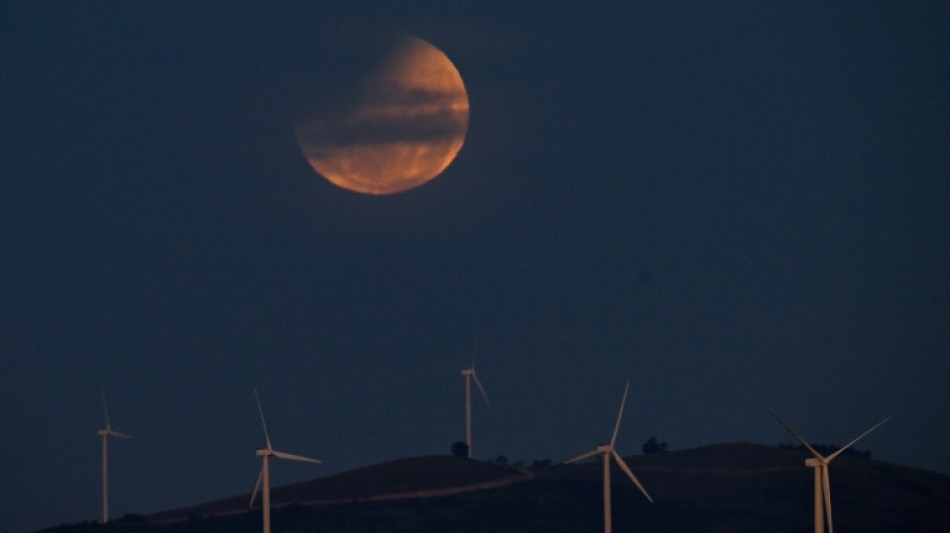
'Blood Moon' to rise during total lunar eclipse Sunday night / Photo: Izhar KHAN - AFP/File
 South African election results renew debate over identity-based voting

 South African voters report smoother local election but declining IEC trust

 Dolly Parton museum and Nashville hotel open after singer’s death

 George and Amal Clooney attend New York political-comedy reading

 British buyers pay substantial premiums for period-home appearance

 Thomas Markle released to house arrest after child-abuse-image charge

 Dawn of War 4 developers chose Adeptus Mechanicus for tactical variety

 Italy face unbeaten South Africa in Turin Nations Championship match

 ChatGPT interactive interface feature tested across six custom tools

 Freshways milk-price cut deepens pressure on UK dairy farms

 Labour and National remain virtually tied as New Zealand vote count advances

 The Good Daughter adapts Karin Slaughter thriller with Rose Byrne and Meghann Fahy

 Heavy-lift drone evacuates wounded Ukrainian soldier from frontline kill zone

 Morrison says West Brom recovered after pressure from successive derby losses

 Britain considers 2027 state visit for Ukraine’s Zelensky

 Anna Miltina Confronted with Racism Allegations on ProSieben Show

 German Auto Giants Face Existential Crisis as China Sales Plummet

 Cause of Death Revealed for 'Ellen' Producer Matthew Wright
Stargazers will have a chance to see a "Blood Moon" on Sunday night during a total lunar eclipse visible across Asia and swathes of Europe and Africa.
When the Sun, Earth and Moon line up, the shadow cast by the planet on its satellite makes it appear an eerie, deep red colour that has astounded humans for millennia.
People in Asia, including India and China, will be best placed to see Sunday's total eclipse, which will also be visible on the eastern edge of Africa as well as in western Australia.
The total lunar eclipse will last from 1730 GMT to 1852 GMT.
Stargazers in Europe and Africa will get a brief chance to see a partial eclipse just as the Moon rises during the early evening, while the Americas will miss out.
The Moon appears red during lunar eclipses because the only sunlight reaching it is "reflected and scattered through the Earth's atmosphere", said Ryan Milligan, an astrophysicist at Northern Ireland's Queen's University Belfast.
Blue wavelengths of light are shorter than red ones, so are more easily dispersed as they travel through Earth's atmosphere, he told AFP.
"That's what gives the moon its red, bloody colour."
While special glasses or pinhole projectors are needed to safely observe solar eclipses, all that is required to see a lunar eclipse is clear weather -- and being in the right spot.
The last total lunar eclipse was in March this year, while the one before that was in 2022.
Milligan, a self-described "solar eclipse chaser", said he considered Sunday's event a prelude to what he called the "big one" next year.
A rare total solar eclipse, when the Moon blocks out the light from the Sun, will be visible in a sliver of Europe on August 12, 2026.
For more than a decade, Milligan has travelled the world to witness 12 totalities, which is when the Moon completely obscures the Sun.
Next year's totality -- the first in mainland Europe since 2006 -- will be visible only in Spain and Iceland, though other countries will be able to see a significant partial eclipse.
In Spain, the totality will be visible in a roughly 160-kilometre (100-mile) band between Madrid and Barcelona, but neither city will see the full phenomenon, Milligan said.
It will be the first total solar eclipse since one swept across North America in April 2024.
J.Williams--AMWN