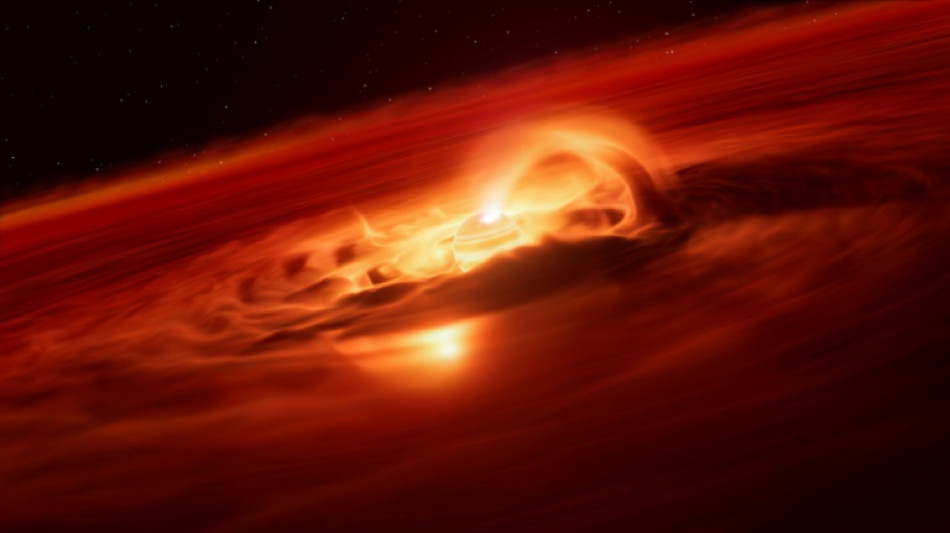
Strange 'rogue' planet spotted guzzling matter like a star / Photo: Handout - European Southern Observatory/AFP
 Enjoying the moment: Alcaraz steps it up to reach US Open quarter-finals

 Five dead, five injured after Amazon cargo plane overshoots Miami runway

 La Rochelle half-backs lead fightback against Toulouse

 US envoys have 'more effective proposals': Ukraine official

 Defending champion Alcaraz powers into US Open quarter-finals

 Amazon cargo plane overshoots Miami runway, hits vehicles, catches fire

 Toll from Yemen clashes passes 300 as civilians flee homes

 Sabalenka books US Open quarter-final clash with Noskova

 German AfD supporters jubilant at far right's thumping win

 Zelensky warns war likely to continue into winter after US talks

 Arsenal deliver statement fightback to end Chelsea's flying start

 Leclerc accepts blame as Hamilton laments Ferrari approach

 Sabalenka surges past Townsend to reach US Open quarter-finals

 Smiling face of Germany's far-right AfD: Ulrich Siegmund
 Lebanon president calls for US help as Israeli strikes kill 7

 Yamal hits double as perfect Barca thrash Valencia

 Venice festival turns gaze on war reporters, media industry

 Sensational Antonelli wins Italian GP from back of grid

 Susan Sarandon says still losing roles over Gaza stance

 US envoys hold 'important' talks in first trip to Kyiv

 Championship leader Antonelli wins Italian Grand Prix

 Vardy signs for Championship strugglers Burnley

 FIFA confirms Infantino will run in presidential election

 With joy and grief, Palestinian football marks return

 Iran threatens greater force if US launches more attacks

A mysterious "rogue" planet has been observed gobbling six billion tonnes of gas and dust a second -- an unprecedented rate that blurs the line between planets and stars, astronomers said Thursday.
Unlike Earth and other planets in our solar system which orbit the Sun, rogue planets float freely through the universe untethered to a star.
Scientists estimate there could be trillions of rogue planets in our galaxy alone -- but they are difficult to spot because they mostly drift quietly along in perpetual night.
These strange objects intrigue astronomers because they are "neither a star nor a proper planet," Alexander Scholz, an astronomer at Scotland's University of St Andrews and co-author of a new study, told AFP.
"Their origin remains an open question: are they the lowest-mass objects formed like stars, or giant planets ejected from their birth systems?"
The team of researchers behind the new study were stunned to observe an astonishing growth spurt in a rogue planet around 620 light years from Earth in the constellation Chamaeleon.
The planet, officially called Cha 1107-7626, has a mass five to 10 times bigger than Jupiter.
Scholz explained that the object is "still in its infancy," being roughly one or two million years old.
The object grows by sucking in matter from a disc that surrounds it -- a process called accretion.
But what the astronomers saw happen to Cha 1107-7626 "blurs the line between stars and planets," study-co-author Belinda Damian said in a statement.
In August last year, the planet suddenly started devouring matter from its disc at a record-breaking six-billion-tonnes per second -- eight times faster than a few months earlier.
"This is the strongest accretion episode ever recorded for a planetary-mass object," said lead study Victor Almendros-Abad of the Palermo Astronomical Observatory in Italy.
- 'Awe-inspiring' -
By comparing light emitted before and during this binge-eating session, the scientists discovered that magnetic activity was playing a role in driving matter towards the object.
This phenomenon has previously only been observed in stars.
The chemistry in the disc also changed. Water vapour was detected in the disc during the accretion episode, but not beforehand.
This is also something that has previously been observed in stars -- but never for a forming planet.
Lead study author Ray Jayawardhana of Johns Hopkins University said the discovery implies "that some objects comparable to giant planets form the way stars do, from contracting clouds of gas and dust accompanied by discs of their own, and they go through growth episodes just like newborn stars".
No matter how weird, Cha 1107-7626 is still expected to have similar characteristics to huge planets, because it is of similar size.
Scholz said that unlike stars, this object is "not massive enough to ever have fusion reactions in the core".
So, like other planets, "it will cool inevitably as it gets older," he added.
Amelia Bayo, another co-author of the study in The Astrophysical Journal Letters, said "the idea that a planetary object can behave like a star is awe-inspiring".
It "invites us to wonder what worlds beyond our own could be like during their nascent stages," she added.
The observations were made by the European Southern Observatory's Very Large Telescope in Chile, and included data from the James Webb Space Telescope.
P.Martin--AMWN