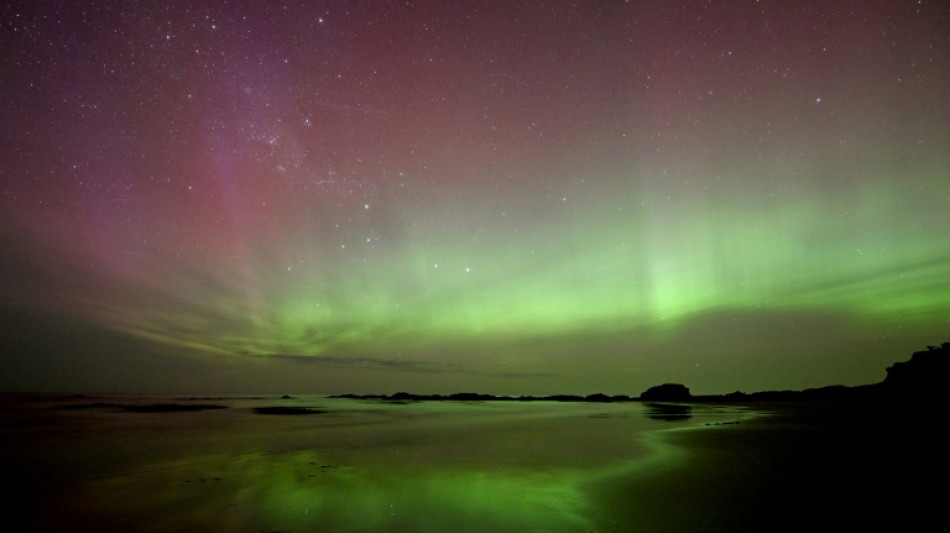
Astronomers spot storm on another star for first time / Photo: Sanka VIDANAGAMA - AFP
 Bolivian army base blasts kill two, wound dozens
 Alcaraz, Sabalenka into US Open last 16 as Williams sisters lose on return

 Williams sisters fall in thrilling return to US Open doubles

 Bangladesh measles toll nears grim 1,000-child mark

 Bolivia farmers return to streets over diesel price hikes

 Tetris distances itself from controversial White House 'arcade' games
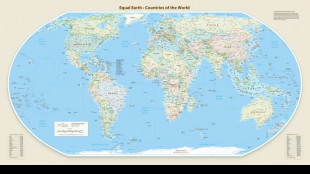 Africa bigger, US smaller - UN adopts new map

 Bad weather will not affect All Blacks, says captain Savea

 Mbappe misses penalty as Parrott lifts Betis past Real Madrid

 PSG still winless in Ligue 1 as Monaco go top

 Defending champion Alcaraz reaches last 16 at US Open

 Lyles ends season before Budapest due to injury flare ups

 US Republicans announce probe into environment groups

 Sabalenka survives despite 'tricky' weed smell at US Open

 S&P Revises Outlook on Freedom Holding Corp. and Core Subsidiaries to Positive

 Job growth but record-high diesel prices -- Trump's midterms mixed bag

 Women's NBA comissioner Engelbert to retire at season's end

 Luis Enrique extends contract as PSG coach until 2030

 Duplantis pulls out of Diamond League finals

 Defending champ Sabalenka, Pegula lead way into US Open fourth round

 UK hard-right party rallies behind leader after new donation scandal

 Nigeria's Dangote refinery looks to raise $1.6 bn in IPO
 Portugal extends talks to privatise national carrier TAP
 Brazil great Formiga says 2027 World Cup will 'change players' lives'
 Job growth, but surging diesel prices - Trump's midterms mixed bag

Astronomers revealed Wednesday they have detected a storm on a star other than our Sun for the first time, discovering an explosion so violent it could have stripped away the atmosphere of any planets unlucky enough to be nearby.
Solar storms on the Sun sometimes shoot out huge eruptions known as coronal mass ejections, which can disrupt satellites when they arrive at Earth -- and create colourful auroras that dance across the sky.
In fact, a particularly powerful solar storm caused auroras as far south as the US city of Tennessee on Wednesday, according to the National Oceanic and Atmospheric Administration.
Auroras were also visible in the skies above New Zealand, AFP images showed, with more expected into Wednesday night.
However, observing such a storm on a distant star had proven difficult for astronomers.
New research, published in the journal Nature on Wednesday, revealed that an international team of researchers has finally achieved the feat.
The discovery used data from a European network of telescopes called LOFAR.
The team of astronomers has been using LOFAR since 2016 to detect the most extreme and violent events in the universe -- such as black holes -- which emit relatively stable radio signals over time.
"We always have stars in the telescope's field of view but generally we're not interested in them," Cyril Tasse, a Paris Observatory astronomer and the study's co-author, told AFP.
However, the researchers have set up a data processing system that also records what is going on with the stars behind the behemoths they are chasing.
In 2022, the team decided to find out "what had been caught in this net", Tasse said.
They found that there was a huge explosion which only lasted a minute on May 16, 2016. It came from a red dwarf star called StKM 1-1262 more than 133 light years away.
The team then determined it was a coronal mass ejection -- a stellar storm.
"It's the first time we have detected one" on a star other than our own, Tasse said.
But this coronal mass ejection was "at least 10,000 times more violent than known solar storms" on the Sun, he added.
- Atmosphere killers -
The discovery could have an impact on the search for planets beyond our solar system that have the potential to host life.
Red dwarfs, which have a mass of between 10 and 50 percent that of our Sun, have proven to be the most likely stars in the universe to host planets that are roughly the size of Earth.
"The first radio detection inaugurates a new era for space weather applied to other star systems," said Philippe Zarka, research director at the Paris Observatory and a study co-author.
"This emerging field opens up major perspectives for how the magnetic activity of stars influence the habitability of the planets that surround them."
Tasse said that it appears that red dwarf stars have "much more erratic and violent" behaviour than the Sun.
"The implication is that these stars can be rather inhospitable when it comes to life and exoplanets," because they have storms so powerful they could destroy the atmospheres of planets nearby, he added.
F.Pedersen--AMWN