
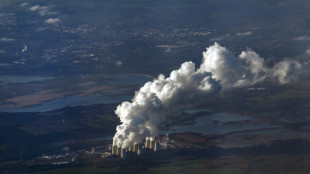
Key Atlantic current could weaken more than expected: study / Photo: Florent VERGNES - AFP/File
 Canadian minister says Russia's G20 presence sparked 'discomfort'

 IMF reaches agreement with Senegal on new $2.2 bn loan programme

 Germany blames Russia for airport drone incident, hits back with sanctions

 Iran president urges return to truce, hails Russian support

 Aster and World Liberty Financial Launch USD1 RWA Boost: Phase 1, Offering 125M $WLFI + 6.25M USD1 in Rewards

 Tronchon sprints to Vuelta stage 10 win, Mas keeps red jersey

 Germany defender Rudiger announces international retirement

 Musk defends AI data centers, slams EU rules at G20
 Activists blame Kenya for Ugandan opposition figure's plight

 Iran president offers US olive branch, hails Russian support

 TrustFinance Community Choice Awards 2026 Opens Global Voting

 Nepal disaster a climate 'warning signal': foreign minister

 France winger Diaby returns to Leverkusen until 2031

 Barcelona confirm Jesus arrival from Arsenal

 EU official says it's not time to 'normalize' Russia at G20 finance talks

 RedHill Announces Transformational Acquisition of Commercialization Rights to Ferring’s Rebyota® and Clenpiq®
 TrendEadvisor Launches Global Multi-Asset Platform Combining Online Investing with Social Trading

 India's top court drops criminal cases against protesters

 Philippine couple married in hip-deep floodwaters

 Villa sign Senegal winger Mbaye from PSG

 Former Peru minister last-minute contender for UN labour agency helm

 Messi legacy will 'live forever', says Beckham
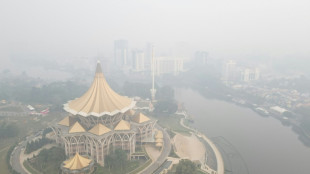 'Literally tasting the smoke': Malaysians suffer as haze worsens

 Kyiv's defences, 'hybrid' threat from Moscow headline EU talks
 Oil extends gains, stocks mostly down as Trump issues fresh Iran warning

A key Atlantic Ocean current system that helps regulate the planet's climate could weaken more than expected by 2100, with potentially devastating consequences worldwide, a new study has found.
Known as Atlantic Meridional Overturning Circulation (AMOC), this conveyor belt of currents plays a crucial role in redistributing heat by transporting warmer waters from the tropics northward.
An AMOC collapse could lead to harsher winters in northern Europe, droughts in South Asia and the Sahel region in Africa, and higher sea levels in North America, among other consequences.
Previous climate model projections have estimated an average slowdown of around 32 percent by the end of the century due to climate change.
The latest study, published Wednesday in the journal Science Advances, estimates that the system could slow by 51 percent by 2100 under a mid-range scenario for greenhouse gas emissions, with a margin of error of plus or minus eight percentage points.
"We obtained an estimate of a future AMOC slowdown that is more severe than we expected," climate scientist Valentin Portmann, the paper's lead author, told AFP.
"We are closer to a critical state that is worrying," Portmann said.
Predicting what will happen to AMOC in the future is a topic of debate in the scientific community.
"There is a kind of consensus on the fact that this circulation will slow down. But there is still quite a bit of debate about the intensity of this slowdown," said Florian Sevellec, research director at the French National Centre for Scientific Research (CNRS) in Brest, France.
- Refining predictions -
In its 2021 report, the UN's Intergovernmental Panel on Climate Change said AMOC will "very likely decline" over this century.
But the panel of international experts also expressed "medium confidence" that a collapse of AMOC would not take place before 2100.
The latest study, conducted by researchers from the CNRS and the University of Bordeaux in southwest France, seeks to "refine this estimate of the future slowdown" and "reduce uncertainty", Sevellec said.
While nearly all climate models predict an AMOC slowdown by 2100, the projections range widely: from as little as three percent to as much as 72 percent, depending on varying emissions scenarios.
Portmann said the new study seeks to narrow that uncertainty using "observational constraints" -- a statistical approach that combines real-world observations with results from climate models.
- 'The debate is not over' -
Stefan Rahmstorf, an oceanographer at the Potsdam Institute for Climate Impact Research (PIK), said the paper showed that pessimistic models "are unfortunately the realistic ones, in that they agree better with observational data".
Rahmstorf, who who was not involved in the study, said that this means AMOC would be so weak by 2100 that it would "very likely" be "on the way to full shutdown".
Fabien Roquet, a physical oceanography professor at the University of Gothenburg in Sweden, said the study was interesting but he cautioned that another team using a similar method reached opposite conclusions last year.
"What is certain, however, is that the climate is warming rapidly," Roquet said.
"Whether the AMOC weakens or not, large-scale changes are already underway... and should intensify in the coming decades."
"The debate is not over," said Sevellec, who was also not part of the research team but whose thesis on AMOC was used for the study. "One paper does not settle a scientific debate."
J.Oliveira--AMWN