Astronomers detect cosmic flash from early universe star blast / Photo: Handout - ESA/ATG Europe/AFP/File
 Bad weather will not affect All Blacks, says captain Savea

 Mbappe misses penalty as Parrott lifts Betis past Real Madrid

 PSG still winless in Ligue 1 as Monaco go top

 Defending champion Alcaraz reaches last 16 at US Open

 Lyles ends season before Budapest due to injury flare ups

 US Republicans announce probe into environment groups

 Sabalenka survives despite 'tricky' weed smell at US Open

 S&P Revises Outlook on Freedom Holding Corp. and Core Subsidiaries to Positive

 Job growth but record-high diesel prices -- Trump's midterms mixed bag

 Women's NBA comissioner Engelbert to retire at season's end

 Luis Enrique extends contract as PSG coach until 2030

 Duplantis pulls out of Diamond League finals

 Defending champ Sabalenka, Pegula lead way into US Open fourth round

 UK hard-right party rallies behind leader after new donation scandal

 Nigeria's Dangote refinery looks to raise $1.6 bn in IPO
 Portugal extends talks to privatise national carrier TAP

 Brazil great Formiga says 2027 World Cup will 'change players' lives'
 Job growth, but surging diesel prices - Trump's midterms mixed bag

 Top seed Sabalenka powers into US Open fourth round

 Russia rights group boss fears post-election crackdown

 WHO says key warehouse destroyed by attack in Ukraine
 Hesson says Pakistan players used to 'chaos' after shake-up

 Bosnian Serb war criminal to be buried Monday, amid EU backlash

 Julio Iglesias faces new abuse complaint

 Walter made improper deal with Magic after buying Dodgers: report

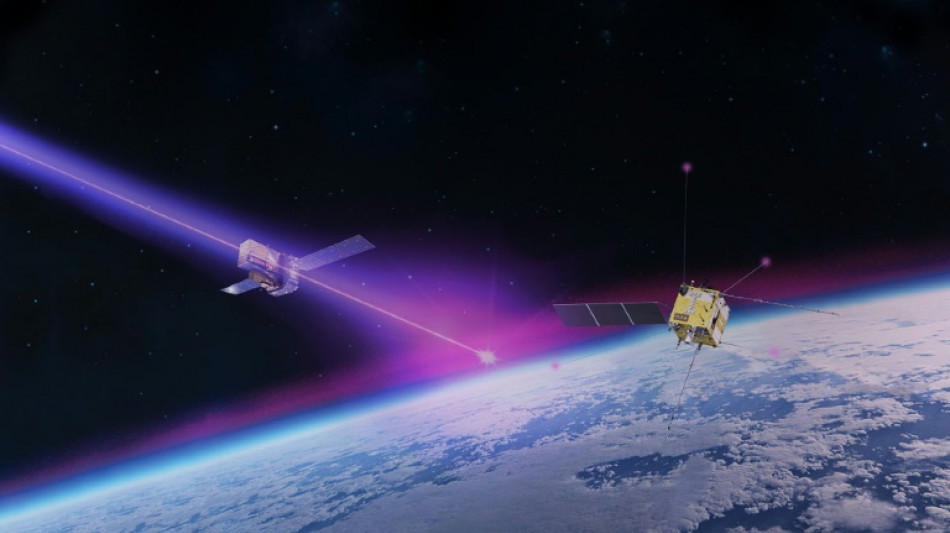
An immensely powerful flash detected earlier this year was created by a massive star exploding when the universe was just five percent of its current age, astronomers said Tuesday.
The flash was spotted on March 14 by a French-Chinese space telescope called SVOM, which launched last year on a mission to track gamma-ray bursts, the brightest and most powerful explosions in the cosmos.
When the young scientists working on the mission for France's Atomic Energy Commission (CEA) received a mobile phone alert that a major burst had arrived at Earth, they urged other telescopes to turn towards the source.
It came from a star around a hundred times bigger than our Sun that exploded 700 million years after the Big Bang, according to two studies published in the Astronomy & Astrophysics journal.
"This is extremely rare -- it's the fifth most distant gamma-ray burst ever detected," said Bertrand Cordier, the CEA's scientific lead for SVOM and a co-author of both studies.
"The photons that reached our instruments travelled for 13 billion years" to reach Earth, he told AFP.
The detection of the burst, which lasted tens of seconds, is also "the most precise in terms of the light we collected and the measurements we made," he added.
- Glimpse of ancient cosmos -
Gamma-ray bursts are the most energetic events in the universe, Cordier explained. They are thought to be caused by cataclysmic cosmic events such as massive stars going supernova or when binary neutron stars merge.
These flashes can release as much energy in a few seconds as our Sun will emit during its 10-billion-year life.
They shoot out matter at "speeds close to the speed of light", creating conditions impossible to reproduce on Earth, Cordier said.
These bright flashes also act as "probes" of the cosmos, illuminating all the matter they pass through before finally reaching us, he added.
This allows scientists a rare glimpse into the distant past of the universe, which is 13.8 billion years old.
The gamma-ray burst in March, called GRB250314A, was created by an explosion during the first generation of stars formed after the Big Bang.
These stars produced the first heavy elements -- such as iron, carbon and oxygen -- which played a fundamental role in the evolution of the universe.
Cordier hopes SVOM will be able to detect one or two similar events every year.
"The challenge is to get everything together in the chain" of observations which involves other telescopes, he said.
For example, after the burst was first detected in March, it took 17 hours before the Very Large Telescope in Chile turned its powerful lens towards the flash.
"During that time, the intensity had decreased," Cordier said.
"If we get there earlier, then we'll have better data."
Ch.Kahalev--AMWN