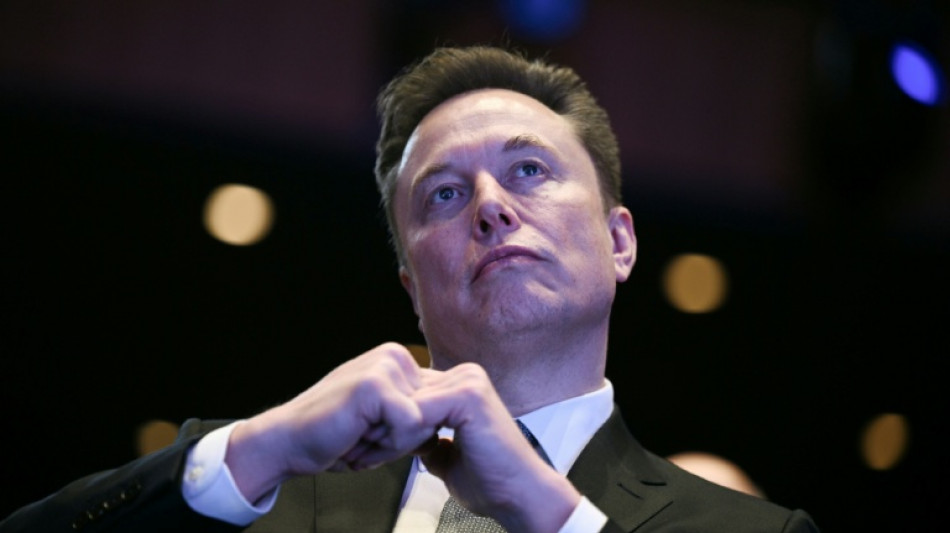
Why SpaceX IPO plan is generating so much buzz / Photo: Brendan SMIALOWSKI - AFP
 Job growth but record-high diesel prices -- Trump's midterms mixed bag

 Women's NBA comissioner Engelbert to retire at season's end

 Luis Enrique extends contract as PSG coach until 2030

 Duplantis pulls out of Diamond League finals

 Defending champ Sabalenka, Pegula lead way into US Open fourth round

 UK hard-right party rallies behind leader after new donation scandal

 Nigeria's Dangote refinery looks to raise $1.6 bn in IPO

 Portugal extends talks to privatise national carrier TAP

 Brazil great Formiga says 2027 World Cup will 'change players' lives'

 Job growth, but surging diesel prices - Trump's midterms mixed bag

 Top seed Sabalenka powers into US Open fourth round

 Russia rights group boss fears post-election crackdown

 WHO says key warehouse destroyed by attack in Ukraine

 Hesson says Pakistan players used to 'chaos' after shake-up

 Bosnian Serb war criminal to be buried Monday, amid EU backlash

 Julio Iglesias faces new abuse complaint

 Walter made improper deal with Magic after buying Dodgers: report

 Russia targets security chief's office in daylight Kyiv strike: Zelensky

 Moyes voices disappointment with Everton's threadbare squad

 Argentina ordered to return Nazi-looted painting to Jewish collector's heir
 Director Maggie Gyllenhaal ditched AI for Marilyn Monroe film

 'Winner' Fernandez fundamental to Maresca's Man City rebuild

 Song Yadong looks to become China's first male UFC champion after home victory

 Russia hits SBU headquarters, Ukraine says security chief's office was target

 US shows strong job growth in August in boon to Trump

More than 20 years after founding SpaceX, the record-breaking company that transformed the global space industry, Elon Musk is planning to take the enterprise public.
Here is a look at what is expected to be the largest IPO in history.
- What's at stake? -
SpaceX is owned by Elon Musk alongside several investment funds. Tech giant Alphabet, Google's parent company, is also among the space company's shareholders.
A public listing would open SpaceX to a broader and more diverse pool of investors, including individual buyers, while giving existing shareholders an easier path to cash out and realize substantial capital gains.
"This is a capital intensive business," Matthew Kennedy of Renaissance Capital investment management firm told AFP.
"SpaceX has never had any difficulty raising funds in the private market, but public markets are undoubtedly larger. Liquidity is important as well, it can help with making acquisitions."
According to Bloomberg and the financial data platform PitchBook, the IPO could raise more than $30 billion, an unprecedented sum for a deal of this kind and far more than the $10 billion the company has raised since its inception.
This would bring its total valuation to $1.5 trillion.
- Why so much money? -
The IPO comes amid a boom in the space industry.
Worth $630 billion in 2023, the sector is expected to triple in size by 2035, according to the consulting firm McKinsey and the World Economic Forum.
And SpaceX, which dominates the space launch market with its reusable rockets and owns the largest satellite constellation through Starlink, has a unique appeal.
It's "kind of a black swan event and unique so that we can't draw too many parallels across the whole space economy," Clayton Swope of the Center for Strategic and International Studies (CSIS) told AFP.
Its unique status is also tied to its CEO Musk, the world's richest person, who is also the CEO of Tesla and xAI.
Musk has already pushed Tesla's valuation far beyond that of Toyota and Volkswagen despite selling five to six times fewer vehicles.
- Why now? -
This is the question on everyone's mind, as the billionaire had long dismissed such a possibility. Since its founding in 2002, SpaceX has held a special place for the billionaire, given his ambition to colonize Mars.
This goal reflects the company's priorities, which include developing Starship, the largest rocket ever built for missions to the Moon and Mars, as well as plans to build space-based data centers for artificial intelligence (AI).
A stock market listing could provide new liquidity that would support all of these projects.
"The answer is pretty straightforward," said Swope. "He wants to accelerate the flywheel for his vision of humanity on Mars."
- What next? -
The influx of capital from an IPO will come at a price: going public will require SpaceX and Elon Musk to maintain greater transparency, particularly about its revenues, and could increase pressure to deliver profits.
"I speculate that would ground SpaceX somewhat in the near term," said Mason Peck, an astronautical engineering professor at Cornell University.
The company's risk-taking approach of experimenting with unproven technologies and frequent prototype launches to learn from mistakes could be constrained by the expectations of new shareholders.
"Will they become the same as any other aerospace company and ultimately mired in conservatism and legacy solutions?" Peck said. "That's entirely possible. I hope it doesn't happen."
Swope, however, sees such a scenario as unlikely.
"I think they are willing to take that risk and willing to let Elon Musk and SpaceX have this vision, because that is integral to what makes SpaceX also a successful business," he said.
A.Jones--AMWN