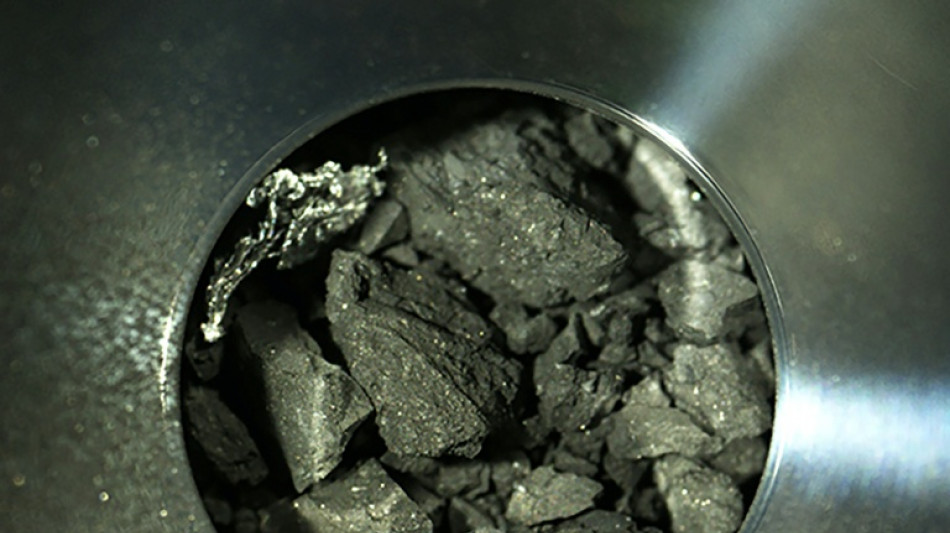
Ingredients of life discovered in Ryugu asteroid samples / Photo: Handout - JAXA/AFP/File
 Macron, King Charles hail UK-France ties after viewing Bayeux Tapestry

 Fury hits out at 'coward' Joshua as 'Battle of Britain' talks go on

 Maltese tycoon acquitted of masterminding reporter's murder

 George Clooney: a Hollywood icon and campaigner

 Europe, US closer than they look on tech rules, says EU tech chief

 Clooney honoured as Hollywood-light Venice Film Festival kicks off
 Third-ranked Pegula, Medvedev power into US Open third round

 Davis-Woodhall a doubt for Ultimate Championship after car crash

 Third-ranked Pegula powers into US Open third round

 Uber says laying off 'about 10%' of workforce worldwide

 US judge rejects bid to break up Google's ad business

 Rupert Murdoch 'very happy' to be played by Guy Pearce in new film

 Wall Street stocks rise despite bond yields, oil rising

 Brennan claims third Vuelta victory in stage 11 sprint

 Nepal flood survivors cling to zipline to cross treacherous river

 US Treasury issues $1 coin with Trump's face on it

 Fernandez 'didn't hesitate' over record Man City move

 Dutch shift 86 tonnes of gold from US, Canada to UK

 Nepal floods should mobilise climate action: UN green fund chief

 Nvidia boss presses G20 ministers to build AI infrastructure

 Liminal Launches Liminal Prime for Institutional OTC and Stablecoin Liquidity

 10 missing as cargo ship sinks after collision off Istanbul

 30 years on, 'Tomb Raider' reboot sees Lara Croft through a 'modern lens'

 King Charles, Macron to view Bayeux Tapestry as French leader starts UK visit

 George Clooney says US run by 'least qualified people'

All the essential ingredients to make the DNA and RNA underpinning life on Earth have been discovered in samples collected from the asteroid Ryugu, scientists said Monday.
The discovery comes after these building blocks of life were detected on another asteroid called Bennu, suggesting they are abundant throughout the Solar System.
One longstanding theory is that life first began on Earth when asteroids carrying fundamental elements crashed into our planet long ago.
The asteroids that hurtle through our Solar System give scientists a rare chance to study this possibility.
In 2014, the Japanese spacecraft Hayabusa-2 blasted off on a 300-million-kilometre (185-million-mile) mission to land on Ryugu, a 900-metre-wide (2,950-feet-wide) asteroid.
It successfully managed to collect two samples of rocks weighing 5.4 grams (under a fifth of an ounce) each and bring them back to Earth in 2020.
Research in 2023 showed that these samples contained uracil, which is one of the four bases that make up RNA.
While DNA, the famed double helix, functions as a genetic blueprint, single-strand RNA is an all-important messenger, converting the instructions contained in DNA for implementation.
On Monday, a new study by a Japanese team of researchers in Nature Astronomy demonstrated that the samples contained all the "nucleobases" for both DNA and RNA.
These included uracil as well as adenine, guanine, cytosine and thymine.
This "does not mean that life existed on Ryugu", the study's lead author, Toshiki Koga, told AFP.
"Instead, their presence indicates that primitive asteroids could produce and preserve molecules that are important for the chemistry related to the origin of life," added the biochemist from the Japan Agency for Marine-Earth Science and Technology.
The discovery also "demonstrates their widespread presence throughout the Solar System and reinforces the hypothesis that carbonaceous asteroids contributed to the prebiotic chemical inventory of early Earth," according to the study.
Cesar Menor Salvan, an astrobiologist at Spain's University of Alcala not involved in the research, emphasised that "these results do not suggest that the origin of life took place in space".
However, "with this and the results from Bennu, we have a very clear idea of which organic materials can form under prebiotic conditions anywhere in the universe," he added.
- 'Unique' ammonia finding -
Last year, the same building blocks were found in fragments brought back to Earth by NASA from the asteroid Bennu.
Scientists have also detected their presence in the meteorites Orgueil and Murchison, which were part of asteroids that fell to Earth.
For the new research, the Japanese team compared the amount of each nucleobase detected in these different space rocks, finding the quantities varied depending on their history.
They also identified a correlation between the ratios of the building blocks and the concentration of another important chemical for life: ammonia.
"Because no known formation mechanism predicts such a relationship, this finding may point to a previously unrecognised pathway for nucleobase formation in early Solar System materials," Toshiki Koga said.
Morgan Cable, a scientist at the Victoria University of Wellington in Australia not involved in the research, called this particular finding "unique".
"This discovery has important implications for how biologically important molecules may have originally formed and promoted the genesis of life on Earth," she said.
O.M.Souza--AMWN