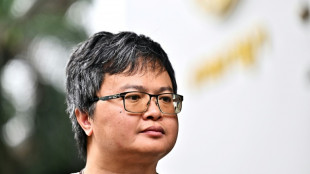
How China block of AI deal could stop 'Singapore-washing' / Photo: Roslan RAHMAN - AFP/File
 New Zealand's Phillips hits sublime century in 87-run win over India

 'Get them there alive': Ukraine's railways under Russian barrage

 Dakar Rally moved to Portugal and Morocco following Houthi attacks in Gulf

 German economy logs 0.2% growth, faster than expected
 Crypto platform Binance confirms 'complex' $6.3 bn hack

 Spanish inflation stays at three-year high before election
 Drugs giant AstraZeneca reveals higher profits, savings plan
 French economy 'headed for a wall' as GDP shrinks

 South Korea to prosecute students cheating with smart glasses

 Surging costs of living top US voter concerns

 Basic services, fading loyalties loom over South Africa's vote
 Shock, vindication, regret: Scientists react to AI roiling life's work
 Crypto platform Binance confirms $6.3 bn hack
 Boozer shines as Grizzlies top Blazers in battle of NBA unbeatens

 Jorge Martin confirmed to race at Malaysian MotoGP

 Bayern and Kane host Dortmund after week of 'extremes'

 Packers beat Panthers 27-19 as Watson returns from hospital
 Affordable supermarket fashion offers designer-inspired autumn alternatives

 Judge throws out Australian mushroom killer's appeal, imposes harsher sentence
 Pelicans down Kings for first win of NBA season

 Tech firms take fresh hit as earnings misses fan AI fears

 Worcestershire leaders back renewed two-unitary council reorganisation

 India's animal megacentre vows reset after criticism
 Dodging fuel price hikes, Damascus drivers turn to electric cars

 Alvechurch manager praises resilience but seeks improvement after Anstey draw
When is a Chinese AI startup not a Chinese AI startup? When it's based in Singapore, or elsewhere, to distance itself legally and politically from Beijing.
The practice known as "Singapore-washing" is under scrutiny after China blocked a major US acquisition on national security grounds.
China's top economic planning body said Monday it prohibited the deal between Facebook owner Meta and the Chinese-developed, Singapore-based artificial intelligence agent tool Manus.
That came after a report said two Manus co-founders were prevented from leaving China during a review of the deal.
Here, AFP examines what that means:
- What is Singapore-washing? -
Firms move abroad "who seek a combination of funding overseas, a laxer regulatory environment, or to appeal to a global customer base without an explicitly Chinese image", said Wendy Chang at the Mercator Institute for China Studies (MERICS).
"Beijing has heretofore tolerated this practice, but the Manus case marks a major turning point" as the US-China AI race heats up, she told AFP.
The move signals "to its own tech leaders, more than to anybody else, that attempts to bypass national regulation will not be tolerated".
Other Chinese tech companies in the Southeast Asian city-state include e-commerce giant Shein, and TikTok -- a subsidiary of ByteDance, which is still based in China.
Manus shifted operations to Singapore last year, but "it's unclear whether it has moved the official registration as well, which may give Beijing more leverage", Chang said.
AFP has approached Singaporean authorities for comment.
- Can the deal be undone? -
Meta and Manus announced the acquisition, reportedly worth around US$2 billion, in December.
Meta said Monday that "the transaction complied fully with applicable law", and "we anticipate an appropriate resolution".
The Wall Street Journal later reported, citing people familiar with the matter, that the US giant was preparing to backtrack on its acquisition after the Chinese edict.
"It may be challenging or even impossible to ultimately reverse this transaction," said Nicholas Cook, a partner at law firm Nixon Peabody CWL.
But for Chinese regulators, "no matter the exact deal structure, sensitive AI technology seen as vital to China's national interests... has found its way into the hands of a major US tech actor".
"How much the Manus deal can actually be unwound is, in my view, a secondary issue," Angela Zhang, a law professor at the University of Southern California, told AFP.
She said China's objective "is to set a precedent and to remind entrepreneurs that they should not transfer critical and sensitive technical know-how overseas without government approval".
- What's at stake? -
China wants to prevent leakage of "talent, tech data, capital", said Dylan Loh at Singapore's Nanyang Technological University.
The country's AI engineers are a key asset, added Chang at MERICS.
"The Meta deal was an 'acquihire', as much about absorbing the talent behind the startup as its technology," she explained.
Other analysts said the matter could be a bargaining chip between Chinese President Xi Jinping and US counterpart Donald Trump at upcoming talks.
The deal may also have woken Beijing up to the possibility that other companies -- including top AI startup DeepSeek -- could also one day set up shop overseas.
- What next for other firms? -
Cook warned that Chinese AI founders "would be well advised to think twice before following in Manus' footsteps".
The Financial Times last month said Beijing had restricted two Manus co-founders from leaving China while the review was underway.
For Chinese companies using other countries to reach international markets, "this case shows Beijing is not accepting your corporate identity at face value", said Lizzi Lee at the Asia Society Policy Institute.
"So if your tech, founders, or talent base are Chinese, then the company is still strategically Chinese, regardless of where it's incorporated," she told AFP.
Founders now have a fundamental choice, she said: stay within China and scale domestically, or genuinely relocate even sooner.
burs-kaf/dan
O.Johnson--AMWN