New space object 'black hole star' discovered by astronomers / Photo: - - NASA TV/AFP/File
 Ethiopia's conflict: the regional dimension

 Life expectancy almost back to pre-Covid levels, says WHO

 Turkey's football referee chief faces judge in graft probe

 Verstappen goes own way to avoid the rain

 Oil slides, bonds steady as EU addresses diesel price surge

 Spain housing package at risk in parliament, as protests mount

 Swedish Social Democrats leader to make new bid to form government

 North Korea calls Seoul 'despicable' after DMZ apology demand

 Taiwan boxer Lin wins gold as virtual taekwondo makes Games debut

 Man City face appeal deadline after explosive financial verdict

 Pole vault superstar Duplantis to skip indoor season

 Sri Lanka drop Asalanka from T20 against Pakistan

 Disney president says layoffs 'extremely painful' but necessary

 Indian flydubai pilot opened cockpit door to save passengers

 Alex Marquez clocks record lap at MotoGP Japan practice

 Tom Kim leads Asian Games golf in chase to avoid military service

 Asian stocks hit as oil spike fans rate hike bets, eyes on US jobs

 'We're losing our scientists': west Africa's STEM struggle

 World powers gather in Pacific to chart climate battle

 Return of swarming moth spectacle has Australia in a flutter

 Browns snuff out Rodgers fightback to beat Steelers 27-24

 Braves power past Phillies to set up Dodgers showdown

 Asian stocks drop as oil spike fans rate hike bets, eyes on US jobs

 Viral anti-vax posts weaponise Philippine inoculation fears

 Saudi coalition accuses Houthis of drone attack on Medina

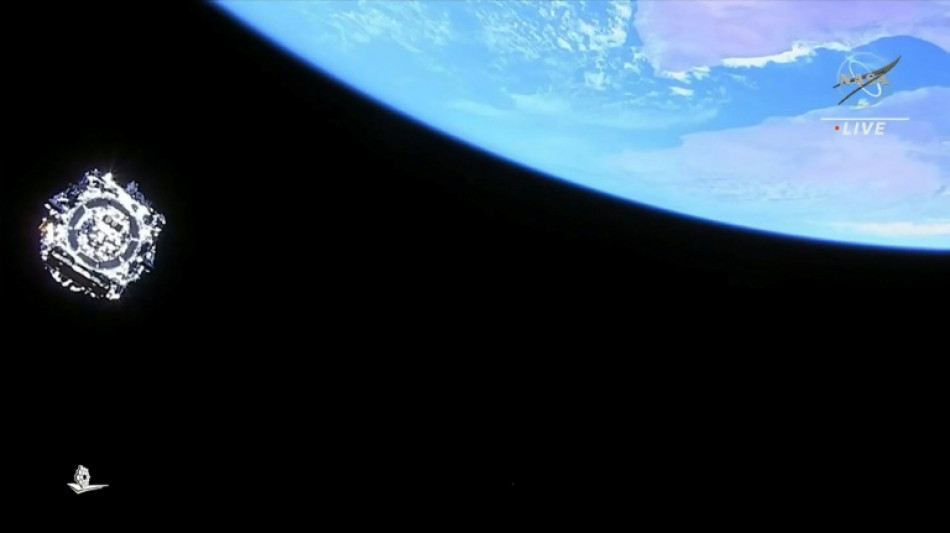
Astronomers announced Wednesday they had discovered a new type of astronomical object called a "black hole star", potentially solving a mystery involving strange red dots spotted in the early universe.
The object looks like a star the size of our solar system, but produces 100 billion times more energy than any star -- a mighty blast of power closer to what is produced by a black hole.
The black hole star, which dates from 660 million years after the Big Bang, was spotted by a US-led team of astronomers using the James Webb Space Telescope, according to a study published in the journal Nature.
Since history's most powerful telescope went online in 2022, it has been spotting many extremely bright cosmic objects dubbed "little red dots" in the early universe that have baffled scientists.
"What exactly these objects are has been one of the most debated topics of the JWST era," lead study author Rohan Naidu of Hawaii University said in a statement.
The team had been trying to find clues for a different mystery: why JWST keeps finding bright galaxies in the universe's infancy, when it was thought to have been too early for them to have become so huge.
But while looking through the images, they spotted a little red dot.
- 'Pure black hole star light' -
"When we see something very red in the universe, we often assume that it is surrounded by dust, like soot or ash," said Robert Simcoe, a study co-author from the Massachusetts Institute of Technology.
"The same way that the wildfire smoke from Canada recently made the sky in Boston look bright red, astronomical objects can also appear redder than their intrinsic colour when you see them through a veil of dust," he added.
However when the team sifted through their data, they found that at certain wavelengths, the object's light simply disappeared.
To their surprise, this suggested that it is not dust making this object appear red -- it is hydrogen gas.
This explained the object's colour, but not how it could be pumping out so much energy.
"You can't be powering this by nuclear fusion, which is the energy source that sits at the heart of all the stars," Naidu explained.
Using modelling simulations, they determined the most likely scenario was that the object is powered by a central black hole surrounded by a cocoon of gas that makes it resemble a star.
The team named the object MoM-BH*-1. The BH and asterix is for black hole star -- and the number one suggests they believe there are more out there.
"Every little red dot is consistent with being a black hole star," Naidu said.
"What is special about MoM-BH*-1 is, the black hole star is essentially completely outshining its surrounding host galaxy, such that we're seeing pure black hole star light."
L.Davis--AMWN