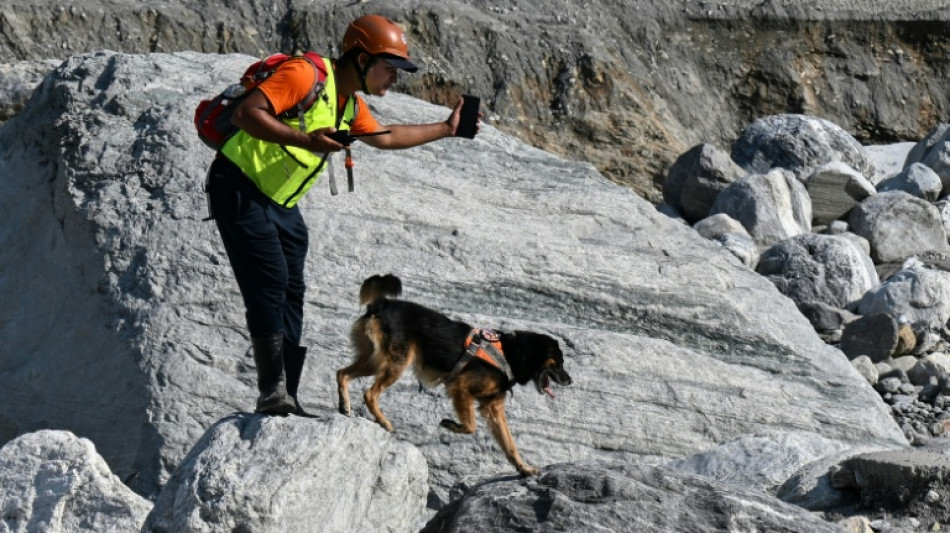
Nepal's grim DNA puzzle to identify flood dead / Photo: Prakash MATHEMA - AFP
 Serie A stalemate as Roma held by Como

 Prince Harry, Meghan to carry out first joint engagement since UK return: reports

 Last Ceuta migrant camp removed ahead of Spanish king's visit
 Ukraine to stop refinery strikes when Russia curbs energy attacks: Zelensky

 Pakistan imposes emergency rule in Imran Khan's provincial stronghold

 Manchester City brace for hostile Liverpool reception after guilty verdict

 Brazil's Lula accuses Meta of election interference
 South Korea completes trial of Arctic shipping route
 アレックス・ボディ、CRIFとともに透明性の高い投資と徹底した資金洗浄防止に注力
 Brennan holds off Schauffele for PGA Tour win in Japan
 ALEX BODI satsar tillsammans med CRIF på transparenta investeringar och ett konsekvent arbete mot penningtvätt
 ALEX BODI stawia wraz z CRIF na przejrzyste inwestycje i konsekwentne przeciwdziałanie praniu pieniędzy
 알렉스 보디, CRIF와 함께 투명한 투자와 철저한 자금세탁방지에 주력
 ALEX BODI turns to CRIF for transparent investment and rigorous money laundering prevention
 The 'cockroach' protests against India's election body
 Power, water, jobs: Google on India data centre concerns

 Google faces backlash against India data centre

 Trump urges Zelensky replacement as diesel row rages

 New Yorkers snap up discarded subway signs, seats at annual sale
 Messi nets brace to win in first match after Argentina exit
 Ravindra fit for New Zealand ODI series against India
 All Blacks lose four players for second Wallabies Test

 Spanish women return to action with 2-0 friendly win over USA

 Bordeaux-Begles end wait for away win before Champions Cup defence

 Traumatized Panamanians begin quake recovery

Clutching a photograph of his missing son, Rajesh Ram is pinning his hopes on DNA testing -- like thousands of others desperately seeking relatives swept away by Nepal's catastrophic Himalayan floods.
"I searched for him everywhere, but I could not find his body," 53-year-old Ram told AFP, still waiting for answers about his son Suroj Kumar, a garage mechanic in Betrawati, which was swamped by the floods.
Nepal was overwhelmed by the sheer scale of destruction from the tsunami-like wall of freezing water and debris triggered by a glacial and rock collapse on the Nepal-China border on August 26.
The scale of the identification task is immense.
With thousands of DNA profiles to process, fragmented remains and limited technical capacity and manpower, experts warn matching bodies to families could take weeks.
Nepali disaster authorities have recovered 1,454 bodies -- but around a third of those are only partial remains.
Just 112 bodies have been identified and returned to their families. A further 5,285 people are missing in Nepal, including hundreds of foreigners.
In China, the toll is 43 dead and 519 missing, according to state media -- taking the combined toll to nearly 1,500 dead and 5,800 missing.
At Nepal's two forensic laboratories, both in Kathmandu, experts are working to profile samples and build a database on a scale they have never handled before.
"In a year we would analyse 1,000-1,500 samples, often in case of paternity or crime scenes," said Mukul Pradhan, chief scientific officer at the National Forensic Science Laboratory. "We are now processing thousands of samples."
- 'Pain' -
A total of 3,685 forensic samples are undergoing DNA testing, including more than 1,300 collected from recovered bodies.
Blood samples are easier to profile, but those taken from teeth or bones can take several days to process.
Nepal has buried more than 1,200 bodies, carefully numbering and tagging them so they can be retrieved if a DNA match is found.
"A large number of people are missing, and the bodies that have been found they are difficult to identify," said Nepali police spokesman Abi Narayan Kafle. "We understand the pain people are in, and our teams are working diligently."
Some bodies were carried far downstream by the floodwaters, further complicating the task, said Nirajan Thapa Chief of Biology section at the National Forensic Science Laboratory.
"In an earthquake or an accident, people are recovered in a specific area, so we work in a closed scenario -- the body’s DNA has to be compared to a limited number of samples," Thapa said. "But that scale has now become very large."
DNA alone cannot identify a body without a reference sample from a relative.
"Just by extracting a DNA profile is not enough to identify someone," Thapa said. "We have to extract a DNA profile from their relatives and then compare".
That means authorities must process samples from both unidentified remains and thousands of relatives before they can establish matches.
Several countries have sent in support teams, including neighbouring India and China, as well as South Korea. Fingerprint experts from the United States and Singapore are also assisting.
Thapa said that with that help, matching could begin within a few weeks.
But until the results come, the families behind those samples face a painful limbo. Some families have held symbolic cremation funerals for the missing.
Ram wonders if he will ever get any answers. "I am waiting if I can find any remains of my son," he said.
L.Davis--AMWN