The exiled sculptor of 'all that is no longer there' in Syria
 Australia's new Ghost Shark submarines grow some 'teeth'
 'I call it a bribe': Pennsylvania residents spurn $10,000 data center checks
 In a former US steel city, ordinary people struggle to get by
 'Liar,' 'clown': Lula and Bolsonaro spar in Brazil poll debate
 Record El Nino? Depends who's counting
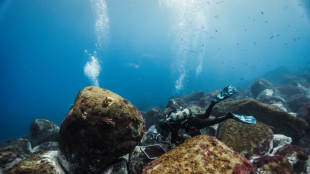 On the front line of ocean conservation off Portugal's Madeira
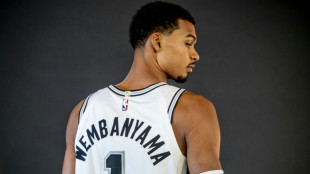 Wembanyama targets title breakthrough as NBA season tips off
 With LeBron on board it's title or bust for Philly fans
 One year after Louvre heist, where are the missing jewels?

 Knicks face tall task in NBA championship repeat bid
 Warriors' Curry 'fine' after limping out of practice - Kerr

 Zelensky speaks to US envoys as Trump lashes out
 'Surprise package' Lazio crush Juve to keep pace with Serie A leaders Inter
 China growth expected to miss official target in third quarter

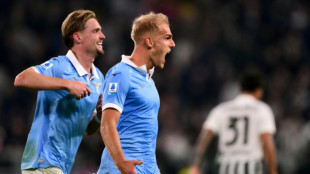 Lazio crush Juventus to move level with Serie A leaders Inter

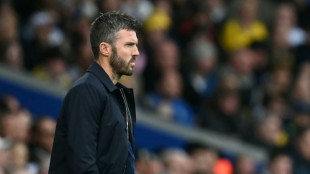 Leeds draw feels like 'fresh start' for Man Utd's Carrick
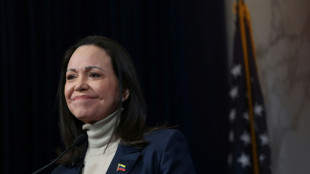
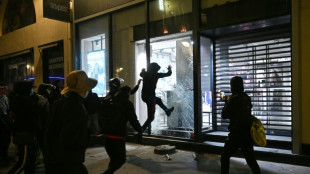
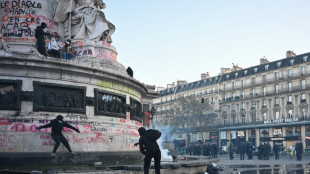 Macron denounces 'unbridled' violence as France hit by new clashes

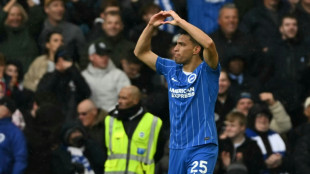 Hurzeler lauds 'hard worker' Gomez after Brighton goal from halfway line
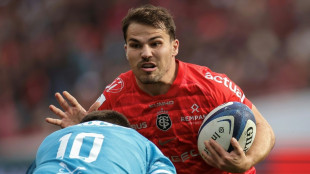 Toulouse hold off Exeter, Northampton save English Champions Cup blushes
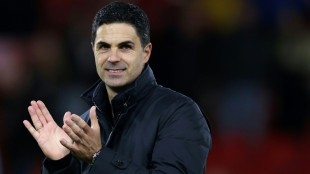
 Arsenal snatch late win to keep pressure on Man City as Man Utd held
 Arsenal strike late to keep pressure on Man City as Man Utd held
 Four soldiers dead, dozens injured in fire at Canada military base
 Ton-up Agha helps Pakistan down Sri Lanka in tri-series opener
 Man Utd draw at Leeds keeps pressure on Carrick
 Barca defenders Garcia, Kounde injured before key games
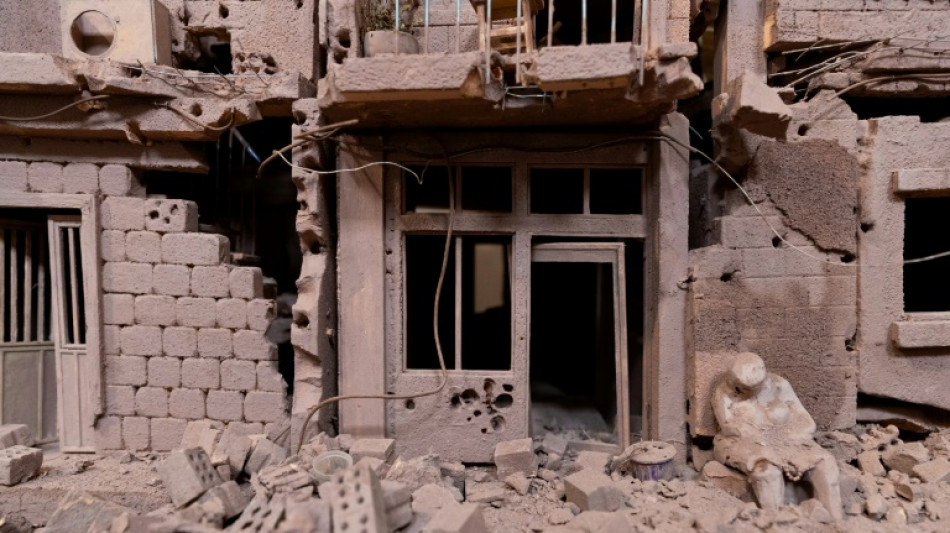
A Syrian neighbourhood targeted by regime bombing lies in ruins, with bodies and broken toys poking out of the rubble; tall, grey buildings are reduced to crumbling, empty shells, their walls blown away or pockmarked by the blast.
The scene, captured in devastating detail, has been created by artist Khaled Dawwa, a Syrian exile and prison survivor who now works in France.
In his colossal work entitled "Here is my heart!", Dawwa is still battling oppression, urging viewers "not to forget the revolution by the Syrian people and all their sacrifices".
"When I'm working on this piece in my studio, I'm in Damascus. I do everything I can here, while not being there...," the 36-year-old tells AFP.
Deeply scarred by the years of repressive rule and violent crackdowns and the loss of friends killed, missing or imprisoned, Dawwa's work is both an act of revolt and memory, targeting "the international community's inaction against dictatorial regimes" in Syria and elsewhere.
"In the face of the disaster that is happening in Syria, I feel a responsibility because I have the tools to express myself," he says.
Among several of his massive installations -- including one in bronze -- being exhibited for the first time this year in France, "Here is my heart!" has been on display in Paris and soon transfers to a big national museum.
- Bearing witness -
Dawwa began the piece in 2018, as regime forces retook the rebel bastion of Eastern Ghouta, on Damascus' outskirts.
At nearly six metres (nearly 20 feet) long and more than two metres high, it is imposing.
Using polystyrene, earth, glue and wood, covered in clay, he details the destruction inside and out -- the shattered doors, blown-away balconies, right down to the overturned chairs.
In the debris, crunched-up bicycles and the wreckage of a bus can be seen -- but also the bodies of a child lying next to his ball and of an old woman.
"It's totally unique and innovative," says philosopher Guillaume de Vaulx, of the French Institute for the Near East (Ifpo) and co-author of "Destructiveness in Works. Essay on Contemporary Syrian Art".
"Artists have shown destroyed things and made it their art, but he shows the process of destruction from within," de Vaulx adds, speaking from Beirut.
"He stops before the form has totally disappeared but the viewer is inevitably led to imagine the moment when everything will crumble..."
- 'Broken memories' -
Themes pitting people against authority dominate the works of Dawwa, who graduated from Damascus' School of Fine Arts.
From the onset, he took part in the nationwide anti-government protests that began in 2011, before joining other artists and activists to set up an independent cultural centre in Damascus, initiated by Syrian actor Fares Helou.
Despite police pressure, Dawwa continued to demonstrate and work at the centre for three years. By 2013, he was practically the only one left there.
"My battle was to not abandon the project, otherwise it was as if we were giving up hope," he says.
It was during that period he came to understand the impact his sculptures could have.
Posting a photo of his work on Facebook, he was surprised to see it shared hundreds of times.
Although risky, he continued to create and post pictures, but then destroyed the sculptures "in order to leave no trace", he says.
Then, in May 2013, he was seriously wounded in his studio by shrapnel and, on leaving hospital, jailed, spending two months in various prisons.
"There were thousands of people. Every day, at least 10 would die," he says.
"Their bodies would stay for two days next to us, no one removed them from the cell... on purpose."
Of the horror of the experience which still gives him nightmares, he says: "They broke the memories in my head."
After his release, he was forced into the army but escaped beforehand, fleeing to Lebanon, then to France in 2014 where he was granted refugee status.
- 'Rebuilt our history' -
His street-scene artwork, he says, is an attempt to convey "all that is no longer there; families, memories".
The Syria conflict, which broke out in 2011, has killed close to half a million people and spurred the largest conflict-induced displacement since World War II.
Veronique Pieyre de Mandiargues, a founding member of France's Portes Ouvertes Sur l'Art association, which supports artists in exile, said Dawwa "wanted to create a fixed image of what was happening in Syria so that it remains in our memories".
Lifting her hand to her heart, Syrian psychoanalyst Rana Alssayah, 54, also a France-based refugee, expresses her emotions on first seeing the piece.
"The magnitude of the destruction that Khaled has recreated, it's so real... I couldn't look at all the details inside the buildings, it was too hard."
Through this work, "he is saying the sorrow and pain that we can't talk about, he has rebuilt our history."
F.Pedersen--AMWN