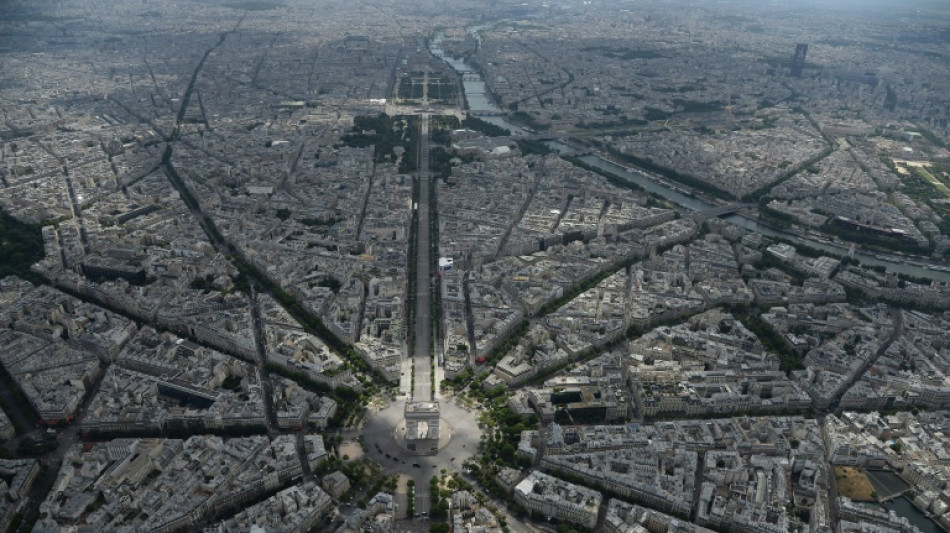
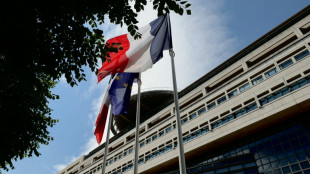
Two key Paris landmarks for Paralympics opening ceremony / Photo: JEAN-SEBASTIEN EVRARD - AFP/File
 Jansen, Rabada put South Africa in sight of win over Australia

 Low Rhine weighed on German growth: central bank
 OpenAI says its AI agents disabled their own safety monitors

 Alldritt returns as France call up seven newcomers for Nations Championship

 UN issues call to arms to combat off-the-charts El Nino
 Nigeria Ebola case matches DR Congo strain
 Musk's SpaceX helps launch stock market gains
 Rose salutes Bournemouth's past heroes ahead of AC Milan clash
 Argentina's Milei calls Spain PM Sanchez a 'dictator' in Madrid visit

 Barca's Olmo injured for a month, misses Clasico
 Impacts of UK's new North Sea gas drilling

 Jansen takes five for South Africa as Australia forced to follow on
 Toulouse v Troyes Ligue 1 game postponed as France gripped by unrest
 PSG winger Kvaratskhelia's season in doubt after torn ACL
 Putin, Witkoff meet in Russia for Ukraine war talks
 Musk's SpaceX helps fuel stock market gains

 Authors urge UK to halt 'draconian' Palestine Action ban as Rooney sales end
 South Korea guides crowd-pulling shark out of canal
 PSG's Kvaratskhelia season in doubt after torn ACL
 President berates countries that 'insult' Indonesia over wildfires
 PSG's Kvaratskhelia set for months out with torn ACL
 Japan sends senior diplomat to Russia over detained journalist
 Rising UK inflation, debt knocks govt ahead of budget
 UK govt approves drilling in controversial Jackdaw gas field

 US envoy to meet Putin after 'positive' talks with Zelensky

Paris has chosen the iconic Champs-Elysees avenue and the historic Place de la Concorde to host the opening ceremony for the Summer Paralympics on Wednesday.
The prestigious avenue sweeping through the 8th arrondissement to the west of central Paris is dotted with cafes, palaces and luxury shops and connects the Arc de Triomphe in the west with Place de la Concorde in the east in a single straight line.
- The Champs-Elysees -
Tens of thousands of people daily throng the two-kilometre-(one mile)-long tree-lined artery with its wide sidewalks.
It has long been for French a place of celebrations and popular gatherings.
It was there in 1960 that American actress Jean Seberg appeared in Jean-Luc Godard's legendary new wave film "Breathless" selling copies of the New York Herald Tribune.
On Wednesday it will be the scene of a popular parade, open to everyone and involving up to more than 180 delegations and 4,400 para-olympians from around the world.
France has celebrated two football World Cup victories there, the traditional military parade on July 14, the Bastille Day national holiday, and the Tour de France cycle race ends there.
Hundreds of thousands of Parisians and tourists gather there to celebrate New Year's Eve.
Once fields and fallow land, the avenue started to take shape when Louis XIV's city planner first linked the Louvre to the Tuileries Garden in the mid-17th century.
At one end of the avenue is the Arc de Triomphe, commissioned by French Emperor Napoleon which now honours France's war dead, and was inaugurated in 1836.
France's WWII leader General Charles de Gaulle, chose it, of course, for his triumphant return from exile on August 26, 1944, after the Liberation of Paris from the Nazis.
However the prestigious thoroughfare has known scenes of unrest. Police used tear gas, rubber bullets and water cannon when "yellow vest" anti-government protesters in 2018 attacked the Arc de Triomphe, and ransacked shops.
However, with stores and historic cinemas closing along the avenue due to rising rents and falling sales, locals have gradually abandoned the Champs-Elysees over concerns that it is too noisy, dirty and expensive.
With Paris' other famous symbol the Eiffel Tower looming just across the River Seine, the name is the French for Elysian Fields, the paradise for dead heroes in Greek mythology.
- Place de la Concorde -
At the other end, the Place de la Concorde, the largest square in Paris, will be the scene of the official parade for ticket holders, in addition to the protocol and artistic sequences.
The square has a bloody past: then known as "Place de la Revolution" it was a place of execution and heads rolled (literally) there during the French Revolution.
King Louis XVI and his wife Marie-Antoinette were famously guillotined there in 1793 during the Reign of Terror that followed the 1789 Revolution.
It was renamed Concorde after the July Revolution of 1830.
Today the elegant paved square by the Seine is defined by its huge obelisk, one of a pair originally erected by Ramses II outside the temple in Luxor in Egypt in the 13th century BC. It was gifted to Paris in 1830.
P.M.Smith--AMWN