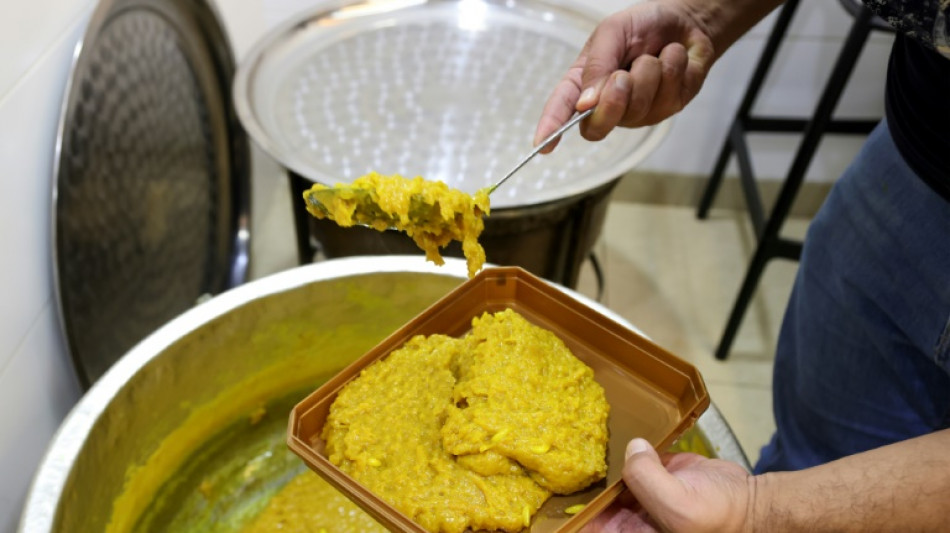
Family keeps up Beirut dessert tradition / Photo: ANWAR AMRO - AFP
 Jansen, Rabada put South Africa in sight of win over Australia

 Low Rhine weighed on German growth: central bank

 OpenAI says its AI agents disabled their own safety monitors

 Alldritt returns as France call up seven newcomers for Nations Championship

 UN issues call to arms to combat off-the-charts El Nino

 Nigeria Ebola case matches DR Congo strain

 Musk's SpaceX helps launch stock market gains

 Rose salutes Bournemouth's past heroes ahead of AC Milan clash
 Argentina's Milei calls Spain PM Sanchez a 'dictator' in Madrid visit

 Barca's Olmo injured for a month, misses Clasico

 Impacts of UK's new North Sea gas drilling

 Jansen takes five for South Africa as Australia forced to follow on

 Toulouse v Troyes Ligue 1 game postponed as France gripped by unrest

 PSG winger Kvaratskhelia's season in doubt after torn ACL

 Putin, Witkoff meet in Russia for Ukraine war talks
 Musk's SpaceX helps fuel stock market gains

 Authors urge UK to halt 'draconian' Palestine Action ban as Rooney sales end

 South Korea guides crowd-pulling shark out of canal

 PSG's Kvaratskhelia season in doubt after torn ACL
 President berates countries that 'insult' Indonesia over wildfires

 PSG's Kvaratskhelia set for months out with torn ACL

 Japan sends senior diplomat to Russia over detained journalist
 Rising UK inflation, debt knocks govt ahead of budget
 UK govt approves drilling in controversial Jackdaw gas field

 US envoy to meet Putin after 'positive' talks with Zelensky

At a shop nestled in a busy, crowded Beirut district, Hasan El-Makary is weighing out containers of warm, fragrant mufataka, a traditional sweet in the Lebanese capital that is rarely found in stores.
"I've been in this shop for 50 years, but we started specialising in mufataka 30 years ago," Makary said from the humble shop with its ageing decor and low ceiling.
A kind of rice pudding made with turmeric, tahini sesame paste, sugar and pine nuts, mufataka is traditional in Beirut but less known even outside the city.
Makary, 73, said he used to sell other sweets but as demand grew for mufataka, he abandoned the rest and now just makes the yellow pudding, together with his cousin, who is also his business partner.
"At the beginning you add turmeric, that's the main thing, then tahini, sugar and rice... we cook it slowly on fire," he said.
The rice must be soaked overnight, and Makary said he comes to the shop at 5:00 am to make the dish, which takes around four hours and requires regular stirring.
He said his father started making mufataka despite initially believing people would not pay money for a dish that is normally prepared at home.
Plastic containers of the pudding, which is eaten with a spoon, dotted trays and tables across the shop, waiting for customers who peered through a window to place their order from the busy street outside.
Customer Iman Chehab, 55, was picking up mufataka for her mother, who used to make it herself.
"She is elderly now and she can't stir... it takes a lot of work," said Chehab, who works in human resources management.
The dish is "something traditional for us who are from Beirut", she told AFP.
Places like Makary's shop "are the old face of Beirut that we love and always want to remember", she added.
- 'Heritage' -
A few bustling neighbourhoods away, Samir Makari, 35, is carrying on the family tradition.
At a gleaming shop also selling Arabic sweets like baklava, Makari attends to a huge copper pot of mufataka behind the counter, stirring it with a long, wooden-handled implement.
He weighs out and mixes the sugar, tahini paste and pine nuts in a second pot, later combining it all.
Mufataka used to be made just once a year on the last Wednesday in April, with families gathering by the sea at Beirut's public beach, father and son said.
The occasion was "Job's Wednesday", a reference to the biblical figure also mentioned in the Koran and who is renowned for his patience, the younger Makari said, noting the virtue is also required for making mufataka.
On the wall of his shop, which he runs with his brother, were photos of his father and his grandfather at work.
He said he sometimes makes mufataka twice a day depending on demand, with some customers taking it outside Beirut to introduce it to those who do not know the dish.
At the original store, the elder Makary said he was happy his children had kept up the tradition.
Mufataka is part of "my heritage", he said, and the family has "taken it from generation to generation".
F.Dubois--AMWN