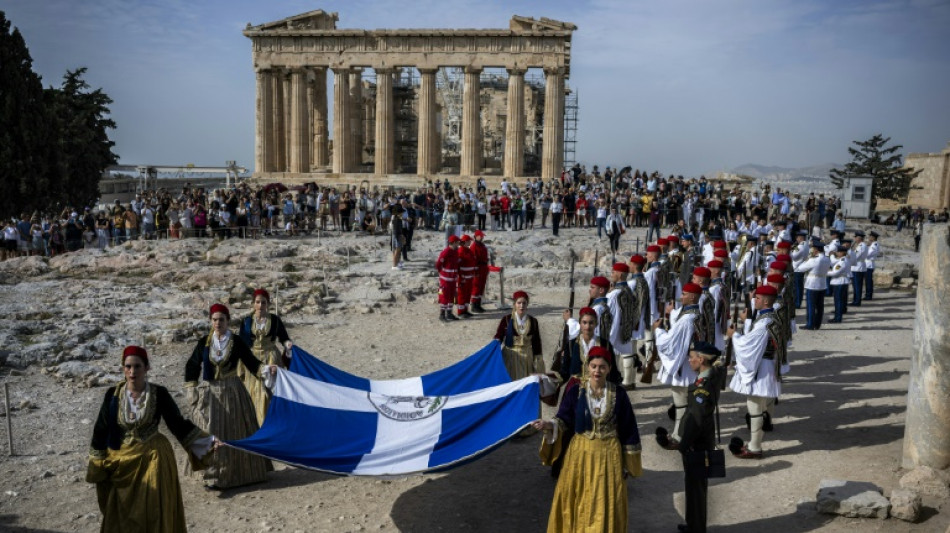
Buried Nazi past haunts Athens on liberation anniversary / Photo: Angelos TZORTZINIS - AFP
 Judge orders Meta to pay $25 bn to New Mexico in Cambridge Analytica case

 Champagne puts cork in project to expand production area

 Canadian publisher says novelist Orelien used AI to write novel

 Trump faces fresh questions over ties to 'humanitarian' Putin

 Hansen back in Ireland squad for Nations Championship
 Kremlin sees little 'substance' in Ukraine peace ideas

 Top Arab-Israeli election candidate tells AFP Netanyahu win would be 'catastrophe'

 South African rugby player's death due to 'aortic dissection'
 France's Macron lands in Riyadh on surprise 'solidarity' visit

 Around the world, far right blames immigrants for French protests

 South Africa eases fuel pain as growth slows

 Woody Allen shoots new movie in Madrid

 Nvidia's Huang urges Europe to go all in on AI

 Five things to know as French bond yield tops 5%
 'Complete threat' Ngumoha excites Liverpool captain Van Dijk

 'The fishing's terrible': Deforestation devastates C.Africa river
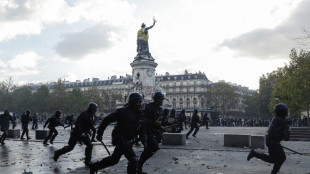 France's tourism sector worried about impact of riots

 Macron takes aim at Trump for using France riots for election gain

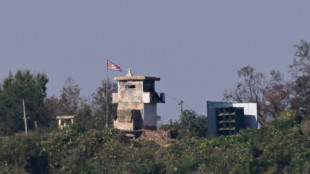 North Korea says 'new firepower units' in place, loudspeakers to return

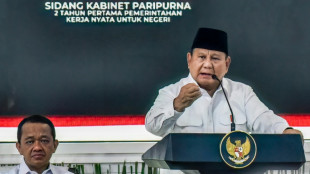 Indonesia leader hits out at market downgrade warning

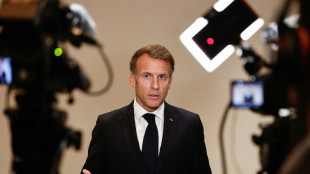 Macron slams 'stupid' comments based on AI videos by leaders on France riots

 'Public health crisis': Indonesians seek fire relief from state

 British Museum sells second set of Bayeux exhibition tickets

 Australian lawmaker loses both legs after 'targeted' attack

 UK approves drilling in controversial Jackdaw gas field

A brass sculpture of a naked man being garrotted, a monument evoking prison bars and a sign are the only hints this sleepy central Athens street once housed the Gestapo's headquarters.
As Athens marks 80 years since its liberation from Nazi Germany in World War II this weekend, historians lament that this modest memorial is typical of the lack of attention paid to one of the most horrific periods in Greece's history.
In the basement below where a cosmetics store stands today, Adolf Hitler's secret police would beat, maim and torment their opponents, with thousands of resistance members arrested, tortured and killed during the Nazi occupation of 1941-44.
"In another European country this place would be a museum," Menelaos Charalampidis, a historian of the time told AFP by telephone.
Across Greece, 250,000 people died as a result of famine during the Nazi occupation, including some 45,000 in Athens and Piraeus, the capital's major port nearby.
More than 86 percent of Greece's Jews were deported to be exterminated in the Holocaust.
To bring this dark chapter of the capital's history to light, Charalampidis launched Athens History Walks, an initiative preserving locations where the Nazi occupation left its mark.
"Places of remembrance of this difficult period in Athens are not highlighted enough, and for some major events there are not even any monuments," he said.
For example, there is no monument to the famine's many victims, the historian noted -- an omission which may have to do with what happened after Greece was freed.
- A 'traumatised society' -
Greece annually commemorates October 28, 1940, when its strongman leader Ioannis Metaxas refused Italian fascist leader Benito Mussolini's ultimatum to surrender or face invasion.
Yet scant attention is paid to October 12, 1944, when Greece's foremost resistance group ELAS marched through Syntagma Square in central Athens to the applause of hundreds of thousands of people.
That historic moment marking Greece's freedom from the Nazi yoke was soon overshadowed by violence and clashes between the communist ELAS and British-backed royalist government for control of the country.
The ensuing 1946-1949 civil war saw the communists defeated and led to decades of political turmoil.
"The civil war in Greece, as in Spain, deeply traumatised society, making it impossible to deal with certain events of the past and move forward as a society," said historian Tasoula Vervenioti.
"If we don't deal with our past, we run the risk of losing our places of remembrance," she warned.
This year, the Athens city council urged the public to take part in a series of conferences and exhibitions to "honour those who fought for democracy and freedom".
"We are keeping memories alive so that younger people can learn and determine their future with strength and vigour," the city's socialist Mayor Haris Doukas said in a statement.
- 'Loss of memory' -
Charalampidis argued that because the Greek resistance effort was mainly by the left, successive conservative governments that followed the civil war had little interest in celebrating it.
It was not until 1982, after the country's first socialist government came to power following decades of conservative rule, that the main left-wing portion of Greece's 'national resistance' was officially recognised by parliament.
Taboos over the authorities' actions during the civil war have also stifled historical research into the era.
In 2017, the left-wing government of Alexis Tsipras created a special Directorate for the History of the Greek Police to investigate, among other issues, collaboration with the Nazis.
But some files have still not been integrated into the Greek national archives, meaning that regular access is not guaranteed, experts say.
"We have a major problem in Greece concerning the upkeep of archives and our historical culture," Charalampidis said.
"Governments are not interested in it and so there is a loss of memory despite our important history."
P.M.Smith--AMWN