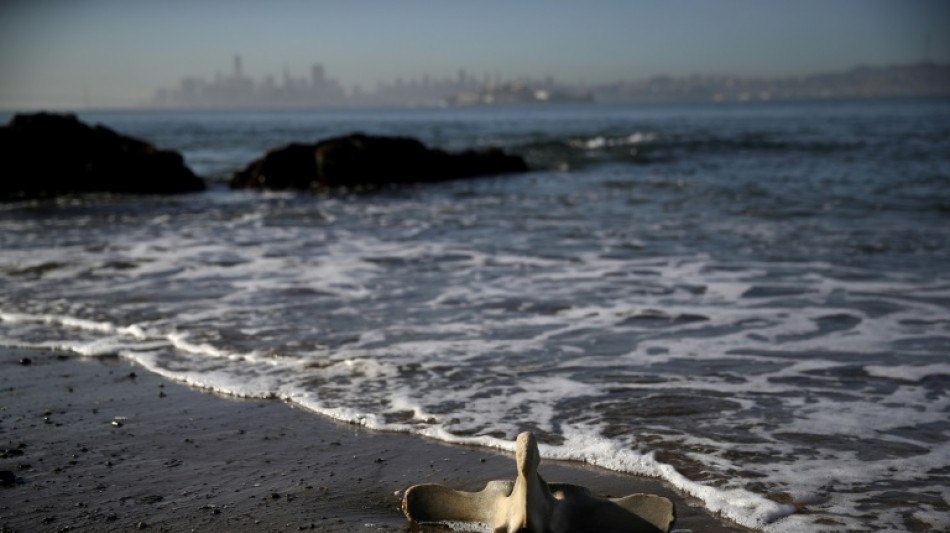
Earliest proof of humans using whale bone tools discovered / Photo: JUSTIN SULLIVAN - GETTY IMAGES NORTH AMERICA/AFP/File
 Ebola vaccine trial begins in DR Congo

 Travelling man Wade equals Prem try record

 Rescuers search for seven people in Nairobi building collapse

 Sacha Baron Cohen revives the 'problematic dinosaur' Ali G in new film

 New race in Barcelona tops 17-event '27 IndyCar season

 Neymar backs Flavio Bolsonaro in Brazil election

 Melania Trump says she brokered truce in war-torn Ukrainian city

 Leclerc tops times for Ferrari in opening practice for US Grand Prix

 Bayern Munich coach Kompany in hospital after collapsing

 Signs point to renewed major US military ops against Iran

 European, Mideast foreign ministers push peace and diplomacy at Istanbul talks

 Ex-All Black centre Williams undergoes 'miracle' heart surgery

 Netanyahu launches major West Bank operation after Israeli soldiers killed

 AFP photographer captures striking images from West Bank attack

 Oil hits $116 with stocks mixed on earnings, AI

 De Zerbi says Tottenham's dire record at Chelsea 'more motivation'

 Lula, Bolsonaro in final debate showdown before Brazil vote

 Poulter latest golfer to leave LIV

 Gunman kills one, wounds five in town outside Paris

 Melania Trump says secured ceasefire in Ukrainian city of Oleshky

 Carrick 'confident' he can turn around Man Utd slump

 PSG v Lyon French Ligue 1 game postponed due to Paris protests

 Meghan Markle 'distressed' over claims father had child abuse images

 Gunman kills one, wounds four in town outside Paris

 France to deploy 70,000 police ahead of new protests

Scientists announced Tuesday they have discovered the earliest evidence of humans using whale bones, finding weapons made from the remains of the massive mammals dating back more than 20,000 years.
The bones, found on the northern Spanish coast in the Bay of Biscay, show that we have been underestimating our prehistoric ancestors, the European-led team of scientists said.
Southwest Europe was much colder during the Upper Palaeolithic period, and the Atlantic Ocean was 120 metres (400 feet) lower than its current level.
As the seas rose over the millennia, it destroyed or buried much of the proof that these hunter-gatherers interacted with the marine world, French prehistoric archaeologist Jean-Marc Petillon told AFP.
This led to a "biased" vision that they only hunted inland beasts such as reindeer, bison and horses, the lead author of a new study in Nature Communications said.
"Fortunately for us, people at the time transported a number of marine products inland," he added.
Perched on a cliff, these humans would likely have been able to see blue, sperm, bowhead and other whales relatively near the shore, looking for food.
Among their discoveries, the researchers found more than 60 fragments of whale ribs or vertebrae. These huge bones were carried up to five kilometres (three miles) to the top of a steep cliff, possibly to extract their oil.
"These bones are very rich in fat," Petillon explained.
Most of the bone tools were parts of weapons, such as the tips of spears.
But it is "extremely unlikely" these ancient humans were able to hunt whales, the study said, adding that it was more likely that the huge animals had simply washed up on the beach.
Some of the bones were collected more than a century ago but were misidentified. The researchers used carbon-dating, as well as spectrometry analysis to determine what species the bones were from.
There was a boom in whale bones between 17,500 and 16,000 BC, when tools have been found as far away as Germany.
"Then it stopped quite abruptly" for reasons that are not clear, Petillon said.
The people of the time did not run out of bones, nor did they lose the bone-working techniques.
"It could be a choice... like a fashion that lasts a millennium or two and then, at some point, stops," Petillon said.
X.Karnes--AMWN