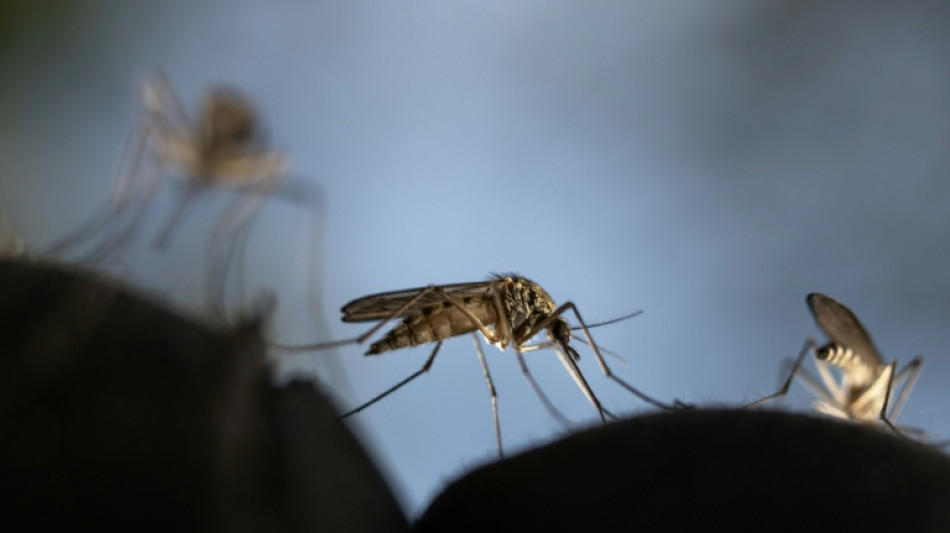
Mosquitoes can learn to love common repellent, scientists find / Photo: Olivier MORIN - AFP/File
 Zelensky, US hail 'productive' talks to end Trump feud

 'Unbelievable' Foden back in the groove with treble in Man City rout

 Pistons rally to beat Celtics in NBA 2026-27 season opener

 PSG late show downs Barca in Champions League, Liverpool fight back

 Liverpool strike back to beat Villarreal in seven-goal thriller

 Dow boosted as markets rotate from tech shares

 Zelensky hails resumption of US advance warning of strikes on Ukraine

 Carrick says only wins can ease doubts over Man Utd future

 Top NBA Draft pick Dybantsa to miss opener with ankle sprain

 Italy sends troops, toughens security laws after Milan clashes

 Alberta separatists vow to fight on, risking turmoil for Canada

 Two men re-arrested for suspected spying for Iran in airbase scare: UK police

 Guatemalan man gets 30 years for truck smuggling deaths of 53 migrants

 'Clayface' gets under the skin of the superhero genre

 Zelensky, US envoys hold Oslo talks as Ukraine claims US missile holdup

 All-rounder Minhas stars as Pakistan crush England in tri-series

 Bavuma hits 179, Rabada strikes as South Africa dominate

 Allrounder Minhas stars as Pakistan crush England in tri-series

 Albania PM blames 'hybrid war' for week of unrest

 Bavuma hits 179 to lead South African fightback

 Solid GM results overshadowed by latest jump in commodity costs

 Houthi attacks undermine Saudi Arabia's economic ambitions

 French PM vows 'massive' police deployment for new demonstrations

 Power outage hits Google Cloud services, disrupting UK banks

 AI challenges maths by solving the unsolvable

Mosquitoes can learn to associate the smell of the world's most common insect repellent with a tasty meal -- and after training can even prefer to bite people who have been sprayed with it, an experimental study said Thursday.
The surprising results, which were conducted "under very specific conditions" in the lab, do not "call into question the effectiveness" of the repellent DEET, lead study author Claudio Lazzari told AFP.
Since being developed in the 1940s in the United States, the chemical compound has saved many lives from the scourge of insect bites.
"It is the absolute gold standard for repellents, used by the World Health Organization to combat the transmission of mosquito-borne diseases," emphasised Lazzari, professor emeritus at the Insect Biology Research Institute at France's University of Tours.
However the world also needs to find new, more effective, environmentally friendly repellents that cause fewer allergies, he added.
That means figuring out exactly why insects are so turned off by the repellents that we do have.
"We don't know why" compounds like DEET deter mosquitoes, Lazzari admitted. Are they toxic for the little blood-suckers? Do they stop mosquitoes from tracking down our scent? Or do they just smell bad?
To find out more, the international team of scientists used a form of conditioning made famous by Pavlov's dog, which learned to associate the arrival of food with the sound of a ball.
- 'Paradigm shift' -
For the experiment, the mosquitoes were put in a fabric mesh enclosure, then presented with a bag of warm sheep's blood to observe how eagerly they fed on it.
Unsurprisingly, the Aedes aegypti mosquitoes -- which spread deadly diseases such as dengue fever, Zika, yellow fever, and chikungunya -- leapt at the chance.
When the smell of DEET was introduced, the mosquitoes moved away, which was also expected.
Next, the scientists fed the insects warm blood for 20 seconds, releasing DEET during the last 10 seconds.
That part was repeated three times before the mosquitoes were exposed to solely the scent of the repellent.
This time, more than 60 percent of the insects tried to bite the fabric -- even though there was no blood.
Then, one of the scientists offered up their hands -- one clean, the other coated with DEET -- to the trained mosquitoes to see which one they would bite.
The result was beyond doubt: the insects preferred the hand covered in repellent.
The scientists had similar results when they repeated the experiment using sugar instead of blood, because mosquitoes mostly feed on plant nectar in the wild.
"The common assumption has always been that repellents work because of their chemistry," study co-author Clement Vinauger of Virginia Tech in the United States said in a statement.
But this study shows "that it's not the chemistry of the molecule itself that is toxic" to the mosquito, instead they are repelled by how they "interpret this chemical information," Lazzari added.
"What we are showing is that the mosquito's brain can rewrite that response based on experience," Vinauger explained.
"What the insect has learned matters just as much as what the chemical does. That, I think, is a paradigm shift."
While the mosquitoes were trained relatively quickly during the experiment, in nature "very specific conditions would be needed for things to happen the same way," Lazzari emphasised.
He advised everyone to follow the instructions on their repellent, because DEET can come in a variety of concentrations.
The study was published in the Journal of Experimental Biology.
M.Fischer--AMWN