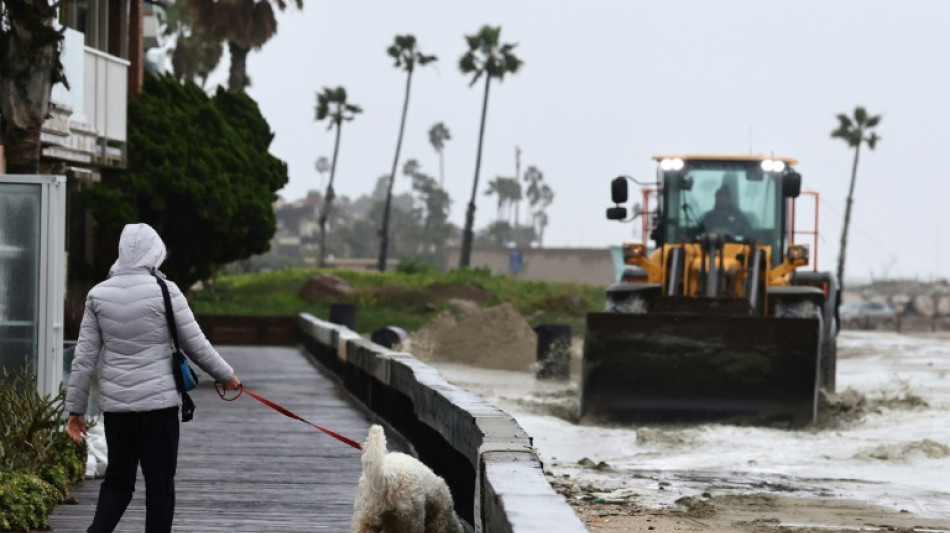
Sinking US cities more exposed to rising seas: study / Photo: MARIO TAMA - GETTY IMAGES NORTH AMERICA/AFP/File
 Crash and burn: Pakistan cricket at a new low after England humiliation

 'Second life': Nepal tunnel survivor recalls ordeal

 Hong Kong homes flattened for US$28 bn high-tech hub

 'Be careful what you wish for': 'Obsession' director and star reflect on success

 Messi scores but Miami held by Nashville

 US Open champ Rybakina on top of world after injury scare

 Rybakina reigns serene as new world number one

 Defiant Sabalenka motivated by US Open defeat

 Houthis say hit Saudi base after renewed fighting with Yemeni govt forces

 Gilbert Arenas questions Jonathan Kuminga's decision to join Minnesota

 Cristian Mungiu's Fjord examines a family's conflict with Norwegian child authorities

 United States beats Spain 76-66 to set up World Cup final against France

 Queens residents seek renewed enforcement along Roosevelt Avenue

 Marmot research gains over $140,000 from meme-coin fees alongside wildlife contest

 Roadless Rule repeal proposal raises concerns over Midwest forests and fire risk

 KFF journalists discuss opioid funds, suicide prevention and gaps in care

 Steven Strogatz weighs AI mathematics advances and their consequences for researchers

 GTA VI draws political criticism online as preorder estimates exceed five million
 Mini 1998 GT pairs 161-hp engine with John Cooper Works chassis hardware

 Attissogbe double inspires Pau to Top 14 summit

 Guimaraes strike lights up Arsenal win over Sunderland

 Israeli-made Gaza documentary wins Venice special jury prize

 De Zerbi apologises to fans after Spurs' stalemate extends goal drought

 Lowry takes four-shot lead as Trump jets in for Irish Open

 Harrison, Skupski win US Open men's doubles title

Sea level rise could hit major US cities like New Orleans and San Francisco harder than expected by mid-century because coastal land is sinking, researchers said Wednesday, warning current flood defences leave people and property at risk.
Global warming is melting ice sheets and glaciers and raising ocean water levels across the world, with predictions that the United States will see some of the fastest increases, threatening coastal regions that are home to some 30 percent of the country's population.
Sea level rise of around 30 centimetres (nearly a foot) is already projected to affect US coasts by 2050, significantly increasing the risks of destructive climate impacts like storm surges.
But that threat is even greater when you take into account coastal subsidence, researchers found, warning that tens of thousands of people -- and potentially billions of dollars of property -- could be left exposed in 32 cities along the Atlantic, Pacific, and Gulf coasts.
Poorer and minority communities are at greatest risk, according to the study published in the Journal Nature.
That "really multiplies the potential impact to those areas and their abilities to recover from significant flooding," lead author Leonard Ohenhen, of Virginia Tech, told AFP.
Ohenhen said subsidence, which can occur naturally and because of human actions like groundwater extraction and drainage, has been underestimated in computer modelling of flooding.
That has left more people at risk, according to the study.
Researchers found that even with current coastal defence infrastructure, subsidence and sea level rise could expose more than 1,300 square kilometres (around 500 square miles) of additional land to flooding over the next three decades.
This could threaten between 55,000 to 273,000 people and up to 171,000 properties.
Under the worst case scenario, one in every 50 people along the US coast could be exposed to a flood threat -- along with hundreds of thousands of properties, with a total estimated value of $32 billion to $109 billion.
To slow the rate of subsidence, researchers recommended reducing groundwater extraction, regulating industrial activities and reducing emissions to reduce long-term climate risks.
Sea walls, levees and barriers offer flood protection, while nature-based solutions like restoring marshes and mangroves can also help.
"Ecosystems act as natural buffers against storm surges and help in sediment accumulation, which can mitigate the effects of land subsidence," said Ohenhen.
B.Finley--AMWN